Book cover shoot confuses the dog

Annie watched me, confused. Why was I setting up a card table on the deck and covering it with a tablecloth? Why was I carrying out dishes, silverware, cloth napkins, and a candle? And hey, why was I putting her bowl on that table, where she couldn’t even reach it?
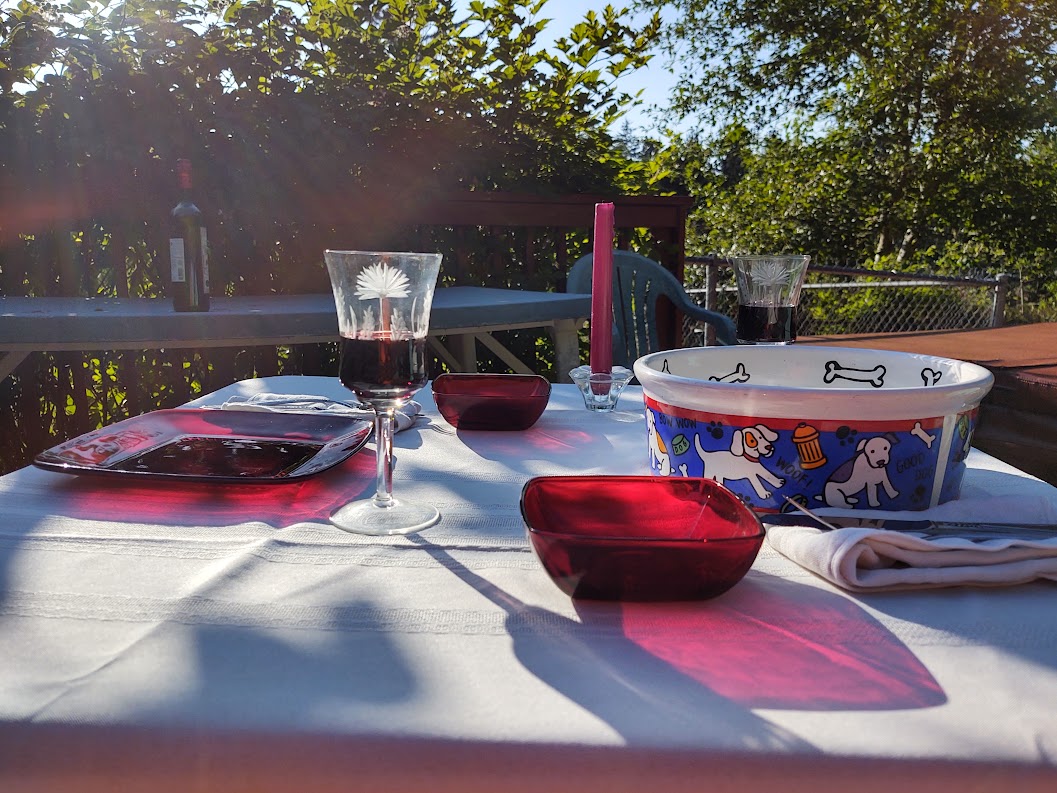
outdoor table set with white cloth, ruby-colored plate and bowls, wine glasses with red wine, and a red, white and blue dog bowl. Set up for a photo shoot.

I was doing a “photo shoot,” trying to create a cover picture for my poetry collection, Dining Al Fresco with My Dog, coming out next year from Moonpath Press. Turns out it’s not as easy as it looks.

For years I marketed that book as Bully Wind and pictured a woman standing outside in a storm, defying the weather. My editor vetoed that title. This one is more fun anyway, but here I was fighting the Oregon coast wind to set my table.

For the first try, I used one of the tablecloths my mother embroidered sixty years ago for her canasta club, my blue Currier and Ives plate, Annie’s silver bowl, and one Oregon Coast Aquarium commemorative wine glass. I filled my plate with raviolis and an artichoke and put kibble in Annie’s bowl. I took umpteen photographs, trying not to get too much of the hot tub, the chain link fence, or the defunct yellow wheelbarrow I plan to turn into a planter someday.

Photo shows part of a table with a lavender cloth embroidered with purple and green flowers and a big yellow dog licking her nose and 
standing over an empty silver bowl.

I left the wine glass empty because wine conflicts with my meds, and I don’t actually drink much. Once everything was set up and photographed, we did indeed dine al fresco. It was delicious, although the raviolis were a little cold. However, in the photos, the food looked disgusting.

There’s an art to photographing food, and the pros use a lot of tricks that make the food look good. Check out this site about styling food for photos. You won’t believe the things they do. For example, that “syrup” on the pancakes might actually be motor oil, and there might be glue in that cereal instead of milk.

I sent photos of the table without food. The editor liked the concept, but said Annie needed her own wine glass, silverware and cloth napkin.

Okay. This time, waiting until the sun wasn’t blasting the shooting area, I used my good white tablecloth, my red Depression dishes, and Annie’s fancy bowl with pictures of dogs on it. I found two wine glasses without writing on them and poured red wine in them, taking a few sips as I went along. I didn’t bother putting food in the dishes because, ick.

This time the editor liked the shots, but she said the dog’s bowl and silverware weren’t completely in the frame and I needed to reshoot in high resolution, something I knew nothing about. There’s a setting for that on my phone? Turns out there is.

I will be reshooting again tonight. Dinner is leftover stir fry for me, Purina’s “vibrant maturity” kibble for Annie. There will be wine in our glasses, but I promise Annie won’t be drinking any.

AI generated photo shows a golden retriever sitting on a chair at a table in a garden. The table has plates, candles, and a big hot dog with a parsley garnish.

This time of year, dining outside is wonderful, but it feels odd doing it alone. I miss the family barbecues when it was too hot in the house, so we took everything out to the patio, sat around the picnic table, and dove in. Hey, there’s a poem about that in the book.

I have set up many pictures for this blog. Usually it entails plopping some object on a plain surface, taking its picture and uploading it to WordPress.com. I also purchase art from 123rf.com and use free art from pexels.com.

Is it common for an author to be asked to provide her own cover image? Not so much, but it happens. In the best cases, you have an artist or photographer in the family or already own the perfect picture. Otherwise, it’s time to get creative.

I have had good and bad experiences with book covers chosen by others. The original cover of my novel Azorean Dreams, which was supposed to show a romantic couple in the Azores Islands off the coast of Portugal, actually showed a scene from Italy. When I complained that the guy was missing my character’s mustache, they drew one in. Worse, after the book was published, I saw that picture on the back cover in magazine ads all over the place.

It gets worse. I published a book titled Freelancing for Newspapers years ago. (It’s out of date, but still has good advice. If you want a copy, I’ll send it to you for free). The publishing house decorated the cover with a stack of folded newspapers. Makes sense. But on one of those newspapers in big, legible type is the word “genital warts.” Embarrassing!

For a book cover, you need more than just a great picture. It has to be eye-catching and appealing. It has to be a unique high resolution vertical shot, and you need to think about where the type will go, what colors will be prominent, and who owns the rights to the “image” you’re using.

You can’t just rip off a picture from the Internet. You can, but it’s wrong. There are agencies that sell photos, artwork and images created by artificial intelligence, like the one pictured here with the checkered tablecloth from 123rf.com.

The editor preferred to go with an original. So I’ll be setting the table tonight when the light is right. Then Annie and I will dine in style.

Have you ever set up a scene for a photo shoot? Tell us about it in the comments.

Does anyone have a dog who actually sits at the table to eat?
Processing…
Success! You're on the list.

Stories lost in the floppy disk graveyard

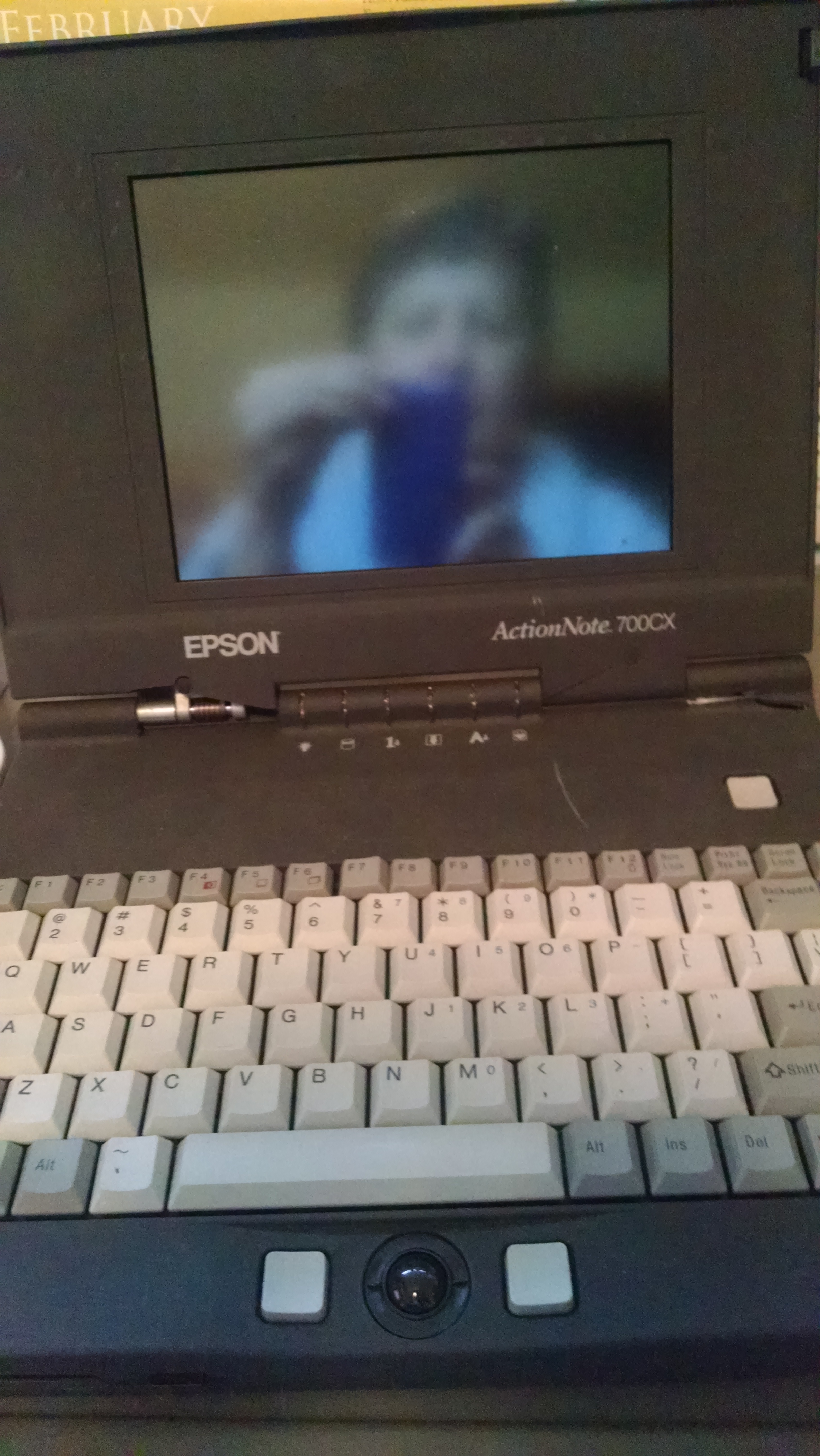
I took the old laptop out of its nifty leather case and stared. Was it always that clunky looking? So square? Like an old Volvo. Instead of a mouse, it has a marble-sized trackball. The screen is about the size of my Kindle screen. And what’s with the giant box with a little plug sticking out of it?

This thing doesn’t have a USB port, but it does have a place to plug in a telephone line for the modem. Suddenly the old backup computer has become an historic artifact. But it’s my only hope to find out what happened to Roberta and Frank.

I’ve been reading through short stories I wrote back in the late ‘90s. Some are so awful I’m relieved no one wanted to publish them. But some are still good, especially this one about Roberta and Frank, who run into trouble while traveling in their motorhome. I was thinking I should polish it and send it out. It’s not too out of date. Look, Roberta even has a cell phone. She doesn’t know how to use it, but I can fix that. I got to the end of page 5. The ambulance is coming and–where’s page 6? Where’s the rest of the story? I have a vague memory that Roberta stops being such a wuss and saves the day, but I don’t know the details anymore.

I have to leave for church in five minutes. I tear through my files. I sent it to literary journals back in the days before we submitted everything online. I have to have more paper copies of “Runaway Dream.”

I find maybe 50 short stories. Lord, I was prolific. But not that one.

Okay, look through the pile of CDs. Nope, too new. Where are those old 3.5-inch floppies? The only computer with a floppy drive that I still have would be that laptop I bought in 1993. There it is back behind the unsold books.

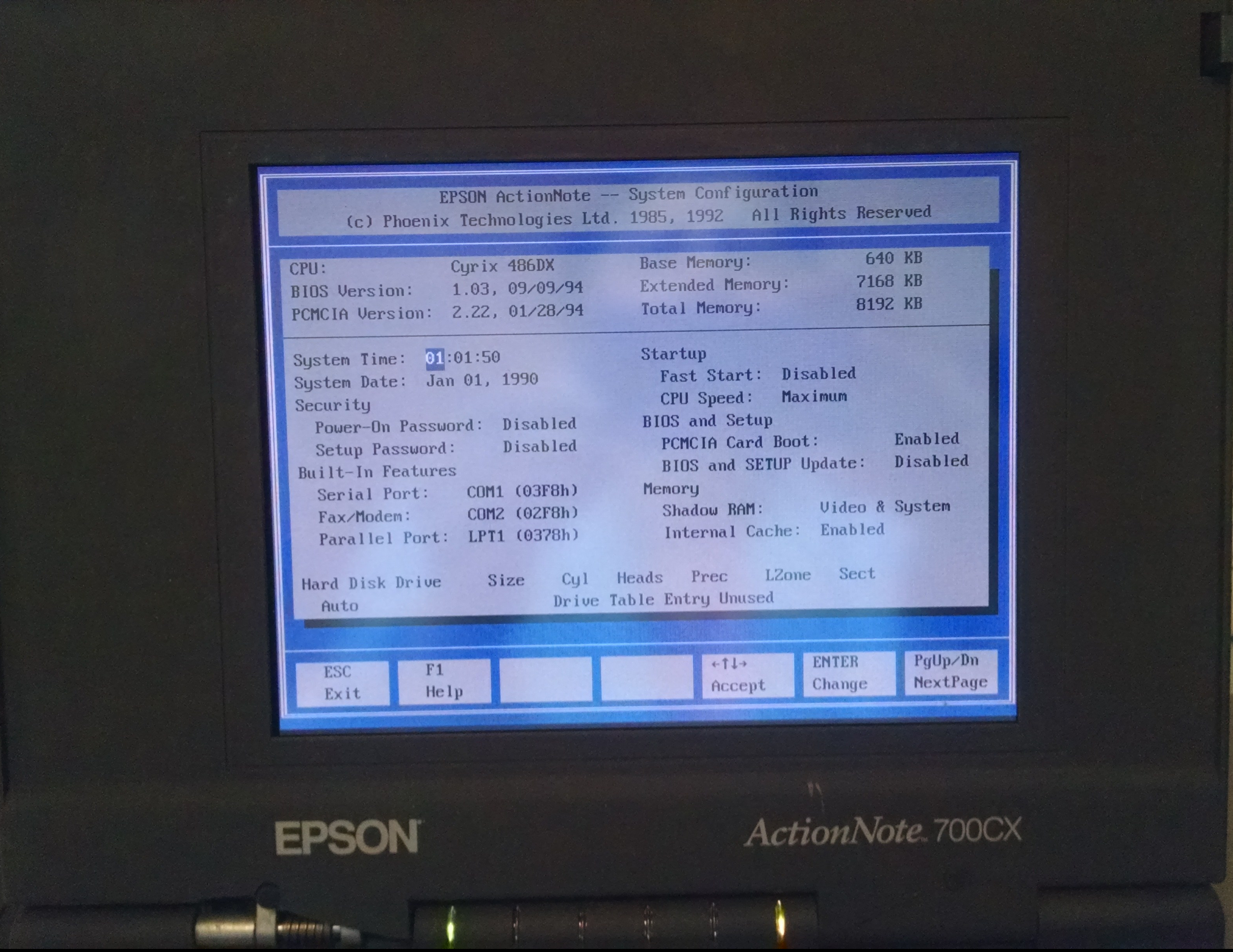
Epson ActionNote 700 CX. I plug it in. The poor thing is beat up, the F7 key coming off, the screen part separating from the keyboard part (unlike a lot of today’s laptops, it’s not supposed to). It turns on. Gray screen, words and numbers. DOS. Oh crap. Does anybody remember the DOS operating systems that preceded Windows?

Press F1. Okay. Setup failed. Press F12 for setup utility. I get a screen full of choices and no idea what button to push. The date shows Jan. 1, 1990. Memories of Y2K. Remember how we thought the world would fall apart because all our computers couldn’t make the leap to a new millennium? Most of them did but maybe not this one.

I decide to take pictures so I can show you all this historic computer. I close the top to shoot the outside. When I reopen it, all the words and numbers are gone. The computer doen’t even hum. When I push the power button, nothing happens. Old ActionNote seems to have passed away while I was trying to take its picture. But how does Roberta get off that deserted road? Does her husband get to the hospital in time?

Wait. Do I have another laptop, an interim between the Volvo and my current HP, a Honda maybe? Can’t find it, but I find some 5.25-inch floppy disks. Short Stories 1 and 2. Great! Oh. I have nothing that can read them. I have always backed up my files, carried copies in my car, and put them in the safe deposit box at the bank. It’s all useless nonrecyclable plastic now.

But wait, the Volvo didn’t die. The plug got super hot and the computer turned itself off. After it cools, I plug it in again. Green light. Must act quickly. Setup. Change the date. OMG. Windows 3.1. Insert disk. Horrible wailing noise. It can’t read the disk, can’t read any of my old disks, but hey, here on the hard drive is the old version of my novel Azorean Dreams. Hello, old friend.

“When the alarm shrilled at 7 a.m., Chelsea groaned and covered her eyes against the light pouring in the bedroom windows.” The whole book is there. Wow.

What else is on this thing? There’s the unfinished novel about a quadriplegic named Daniel. And something called deaderma.wps. Oh, I love that story. Reporter goes to do an interview and finds the subject dead in the rose bushes. Being a reporter, she gets nosy . . .

No Roberta and Frank. I created these people. I need to find out what happened to them, even if I have to retype every blinking word into the new (ish) computer.

I’m still looking. And no, I do not want to write a new ending. The moral of this tale. Print everything out. I still have poems, stories and essays I wrote on manual typewriters 50 years ago, but I can’t read what I entrusted to my computers in 1997. Even 2007 is iffy. Paper lasts longer than modern technology. We’re putting all of our information into machines that will be obsolete before I pay off my Visa bill. Is anybody thinking about that?

Do you have antique computers and antique media hanging around? Ever try to use them? What is going to happen to everything we have entrusted to our computers in five, 10, 20 or 30 years? Are writers the only ones who care?

I could tell you a whole other story about the days I spent last week sticking slides into the old slide projector. I thought I would get them digitized, but then I thought, why? Even my own slides bore me now. It’s been a dusty time in the Lick household lately as I try to sort things down to manageable levels. Within reason. Marie Kondo, queen of throwing away everything that doesn’t give you joy, can’t take my stories away. She’s not even getting the old laptop. Not yet.

Here are some interesting links to read about the history of laptops and the history of data storage.

A fun history of computers (if you mute the annoying music)

Check out this video on how to prevent “data rot” No music, cute guy, but skip the ad after he gets to the stone tablets

You might also want to mute the music on this history of data storage


Robo-Guy Just Doesn’t Understand Me

I’m writing this while listening to “on hold” music that sounds like the record is stuck and somebody needs to move the needle. I try not to do non-writing business during my writing time, but if I wait until later to call my insurance company, I’ll lose my courage, so now, while we have sun and hail happening at the same time (craziest winter ever), I dial the 800 number and encounter Robo-Guy.

Now, Robo-Guy and I have a problem. He does not understand what I’m saying. I think I’m speaking English. I’m enunciating as hard as I can. And yet he doesn’t seem to get me. He keeps spitting out a list of choices, none of which apply to my situation. Specifically, I’m turning 65 on Thursday, I have gotten a pile of stuff in the mail from Medicare and Blue Shield and I don’t understand how the two insurances interact. Do I have a Blue Shield “supplement plan” plus Medicare or what? This is not on Robo-Guy’s list, the same list I saw online before I decided I would have to use the telephone.

Every time I start to mutter to myself, he stops and restarts his list. I must be silent unless I can say something that’s on the list. BUT IT’S NOT ON THE LIST.

I take a chance. I say “Medicare supplement.”

“Did you say benefits?”

“No.”

“My mistake.” He repeats the list.

I repeat “medicare supplement.”

He says, “Did you say benefits?”

Head slap. “Yes.” I’ll say anything that gets me to a human being.

So I get one. I immediately forget his name. Dennis? We’ll call him Dennis. I give could-be-Dennis my information. He puts me on hold. The line goes silent. Am I still connected? Oh! There he is. My plan does not show me having Part D. Part D? But he’s not the right guy, which I knew because I picked a “wrong” choice to get to a human. Would I like to be connected to the other guy? Yes.

Commence the loud hold music. I start to scribble because I am unable to sit and do nothing and the music cannot be listened to. Why is loud annoying music considered better than silence?

Oh! Dennis. He’s still working on it. Hold on.

Why not give us news, information, quizzes, gossip, the Beatles, anything but this noise? How about, this is brilliant, how about employing professional “hold chatters,” friendly people who will talk to you while you’re on hold. You could talk about anything: work, kids, recipes, the weather, frustration with your in-laws. Kind of like therapy. I think it’s a great idea, as long as they’re live people.

Hey! Dennis has delivered me to Erica, who actually makes jokes. She’s going to check which is my primary and which is my secondary insurance. She giggles. “Who’s on first, who’s on second?” She actually remembers the old comedy routine. I love Erica.

Now I’m back on hold. The music didn’t miss a beat. For anyone calling government, insurance or financial institutions, always use the bathroom first and come supplied with coffee, tea, or whiskey and something to do because it’s going to take a while.

Erica is back. I’m listed as a “PPO retiree.” Okay. Blue Shield is still my primary insurance and Medicare is secondary. Is that what it’s supposed to be? Shouldn’t it be flip-flopped with Medicare primary? Somebody who is older than me and understands this stuff, please explain in plain English?

Erica offers to transfer me to another person. I can’t take anymore. “Not today,” I say. I may be over-insured, but going into my birthday, at least I am covered. I am double-blessed with insurance from my late husband and from Uncle Sam. I know a lot of people struggle to have any kind of insurance at all. I am lucky to have had Blue Shield all these years via Fred. On my own, I’d be at the mercy of the Affordable Care Act, which our president wants to abolish.

I’m still thinking about Robo-Guy. Oddly, I feel guilty, like I screwed up our conversation. He wasn’t even real, but he sounded so real, so anxious to please yet so perplexed by what I was saying.

So, tell me about your Robo-Guy experiences. Does he have trouble understanding you, too?

***

I wasn’t going to write about my upcoming birthday anymore. So I’m turning 65. Get over it, right? Right. But let me close with two important reminders about the upcoming anniversary of my birth (Thursday, Thursday, Thursday).

Some of my local area friends are joining me for lunch at The Chalet in Newport on Thursday at noon. Contact me if you want to come, too, so we can get a big enough table. No presents or even cards are necessary. I’m still thinking I will end the day at The Drift Inn in Yachats, where the music begins at 6 p.m. Let me know if you want to join me there, too. In between, I might go for a long hike if the weather is decent. If not, maybe I’ll do a little antiquing.

Rocking the Book Table in Newport

Did you write all this? Which book is your newest? What are you working on now? Behind the book table again at yesterday’s  Celebration of Women in Newport, I felt like the old veteran as I watched people pick up my books, study the covers, and put them back dofbbc5-dscn2584wn—or sometimes even buy them. I have been doing this since Stories Grandma Never Told came out in 1998.

I have sat at book tables all over Oregon and California, including many stints at the annual Dia de Portugal in San Jose, bookstore signings, book fairs in the rain in Lincoln City, and street fairs in Stockton where the only person who bought a book was the fellow author sitting next to me. All too often, sales are sparse, the only purchasers being the other authors.  The truth is, if the event is not specifically about books or about the subject of your books, most of the people attending are not looking to buy books. They’re going to spend their money on food, carnival rides, and souvenirs. The writers are just a roadblock on the way to the fun.

Because I have published three books about Portuguese Americans, my books sold like linguica sandwiches—hundreds—at the Portuguese festival. At the Lincoln County Fair, not so much. Yesterday? Two.

So why go? Exposure. People see you and your book, maybe they’ll take a flyer or postcard, and maybe later they’ll think, hey, I should buy that book by what’s her name. Maybe you get a little free publicity in the newspaper. Plus it’s fun to hang out with other authors, people who understand what you do and can exchange information on how to do it.

Yesterday, I sat between Lee Lynch, author of more than a dozen novels and longtime booktable partner, and Lori Tobias, whose first book, Wander, just came out. Lee and I traded war stories while Lori gathered information and advice and vented about how this was not as much fun as she expected. No, but it could have been worse. We were warm, dry, and the wind wasn’t blowing. At the fair in Medford where the photo above was taken, it was 35 degrees inside and snowing outside. Nobody came.

You learn things over the years. Don’t bring every copy of every book. You only need a few. Have something for people to take: cards, bookmarks, candy, or trinkets related to your topic. Get a cart or a strong person to help you carry the books because they are heavy. Get there early so you don’t get the table least likely to be seen. Bring sunscreen and a hat if it’s outside. Don’t hog your space. Bring dollar bills and coins for change. Keep your book money separate from your personal money. Acknowledge every person who approaches with a greeting and a smile. Resist the urge to read or stare at your cell phone, even if nothing seems to be happening. Wear comfortable clothes; nobody cares what you’re wearing. Etc.

Lori kept saying she’d rather be writing. I was content at the table. It was Sunday afternoon. I had played three Masses at Sacred Heart Saturday night and Sunday morning, so I was too tired to do anything useful anyway. I was among friends.  There was music, wine and chocolate. You learn to ride the writer waves of private time and public time.

Besides, I had new editions of two of my books on their virgin outing. Stories Grandma Never Told, that book about Portuguese women that launched my book table career, has been updated, with a new cover and, for the first time, an e-book version. Azorean Dreams, my Portuguese American romance novel, also has a new look. What’s next? Another novel, a memoir, and perhaps a poetry book. Got to keep adding new merchandise to the table. Also, I’m going to move into the 21st century and start taking credit cards at in-person events for those customers who wind up emptying their purses and pockets to come up with enough nickels and wrinkled dollar bills for a book because they don’t carry cash.

Next time you see somebody sitting at a table with books, walk up and say hello. We’ll be glad for the company and delirious if you buy a book.

Portuguese-American novel lives again

AD new cover 6816 bigSummer 2016 is becoming the summer of revisiting and revising past writing projects. First I did a new edition of Stories Grandma Never Told: Portuguese Women in California. Now I have a new edition of my Portuguese-American novel Azorean Dreams. This is the novel I wrote while I was still trying to sell the Grandma book. One of the women I interviewed, who had published her own book, convinced me that a novel would sell better than nonfiction. I no longer believe that’s true, but since nothing was happening with “Grandma,” I started writing a novel. Some of the people, places and events came directly from my experiences researching Stories Grandma Never Told. Others stem from things that were happening in the late 1990s in San Jose, California. And a lot of it is from my imagination.

My protagonist, Chelsea Faust, is a newspaper reporter working for a local weekly but with ambitions to move up in the business. She’ll do anything to prove herself as a great reporter. Although her mother’s side of the family is Portuguese, with roots in the Azores Islands, she doesn’t know or care much about her heritage. Then an assignment sends her into Little Portugal, and she meets the handsome Simão Freitas, who has not been in the U.S. very long. Romance blooms, but they disagree on many things, plus an incident from Simão’s past threatens to ruin everything.

I never imagined anyone real could have the name Chelsea Faust, but there is a real Chelsea Faust, with whom I connected online. She’s okay with her name being in the book. I have not met a real Simão (sim-OW) Freitas, but there probably are several men with that name because it’s pretty common.

Anyway, my Portuguese-American mother got a chance to read Azorean Dreams before she passed away, and she loved it. For that alone, I’m glad I published it when I did. The first time, I went through a company called iUniverse, that offers “print-on-demand” publishing, meaning when an order comes in, they print a book. There are not boxes of printed books sitting around somewhere. You pay for the service and—here’s the catch with these companies—you pay for copies of your own book. Their designers decide what the book will look like. They also determine the retail price.

To be honest, I never liked the look, the size or the price of the iUniverse version. I have seen the same cover art photo used in advertisements for several products. The background is not even the Azores. I’m pretty sure it’s Italy. The print inside is huge, making the book itself huge. And they charged $20.95 a copy. Who would pay that much for a paperback novel by an unknown writer? Judging by my sales, almost nobody. But I had signed a contract and thought I couldn’t get out of it. I was wrong. As of last month, I am free from iUniverse. They’re not all bad, but it didn’t work for me.

A few years ago, I revised Azorean Dreams a bit and published it as a Kindle e-book. Same stupid cover. But now I have a new cover for both the e-book ($2.99) and the new paperback version. I used Amazon.com’s CreateSpace program, which allowed me to design the whole book myself, so now I love the way it looks. It’s a more reasonable size and price, $14.95. I feel so much better about it, and maybe a few new readers will take a look.

Now I’m immersed in another project that I will tell you about soon. Happy summer, everyone. Get some books and start reading.


This is my kind of tea party

IMG_20150131_150700963[1]An ocean of hot tea, plates of itty-bitty sandwiches, sugar cookies shaped like teapots, and sorbet eaten with doll-sized spoons, plus books–what’s not to like? Saturday I was one of the guest authors at the annual Samaritan House tea in Newport Oregon. The tea raises funds to support our local homeless shelter. The ladies who organize it go all out, and it shows. The tables and walls were decorated with books and antique tea cups. The programs, thick with ribbons and more teacup images, included recipes and bookmarks to use on our next reading adventures. The beautifully crafted treats included cucumber sandwiches, scones with clotted cream and jam, orange lavender polenta cakes, black olive and rainbow chard bars, and little teapot figures created with green grapes and frosting.

IMG_20150131_152111126[1]Held at First Presbyterian Church, the tea sells out early every year. Middle-aged and old ladies and young moms bringing their little girls jam the fellowship hall. They doll up in flouncy dresses and big hats decorated with feathers, flowers, and lace. It’s a scene right out of Great Gatsby–if it was cast with our friends and neighbors. The atmosphere is loud, giddy with too much sugar and caffeine, and generous. In addition to the tickets, the tea-goers bid on a silent auction, buy the books and teacups decorating their tables, and donate cash to the cause.

The theme varies. This year as part of “Tea and Tomes,” six authors were invited to display and sell their books and give brief talks about their work. We shared a table and swapped stories from our publishing adventures. It was fun getting to know each other and showing off our books. Besides me, the authors included: M.C. Arvanitis, author of middle grade and young adult fiction; Patsy Brookshire, author of the novels Threads and Scandal at the Willamina Quilt Show; Deborah Lincoln, author of the historical novel Agnes Canon’s War; Deborah H. Trusty, author of The Kid from Valsetz, a biography of former Newport city manager Don Davis; and Karleene Morrow, who wrote a novel titled Destiny and How to Write a Novel. Morrow passed away recently, but her friends brought her books and told her story.

Many of the people at the tea knew me only as the girl behind the piano at  Sacred Heart Church, which was where I had to go right after the tea, to play for the 5:30 Mass. They were surprised to see how many books I have published. I had five at the table, Childless by Marriage, Shoes Full of Sand, Stories Grandma Never Told, Azorean Dreams, and Freelancing for Newspapers. Info on all of them at http://www.suelick.com/Products.html.

For those who think I’m amazingly talented, I tripped over the microphone cord after my talk. I also dropped one of my little sandwiches face down on the carpet. Nobody’s perfect.

The photo above shows me on the right and my friend Pat Stern in her fancy hat.

Have a cup of tea and read a book. It feels good.