Reach Out to an Elder Orphan This Holiday Season

Have you heard the term “elder orphans”? I am one. No husband, no children, no family nearby, living alone. Some elder orphans literally have no family, while others live far away or are estranged. Either way, they’re alone.

We are many. Don’t go feeling sorry for me. I do that well enough on my own. I do have wonderful people back in California and terrific friends right here on the Oregon coast. Not everyone is so lucky.

While the media makes it look like everybody celebrates the holidays with happy families or groups of friends, there are countless people who dread this time of year because they are alone. They may not have any invitations for Thanksgiving or Christmas dinner or anyone to invite to their own homes. They may not be able to travel. They may be unwell. And guess what, they might not get any Christmas presents. It’s not a matter of finances; it’s a matter of not having people they can claim as their own.

Being alone is not always horrible. My neighbor said she had a delightful Thanksgiving. She read, puttered in the garden, smoked some pot, and ate a delicious all-natural vegetarian meal. She was content with the company of her cats.

I was supposed to go to California to be with family, but due to some health crises down there, I wound up staying home. When a friend from church issued an invitation for any strays to come to her house, I jumped on it, and we had a good time. Thank you, #Phyllis O’Boyle. As it turned out, three different sets of friends invited me to Thanksgiving dinner, and I already have plans for Christmas. I am grateful. I do not do well alone on the holidays. I start feeling abandoned and spend a lot of time crying.

If I chose to be alone, that would be a different story. One of my favorite Thanksgiving memories is the time I stayed home sick with a cold. I ate burritos and watched movies by myself while my husband and stepson spent the day with the in-laws. It’s a question of attitude. I could see myself as sad and lonely, or I could see myself as free to do whatever I want.

I have talked to a surprising number of people who have no one to be with on the holidays. Some of them are outgoing people I would never expect to be alone. But they are.

We don’t always speak up. It’s as if we’re embarrassed to have ended up without people. As in the game of musical chairs, we wound up without a chair when the music stopped.

When you have a family, you automatically know you’ll be spending the holidays with them if at all possible. It may not be as happy as the TV commercials imply, but you know who will be there. You know who will give you presents and who you will give them to. You know who likes turkey breasts and who likes the rear end. You carry out the same traditions year after year. I treasure the memories of my childhood Christmases, which were always at my parents’ house, with both sets of grandparents attending, along with aunts, uncles and cousins. Most of those people are gone now.

If someone in your life does not seem to have family nearby, ask if they have plans. Maybe bring them an inexpensive gift. Two years in a row, I received gifts from a secret Santa, which I think was the Newport senior center. I was so touched because I had nothing else under my tree. Think about that. If you have people, reach out to those who might not. If you are the one who is alone, start talking to people. Make a plan.

Did you know that 27 percent of American homes are occupied by only one person—and a large percentage of those people are seniors? People assume everyone has someone, and if they don’t, they put the burden on the lonely one to reach out. Don’t do that. You be the one. Say hello. Check on them. Be a friend.

Do you find yourself alone on the holidays? How do you handle it?

Do you know someone who might be alone? How might you help them?

I look forward to your comments.

P.S. If you are alone, consider joining the Elder Orphans group on Facebook. It really helps.

Photo by cottonbro studio on Pexels.com

Processing…
Success! You're on the list.

No Phone??? Let Me Talk to the Manager

Cell phone sits on green table, some green leaves in right foreground. On the screen, it says, "HELLO."

It was getting dark. I was alone in an unfamiliar section of Portland overlooking the Willamette River. This was the only restaurant within walking distance of my hotel. I skirted the barefoot young man in rags talking to himself and walked into this Asian fusion place, looking forward to a good meal after a long day at the Portland Book Festival.

High ceilings, mirrored columns, young servers in black, large parties of young people, a computer tablet at the entrance to sign in. I started the process. How many in your party? One. Are you willing to share a table? No. Please enter your phone number and we will text you when a table is ready. Uh-oh.

My phone was charging back in my hotel room. I flagged down a worker. “I don’t have my phone.”

She looked at me like I was from another planet. When she discovered I was also a party of one, she had to consult her boss on how to handle this anomaly. Ultimately, I had to sign in on the tablet, including my phone number.

“I don’t have my phone,” I repeated.

“We’ll work something out,” she said, a little flustered.

I waited on a bench next to two young women who were both staring at their phones. Customers came and went, most of them less than half my age. I started to wonder if I should have stayed at the hotel and eaten microwaved pasta in my room.

Finally, the young woman escorted me to a table. It was a four-top with a great view of the river, the Hawthorne Bridge, and OMSI, the Oregon Museum of Science and Industry. I would have taken pictures, but I didn’t have my phone.

I was the only person in the place occupying a table by myself. I was the only person of grandparent age not eating with children and grandchildren. I was the only person without a phone.

For the record, I would have been happy to share a table with someone close to my age who would actually talk to me, not talk around me to their friends or stare at their phone the whole time.

“Have you eaten here before?” the girl asked. No. She explained that I needed to click on the QR code on this slip of paper for the menu and then order with my phone.

“I don’t have my phone.”

Again, she was flustered. She went off somewhere and found an old-school printed menu. “It’s not up to date,” she warned, leaving me a checklist to mark what I wanted.

I checked a few items, not sure what I’d be getting, a young man whisked it away, and eventually I was served salad greens, won-tons, and beef-stuffed “pancakes.” It was all delicious. I watched the busy staff serving loud, happy parties who were laughing, talking, and sharing food. Outside, white clouds in the blue sky turned pink and then gray, and darkness fell. Inside, I stuffed myself with won-tons dipped in chili sauce and pondered the new world.

When I got back to my room, I had a text message: Your table is ready.

Everything is online these days. I bought my ticket for the festival, reserved my room, and set up my Uber rides online. I listened to music in my car by connecting my phone with the car audio system. I checked the time, checked the schedule, and ordered books by featured authors on my phone.

I received a text with a photo from my brother on my phone and exchanged a long series of texts with a friend to arrange a lunch date.

The one thing I did not do was make or receive a voice call on my phone.

A mobile phone is essential these days. How dare I go walking without one?

The Pew Research Center says 97 percent of Americans own a cell phone. Imagine how much money is being spent for all of those phones and all of those service plans. Not everyone can afford it, but the expectation is that you will have a smartphone, it will have all the apps, and you will know how to use them.

I can imagine what my father would say if he were to come upon this restaurant. Forget the fact that he would never eat Asian food. When asked to check in on a tablet and give his cell phone number, his response would be something like “Are you kidding! I’m not giving them my %$$#@# telephone number.” Followed by, “Whaddya mean there’s no menus? To hell with this place!”

But Dad, who died in 2019, was born 101 years ago, when all you could do on a phone was talk to people–if you were one of the few families lucky enough to have a telephone at all.  

To the restaurant’s credit, the food was wonderful, and at least four workers thanked me and wished me a good evening on my way out. I would go there again, with my phone and with other people. I’m proud that I did not hide in my room eating microwaved pasta. I braved this strange new world all by myself and survived.

Have you found yourself in situations where not having a mobile phone with you has been a problem? Tell us about it in the comments.

Photo by Polina Zimmerman on Pexels.com

Processing…
Success! You're on the list.

Is Your ‘Good China’ Gathering Dust?

blue and white bowl and two cups on brown background

Let’s talk about china. Not the country, the dishes. In my effort to clean up my house, I have come to the “good china.” It’s dusty. I rarely have company. Since my husband died, I don’t throw dinner parties. My home is not the hub that my parents’ house was, with everyone gathering there for holidays, birthdays, and other occasions. I’m the one who lives far away, so other people host the family dinners back in California.

My parents’ china was ivory with green flowers. It was part of a special-occasion ritual. The dining room table was stretched to its full length and covered with a white tablecloth. While turkey cooked in the oven, Dad took the china and silver down from the cupboard above the refrigerator and I set the table, nibbling on salami and celery stuffed with cheese from the hors d’oeuvres plates.

white dishes with blue trim, green bubble wrap, plastic tablecloth with colorful fruit

We sat on the squeaky wooden chairs, Mom said grace, and we started passing food in both directions at once. We ate until we were stuffed. Still photos or home movies were taken. Someone always joked that it got quiet because everyone was eating. Afterward, the women put away the food and formed an assembly line to wash, dry and stack the dishes and silver. Later, Dad put it back in the cupboard over the refrigerator and we went back to eating on plastic plates. Mom’s china never saw a dishwasher. Our house never had one.

I loved that china, but by the time my father died and we cleaned out the house, I had already inherited my mother-in-law’s dishes, so my niece inherited the green and ivory set. May she enjoy many wonderful meals with it.

Picking out one’s china pattern used to be a common ritual for young couples getting married. Before my first marriage, my china had already been chosen by my in-laws. I left it behind in the divorce, and I barely remember it. Rose and green flowers on white?

Fred didn’t get custody of the china in his divorce either. We made do with the “Palm Desert” stoneware we bought for ourselves. The stoneware is all chipped now, and I use blue and white Currier and Ives dishes I have found at antique shops over the years.

Fred’s mother’s china, the 12-piece set shown in the photo, has blue flowers on a white background. It includes dinner plates, dessert plates, salad bowls, cups and saucers, two serving dishes, and a gravy boat. It’s not the most expensive. I think she got it in one of those grocery store deals where you bought one piece a week until you had a whole set.

A little research shows that today’s young couples are not as interested in acquiring fine china that they only use for special occasions. It’s another thing to store, another thing to worry about breaking. The secondhand market is flooded with dishes that belonged to baby boomers and their parents.

The cabinet where Mom Lick’s dishes live also holds wine glasses, serving dishes, and wedding-present platters I ache to use again. Logic would tell me to donate all of it to charity or to someone who might use it. I could sell it on Ebay, I suppose. But I’m not going to. I don’t know when, I don’t know how, but I still want people to gather at my house for food and laughter and hugs. It’s difficult to host a party alone. But maybe someday, I won’t be alone. I put those dishes back in the cabinet as a sign of hope.

What about you? Do you have fine china? Was it passed down through the family, given as wedding presents, or purchased on your own? How often do you use it? Do you know who will use it when you’re gone? Tell us about it in the comments.

Some interesting reading:

“5 Clever Things to Do with Granny’s Old China”

“Millennials aren’t Buying Fine China—and They Don’t Want to Inherit It Either”

“Inheriting the Fine China? Many Younger Folks Say No Thanks”

Processing…
Success! You're on the list.

When in Doubt, the Couch Ate It

It was the last straw. In a month filled with so much grief and so many challenges, now I had lost the remote control for the TV. I had no idea what happened to it. I just had it. I was pretty sure I was losing my mind. Considering the events of the past month, I wouldn’t be surprised. 

But maybe I’m not crazy. Wait till I tell you what I found. 

First, a brief summary of the past month: 

  • My dog Annie died on Sept. 13. Age 15 ½. Cancer. I cried, keened and wailed for days, only able to stop by visiting the liquor cabinet, which was not a good plan. I poured the vodka down the sink.
  • When I took my beloved Honda Element in for an oil change on Sept. 21, the crew found so many needed repairs, it didn’t make sense to keep it. I traded it in for a new car, a Honda HR-V. I love it, but I still can’t figure out half the controls. Despite the Element’s 155,000 miles, they resold it for three times what they gave me for it.
  • At the Florence Festival of Books Sept. 23, I fell off a chair while trying to hang my banner and trashed my tailbone, leading to weeks of pain and walking funny. I still rose to sell books and speak on a panel about writing memoirs. But, ouch!
  • A cousin revealed on Oct. 1 that she had breast cancer.
  • A friend died on Oct. 3.
  • On Oct. 6, I played music at church, got my hearing aids tweaked and picked up Annie’s ashes. 
  • I worked day and night putting together Oregon Poetry Association’s annual online conference, doing tech things that were way beyond my comfort level, leading to an all-weekend migraine. But the Oct. 7 conference went well. My last board meeting is tonight, when I pass the presidency on to someone else. 

It has been a lot. I have been reorganizing my den and trying to get rid of everything that no longer gives me joy. I found treasures I had forgotten about, along with piles of “why do I still have this?” Anybody want an accordion, a knick knack shelf, a Casio keyboard that doesn’t seem to work but might be fixable, or an orange wall ornament circa 1974 that says L.O.V.E? It feels like a time of change, a time for a fresh start. 

As I was cleaning, I found a dead barn swallow in my wood stove. It happens every year. They fall in through the chimney, can’t get out, and suffocate. So sad. I moved her body out to the woods. I grieved for her, too.

But back to the missing remote. Where could it have gone? I was just sitting watching “Bob Hearts Abishola.” This green corduroy sofa is a soft mess of many cushions and pillows. I threw them all on the floor, and shoved my hand down the sides and backs, finding nothing but dirt and dog fur. Surely it had gone down the crevice between the seat and the back. I pushed my hand down as far as I could, getting it stuck a couple times. No remote. 

Then I thought of looking from the back of the sofa. Maybe it fell all the way through. Nothing on the floor. But wait. I reached under and felt along the cloth at the bottom. Something was in there. The staples in one section were loose. I pulled them apart. I’m planning to buy new furniture anyway. We bought this couch with the house in 1998, and it’s time. 

I reached my delicate piano-playing hands in and felt . . . all kinds of stuff. Reach, reach, what??? I pulled out a children’s book, three little rubber balls, shoestrings, a Newport Middle School student ID card for a kid who must be almost 40 by now, three pencils, a plastic ruler, a receipt for repairs on a Chevy Lumina, a string of plastic pearls, a dowel, and a remote. Not the one I just lost, but the one I lost over a year ago and had long since replaced. It worked! 

I kept reaching in for more, even after I cut my hand on a staple. I got everything I could feel with my hand or push out with the dowel. But I know there is more. I know that missing remote lurks somewhere in the bowels of the green sofa. I wonder what the matching loveseat is hiding. I will not be able to resist tearing them both apart. It’s fun finding things, and the hunt is cheering me up.

All these years, I have blamed Annie for most missing objects. After all, she did eat checks, pens, pencils, handkerchiefs, socks, my hearing aid, and more. But she did not eat the remote control. The couch ate it. Bad couch!  

Do you have furniture that eats things? Like what? Please share in the comments. Are you tempted to pat the bottom of your sofa now to see what might be lurking there? 

***

Annie, my beloved companion, is a huge loss. She has appeared many times in this blog and in everything I write. As I told her often, she was the best dog ever. She will live on in our memories now that she is forever unleashed in Oregon. 

Processing…
Success! You're on the list.

Solo Getaway in Oregon and Washington–Don’t Forget the Chargers!

The view from Mt. Angel Seminary in Oregon. Evergreen and deciduous trees in the foreground, red barn and other buildings in the center, open fields and farms to the cloudy horizon.

Sometimes a girl just has to get in her car and drive away. Let the winds carry her where they will. Follow her whims. Be free. Stuff a backpack, grab the keys and go.

Who am I kidding? I make myself crazy planning for months before I go anywhere. I clean the house lest the dog sitter think I’m a slob. I make reservations and fill folders with confirmation email printouts, schedules, and directions. I pack work I’m going to do, work I might do, books to read with backup books in case I hate the first ones, orange juice, granola bars, fruit, tea bags and extra tea bags, extra socks, extra underwear, two bathing suits, three pairs of shoes, copies of my books and my business cards, cold cream, face cream, hand cream, sunscreen, my guitar, sheet music and more sheet music in case I find a piano . . . If I’d had a passenger, he/she would have had to ride on the roof of my Honda.

My five-day journey concluded in Centralia, Washington, where I taught at the Southwest Washington Writers Conference. Centralia is a small town about 80 miles north of the Oregon border. Nice place. Nice college. Nice people. I taught workshops on creative nonfiction and book revision, met some great writers, won a raffle prize, and sold my books. It was a fun time that reminded me how much I love to teach. Or maybe it’s just that finally someone has to listen to me.

Photo shows cases of sausages, some straight, some round, some dark, some light, so many sausages, at a store in Mt. Angel, Oregon.

Before Centralia, I took a mini-vacation in Silverton, home of the Oregon Garden and Silver Falls and neighbor to Mt. Angel, a Bavarian-themed town down the hill from the Mt. Angel Abbey and seminary. I wrote poetry, played my guitar, swam, walked, shopped, explored, and ATE so much great food I couldn’t zip the jeans I had planned to wear for my drive home. But pulled pork tacos, chicken salad croissants, key lime pie, eggs Benedict, German pastries from Mt. Angel . . . It would be a sin not to enjoy the food.

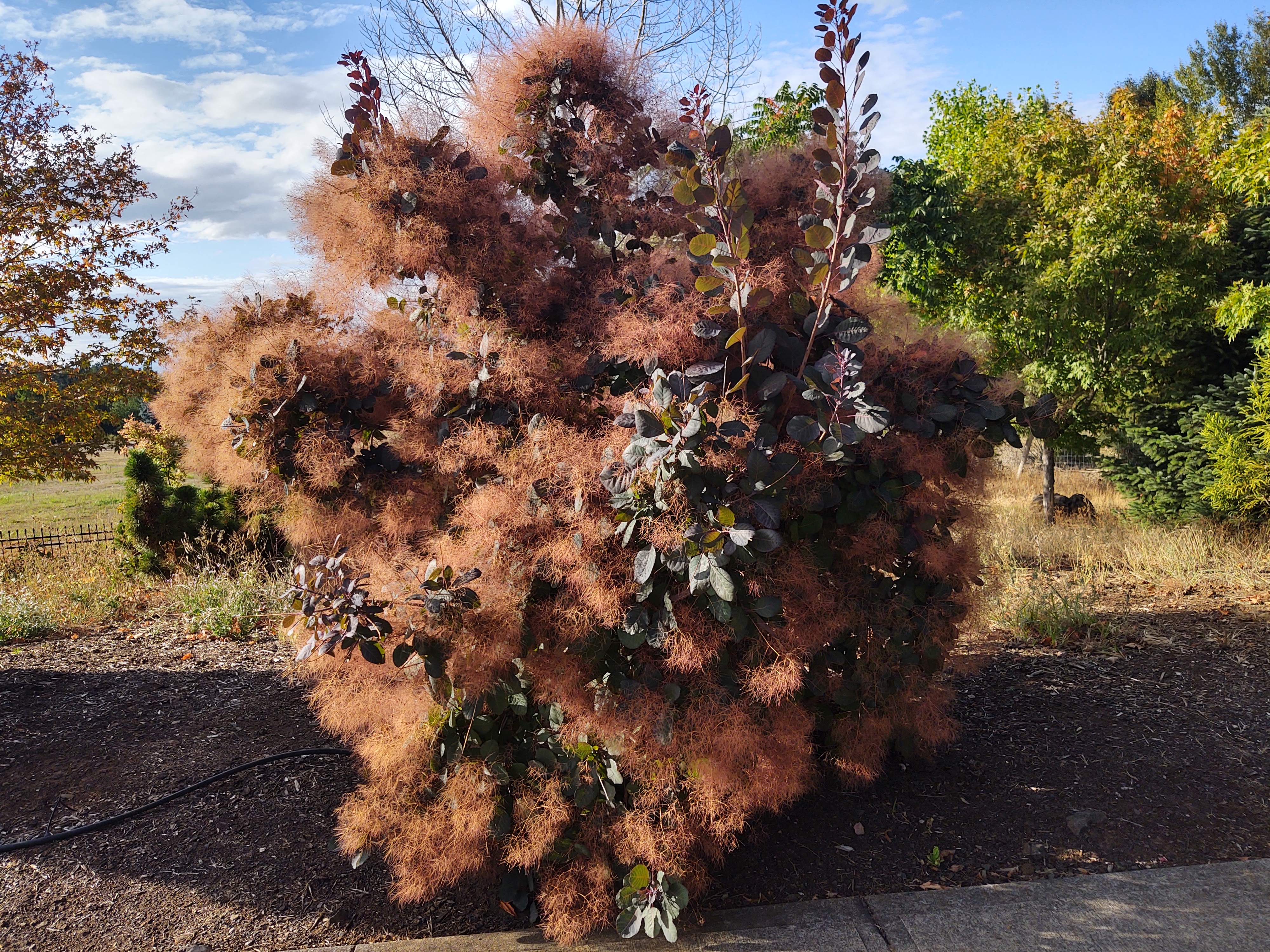
I stayed at the Oregon Garden Resort, up the hill past the gardens. Guests stay stay in separate cottages with about six rooms, each with fireplaces and private patios. All are within walking distance of the restaurant, pool, spa, lounge and garden. Such views. Such flowers. Have you ever seen a smoke bush like the one in the picture? I never had. A friendly stranger who knows her plants told me all about it. Overall, the resort was fancy but affordable and it had a real “camp” feeling.

Photo shows odd-looking bush with orangish fluff surrounding green leaves. It's called a smoke bush.

The other two nights, I slept at the Holiday Inn in Chehalis, another smallish town north of Centralia. It was . . .  a Holiday Inn. Elevators, long hallways, soaps and shampoos in canisters attached to the wall. Kudos for their perfect indoor pool, though, and for the nearby Jeremy’s Farm to Table gluten-free restaurant and store. Fascinating décor, friendly staff, and amazing food with a healthy spin. I ate there two nights in a row and would do it every night if I lived nearby. Sure, I’d weigh 500 pounds. But life is short. Eat the pie.

 I spend most of my life shuttling between Waldport and Newport, Oregon, so it was nice to get out of Lincoln County for a while and see new things. Some folks avoid traveling alone, but I kind of like it. You’re free to do whatever you want, including changing your mind at the last second. You’re also free to get lost, to get sleepy behind the wheel, and to wish you had a designated driver, but that just adds to the adventure. In many situations, I was the only person who wasn’t part of a couple or a group, but I’m learning if I just enjoy myself and talk to whoever is around, I’m not really alone.

Some things I noticed along the way:

  • No one seems to mind men wearing baseball caps in restaurants.
  • Why is there always background music playing when nobody seems to need it or want it—except that one waitress in Woodland, Washington who was singing along as she worked? One of the joys of wearing hearing aids is that when I turn them off, the loud music disappears.
  • Why are hotel doors so heavy and the springs so tight? The one at the Holiday Inn gave me some new bruises as I tried to get in with my guitar and my ice chest. Is there some logical reason it’s three times as heavy as any door on my house?
  • I forgot the plug ends for my charger cords. Most places I stay have USB charger plug-ins anyway, but not this Holiday Inn. How would I keep my phone and hearing aids charged? Would I have to move to a different hotel? I threw an embarrassing hissy fit at the front desk and was handed a converter I could use. Lessons: Calm down and ask if they have a solution. Pack a couple of converters in your suitcase or remember to bring the plugs. At least I remembered the chargers.
  • Gas is way more expensive in Washington, and you get to pump it yourself. At my first gas stop back in Oregon, I got out of my car and a friendly woman in a red shirt came running to pump my gas before I had a chance to mess with her machine. Oregon has some self-serve pumps now, but not there.
  • Almost everyone I saw in my trip up the I-5 corridor in Oregon and Washington was white. With baseball caps. Where are all the people of color?
  • There is so much to see everywhere in this country. Take a ride. Check it out. 

Annie is hanging close to me today. She’s afraid I’ll grab my keys and go away again. Not today.

Tell us in the comments about your adventures.

Processing…
Success! You're on the list.

Book cover shoot confuses the dog

Annie watched me, confused. Why was I setting up a card table on the deck and covering it with a tablecloth? Why was I carrying out dishes, silverware, cloth napkins, and a candle? And hey, why was I putting her bowl on that table, where she couldn’t even reach it?

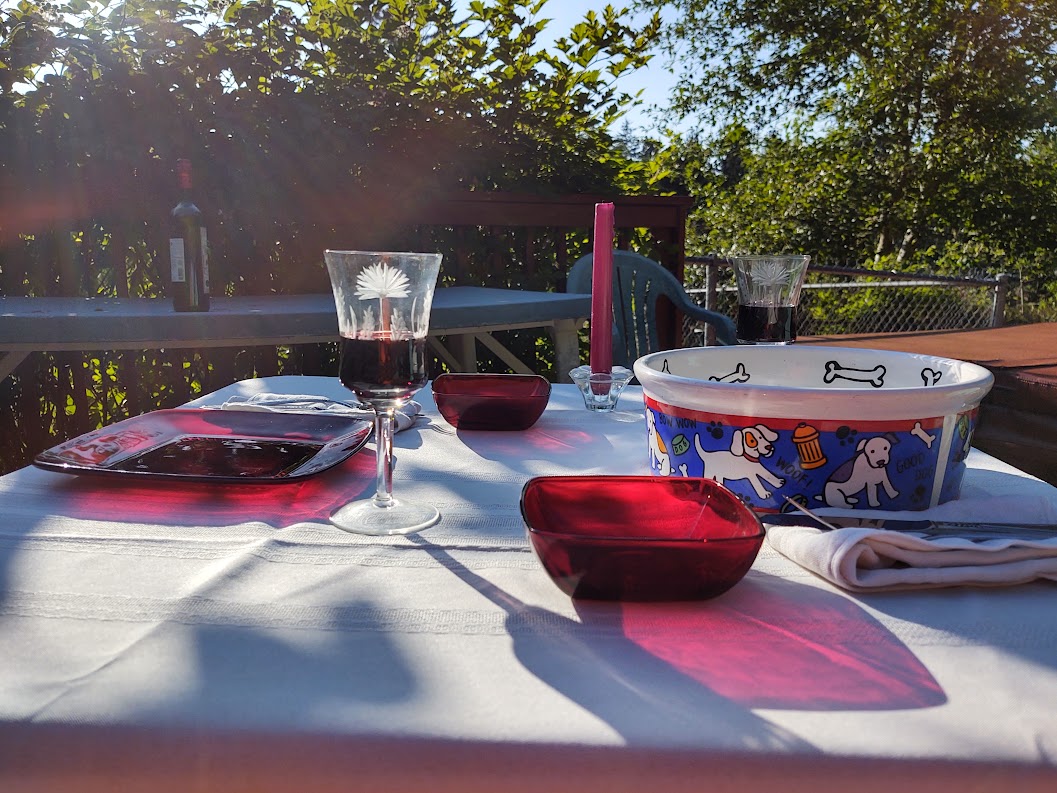
outdoor table set with white cloth, ruby-colored plate and bowls, wine glasses with red wine, and a red, white and blue dog bowl. Set up for a photo shoot.

I was doing a “photo shoot,” trying to create a cover picture for my poetry collection, Dining Al Fresco with My Dog, coming out next year from Moonpath Press. Turns out it’s not as easy as it looks.

For years I marketed that book as Bully Wind and pictured a woman standing outside in a storm, defying the weather. My editor vetoed that title. This one is more fun anyway, but here I was fighting the Oregon coast wind to set my table.

For the first try, I used one of the tablecloths my mother embroidered sixty years ago for her canasta club, my blue Currier and Ives plate, Annie’s silver bowl, and one Oregon Coast Aquarium commemorative wine glass. I filled my plate with raviolis and an artichoke and put kibble in Annie’s bowl. I took umpteen photographs, trying not to get too much of the hot tub, the chain link fence, or the defunct yellow wheelbarrow I plan to turn into a planter someday.

Photo shows part of a table with a lavender cloth embroidered with purple and green flowers and a big yellow dog licking her nose and 
standing over an empty silver bowl.

I left the wine glass empty because wine conflicts with my meds, and I don’t actually drink much. Once everything was set up and photographed, we did indeed dine al fresco. It was delicious, although the raviolis were a little cold. However, in the photos, the food looked disgusting.

There’s an art to photographing food, and the pros use a lot of tricks that make the food look good. Check out this site about styling food for photos. You won’t believe the things they do. For example, that “syrup” on the pancakes might actually be motor oil, and there might be glue in that cereal instead of milk.

I sent photos of the table without food. The editor liked the concept, but said Annie needed her own wine glass, silverware and cloth napkin.

Okay. This time, waiting until the sun wasn’t blasting the shooting area, I used my good white tablecloth, my red Depression dishes, and Annie’s fancy bowl with pictures of dogs on it. I found two wine glasses without writing on them and poured red wine in them, taking a few sips as I went along. I didn’t bother putting food in the dishes because, ick.

This time the editor liked the shots, but she said the dog’s bowl and silverware weren’t completely in the frame and I needed to reshoot in high resolution, something I knew nothing about. There’s a setting for that on my phone? Turns out there is.

I will be reshooting again tonight. Dinner is leftover stir fry for me, Purina’s “vibrant maturity” kibble for Annie. There will be wine in our glasses, but I promise Annie won’t be drinking any.

AI generated photo shows a golden retriever sitting on a chair at a table in a garden. The table has plates, candles, and a big hot dog with a parsley garnish.

This time of year, dining outside is wonderful, but it feels odd doing it alone. I miss the family barbecues when it was too hot in the house, so we took everything out to the patio, sat around the picnic table, and dove in. Hey, there’s a poem about that in the book.

I have set up many pictures for this blog. Usually it entails plopping some object on a plain surface, taking its picture and uploading it to WordPress.com. I also purchase art from 123rf.com and use free art from pexels.com.

Is it common for an author to be asked to provide her own cover image? Not so much, but it happens. In the best cases, you have an artist or photographer in the family or already own the perfect picture. Otherwise, it’s time to get creative.

I have had good and bad experiences with book covers chosen by others. The original cover of my novel Azorean Dreams, which was supposed to show a romantic couple in the Azores Islands off the coast of Portugal, actually showed a scene from Italy. When I complained that the guy was missing my character’s mustache, they drew one in. Worse, after the book was published, I saw that picture on the back cover in magazine ads all over the place.

It gets worse. I published a book titled Freelancing for Newspapers years ago. (It’s out of date, but still has good advice. If you want a copy, I’ll send it to you for free). The publishing house decorated the cover with a stack of folded newspapers. Makes sense. But on one of those newspapers in big, legible type is the word “genital warts.” Embarrassing!

For a book cover, you need more than just a great picture. It has to be eye-catching and appealing. It has to be a unique high resolution vertical shot, and you need to think about where the type will go, what colors will be prominent, and who owns the rights to the “image” you’re using.

You can’t just rip off a picture from the Internet. You can, but it’s wrong. There are agencies that sell photos, artwork and images created by artificial intelligence, like the one pictured here with the checkered tablecloth from 123rf.com.

The editor preferred to go with an original. So I’ll be setting the table tonight when the light is right. Then Annie and I will dine in style.

Have you ever set up a scene for a photo shoot? Tell us about it in the comments.

Does anyone have a dog who actually sits at the table to eat?

Processing…
Success! You're on the list.

Fire Transforms Paradise into Hell

Book cover: Fire in Paradise: An American Travedy. Photo shows a street with remnants of burned houses on either side.

My mind is filled with fire today. Actual fire. Wildfire. I just finished reading Fire in Paradise: An American Tragedy, which is about the blaze that destroyed the town of Paradise, California in 2018. Authors Alistair Gee and Dani Anguiano have done an amazing job of weaving together research and interviews to take us right into the fire.

Imagine being trapped in an endless line of unmoving cars while flames rise only a few feet or maybe inches away. Imagine the car doors are scorching and the tires are melting. It’s morning but black as night. There’s nowhere to go that isn’t on fire.

Searchers found charred bodies sitting in their cars or their living rooms or on their front porches, caught before they could get out. Eighty-five people died in the Paradise fire, and thousands lost everything they had. The town had an emergency plan, but the fire was too big for it to work.

As temperatures rise, wildfires, always a part of nature, are becoming more frequent and more disastrous. We used to think the coast was safe. It’s so damp, we said. But lately, it has been warmer and drier. We got a taste of fire in the north end of Lincoln County where the 2020 Echo Mountain wildfire struck the town of Otis and part of Lincoln City. In all, 1,241 structures were destroyed. Homes, business, churches, everything was wiped out.

Every year, fires burn throughout the west. There are some going now, including a huge one in Curry County.

For those who say, well, that couldn’t happen here, look around. It could. Wherever you are. Whether you live in a forest like me or in a city. This year, fireworks sparked a beach-side blaze in Waldport—just 11 miles down the road from me—that could have been disastrous. Luckily firefighters stopped it before it reached any homes, but residents were evacuated and Highway 101 was closed for hours. It definitely put the fear of God in everybody around there.

It doesn’t take much to start a fire in dry, windy conditions. Fireworks, a debris fire gone out of control, a cigarette, or a spark from a vehicle that falls on brittle leaves and pine needles. The Paradise fire was blamed on malfunctioning power equipment. Pacific Gas and Electric, which provides electricity to that area, was sued for millions of dollars, but they can’t keep up with maintaining all their lines and connections and the trees and shrubs that surround them. The best they can do is shut off the power when conditions are ripe for fire. People have been left without electricity for days, and that’s not a good solution.

Fire has always been a natural part of woodland life, but there didn’t used to be people and buildings in the way. Where my brother lives near Yosemite, he and his family have been ordered to evacuate twice. One time, fire came right to the gate of his housing development. The area all around was scorched. Several years later, it still has that sepia-toned look that comes over burnt land. My brother has cleared all plant life away from the house, a massive but necessary job when fire is so much a part of the landscape. As one fire expert said recently on NPR, they have five seasons now: winter, spring, summer, fall, and fire.

I look out my office window at spruce and alder trees, laurel, sword ferns, and blackberry vines. It’s green and beautiful but vulnerable. When the dog came in a while ago soaking wet from a brief rain shower, I was grateful. We haven’t seen rain in a while, and it was getting awfully dry.

Why am I obsessing over fire lately? It’s research. I’m working hard on the third book of the Up Beaver Creek series about PD and her friends, and a fire is just one of the challenges they face in this book. I can’t tell you any more yet, but the book is coming. If you haven’t read Up Beaver Creek and its sequel Seal Rock Sound, well, why not?

Meanwhile, if I was told to evacuate, I’d grab Annie, a guitar, my laptop, and my purse, along with the pills, clothing, and snacks already in my “go bag.” Have you got a bag packed? What would you take if there was no time to think about it?

Let us know in the comments.

Processing…
Success! You're on the list.

New Book Announcement and More

It’s happening!

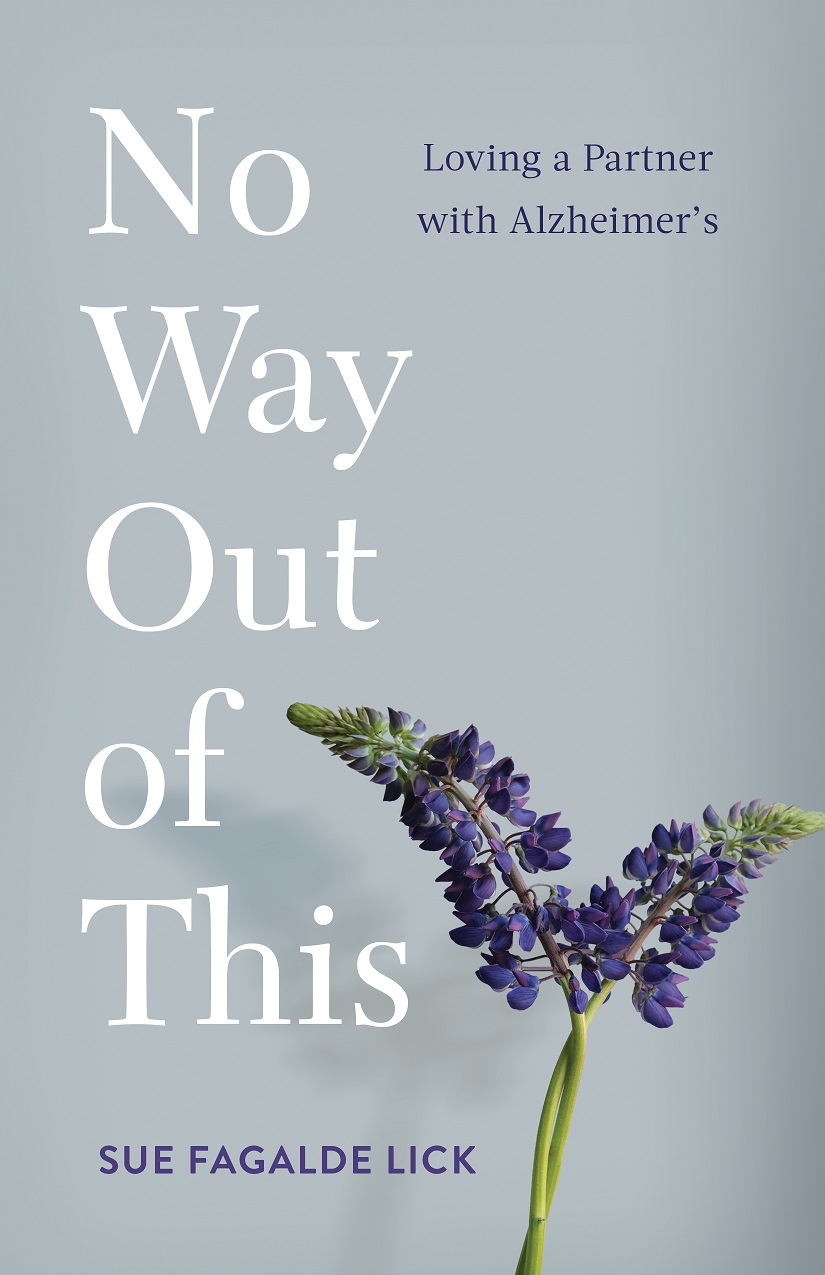
I can finally announce that No Way Out of This, my memoir about the Alzheimer’s journey with my late husband Fred, will be published in June 2024 by She Writes Press. It recounts the gnarly parts of Alzheimer’s, including caregiving, nursing homes and the day-by-day losses, but the reader will also enjoy a good dose of music and the canine antics of Annie and her brother Chico. In the end, it’s a love story.

This book has been in the works for years, starting as journal writings when Fred was sick and undergoing many revisions to reach its current state. Am I comfortable exposing this much of our private lives in print? No, but the story begs to be told, especially when everyone I meet has either lost someone to dementia or loves someone who is going through it now.

In the coming months, I will be working with the publicist to draw attention to the book. I will also be reading proofs and seeking “blurbs,” those mini reviews that go on the back cover. Writing is the easy part.

Give a Listen

I enjoyed being a guest on the June 2 edition of The Free Bin, the Toledo, Oregon library’s podcast. You can hear the interview here. 

This Wednesday, June 21 at noon PDT, the “Nomo Crones,” aka Childless Elderwomen, will meet again online for a panel discussion. Our topic this time:  “Radical Old Women.” Attendance is free. Click https://us02web.zoom.us/webinar/register/WN_YWd0_sZNQY-6rF_fCayMXQ#/registration to register.

On Monday, June 26, I will be one of the featured poets reading at the Salem Poetry Project’s new Poetry on the Lawn series, 7 p.m. at Our Savior’s Lutheran Church, 1770 Baxter Rd. SE, Salem, OR. Road trip!

In the Blogs

https://www.unleashedinoregon.com–“Looking Back for a Novel Set in 2020,” “Old Sheet Music Brings Back Memories”

https://www.childlessbymarriage.com– “When Couples Put Off Having Babies Until It’s Too Late,” “When People Having Babies on TV Make You Cry,” and “Is the ‘Happiest Place on Earth’ Only for People with Children?”

Read and Enjoyed

I spent last month reading books about the COVID-19 pandemic as research for a writing project. I was surprised at how much I had forgotten and how much I never knew. These are my favorites.

Cabin Fever: the Harrowing Journey of a Cruise Ship at the Dawn of a Pandemic by Michael Smith and Jonathan Franklin.

The Emergency: A Year of Healing and Heartbreak in a Chicago ER by Thomas Fisher

And Then We Came Outside and Saw the Stars, an anthology of international writings from March-May 2020, edited by Ilan Stavans.

Watched and Enjoyed
Space Oddity, Amazon Prime, YouTube, AppleTV—I tuned in to this movie because I’m crushing on Kevin Bacon lately, but this story of a young man who is determined to go to Mars is a feel-good flick. Bacon plays his dad.

The Umbrella Academy, Netflix–I don’t usually enjoy science fiction or “action” shows, but this series is so good I can’t stop watching. It’s just weird and wild enough. A crazy rich man adopts seven children, each with a different special power. As adults, they travel through time trying to prevent the end of the world. 

Moonlighting, YouTube—Let’s go back to the ‘80s, when Cybil Shepherd and Bruce Willis were young and beautiful and nobody was getting texts on their cell phones, because they didn’t exist. It’s funny, romantic, and full of surprises. A song-and-dance number? Why not? The client turns out to be the killer? You never know.

That’s the news. Annie says hi. She is now 15 years and 4 months old. Moving slowly, but you would too if you were 105+ in dog years. 

Happy June!

Sue and Annie Lick

Processing…
Success! You're on the list.

Looking Back for a Novel Set in 2020

Small church with photos of parishioners taped to the pews when they couldn't come to Mass due to COVID. Altar boy near the doorway in white cassock.
At St. Anthony’s in Waldport, Oregon, the choir sang in 2020 to pictures in the pews when people had to stay home due to COVID. Masses were shared online. Standing is Red, our altar server.

Remember 2020? Sure, COVID. But there was more.

I have been rereading my journals from that year. I think we have forgotten what an insane time it was. Trump was being impeached. I was glued to the radio. The presidential campaign was in full swing, Bernie vs. Joe vs. Elizabeth against Trump and a bunch of other guys who dropped out before the primary came to Oregon. Police killings of young black men caused riots in the streets. People chanted Black Lives Matter. Anger and tear gas filled the air. Fires ripped through the West and destroyed hundreds of homes. The air was filled with smoke for weeks.

I was grieving the loss of my father and my childhood home, which was demolished by the new owners. The husbands of two of my closest friends died.

It wasn’t all bad. I also got my ears pierced and bought my first hearing aids. I had two poetry chapbooks published and was working hard on another book about childlessness, Love or Children: When You Can’t Have both.

The second week of March 2020, COVID roared and the world shut down. No travel, no getting together, sports, no concerts, no going to restaurants, bowling alleys, movies, or stores. You could go to the supermarket, but good luck finding what you need. Wear a mask, sanitize your hands, and pray you don’t catch anything.

Things weren’t so bad here on the Oregon coast at first. Cases in the single digits, no deaths, despite what was going on elsewhere. It didn’t really hit us until late May when tourists jammed the coast. Pandemic, what pandemic? In June, over a hundred workers at Pacific Seafood got COVID, and it spread like wildfire. Because many of the workers and their families also worked in local restaurants or hotels, they had to shut down, too. People started dying here.

It hit a nursing home in Newport, where 16 patients and 12 staff tested positive and more were expected to get it. Six died.

Even as the numbers, top of the news every morning, continued to rise, President Trump insisted it was not that bad and everything would reopen in a couple weeks. Dr. Anthony Fauci, the nation’s infectious disease guru, on TV seemingly every day, said it could be a couple years.

After all, this was a new virus for which there was no vaccine and no cure.

We learned to use a program called Zoom on our computers to talk to each other. Soon we were having meetings, workshops, readings and more on Zoom. We visited our doctors via “tele-med” if we could get an appointment. Kids went to school on their computers while their parents went to work on theirs—if they could. Churches offered services online, musicians performed on Facebook Live, and families talked by Zoom, Facetime, or Skype because they could not meet in person.

The death toll climbed. 100,000, 200,000, a million around the world, over half a million in the U.S. by 2021, a million by May 2022, 1.1 million last month. We lined up to get our shots in 2021, but COVID didn’t go away.

My dog Annie got dreadfully sick on Christmas Day 2020. She was in the hospital for two weeks, and I couldn’t see her or even go into the building. I sat in the parking lot for hours while rain and wind pounded my car. All around me, other people were doing the same thing. Thank God Annie survived, but it would be another year before I could go into the vet’s office with her.

It’s all over now, right? We’re going to work, eating out, having holidays together again, and even hugging each other. We’ve had our shots, and most of us have set our masks aside. But people are still getting COVID. I got it last Thanksgiving. Thanks to the vaccine, it wasn’t bad, but it wasn’t fun either. I was lucky. Many people are still suffering from the after-effects. The disease will remain with us, new variants appearing regularly. As with the flu, we will need to keep getting our shots.

Why read all these journals, you ask? Especially when my handwriting has gotten so bad even I can’t read it. I’m doing research for the third novel in the Beaver Creek series (Up Beaver Creek, Seal Rock Sound). I had already forgotten many details from that time: the footprint decals at the post office to mark where we should stand for “social distancing,” the jeweled face shield the receptionist was wearing at Les Schwab when I went to get my tire fixed, and how the church hall stayed dark and empty for over a year.

Some things we can’t forget. The Plexiglas barriers are still up at the pharmacy and the grocery store. We are still videotaping and Zooming Masses every weekend at St. Anthony’s because people are still watching from home–and not just in Waldport. Virtual gatherings, talks, and webinars have become a way of life.

Writer friends have told me nobody wants to read about the pandemic, but we can’t ignore such a big chunk of our lives. Besides, there’s a lot of drama to be harvested there. How will my characters deal with the pandemic? Will any of them die? Will they go stir-crazy and turn on each other and end up in a heap of dead bodies like the cast of Hamlet? Probably not. I have some other ideas that I think you’ll enjoy reading. Stay tuned.

Processing…
Success! You're on the list.

Old Sheet Music Brings Back Memories

Once upon a time there was little girl who was enchanted by the piano. She ran out and danced around when she heard her mother playing. She wanted to do that, too.

Her grandpa would sit down without a lick of sheet music and thump out old songs with an oom-pah beat. She wanted to do that, too.

Her mother stopped playing, she never knew why, but she passed on her old how-to-play books and showed her Middle C. A piano player was born.

Sixty-four years later, I am sorting boxes and crates full of sheet music, mine and my mother’s. I have the books and sheets I bought at Campi’s music store in the old Valley Fair shopping Center in Santa Clara, California back when you could get a single song for 99 cents. The best thing in the world was to buy a stack of new songs or a book full of the hits of the day and hurry home to sing and play them, each page turn a new wonder.

I’ve got titles like “World’s Great Hits of the Seventies” and “All-Time Hit-Paraders, music from Simon and Garfunkel, the Beatles, the Doors, Barry Manilow, “The Best of Broadway,” “Willie Nelson’s Greatest Hits” and stacks of country, folk, and church music.

I inherited my mother’s music, which had been stored in a closet for years. As a teenager, she used to go to the music store once a week to pick up the featured song. Her collection, mostly from the 1940s, includes songs by folks like Tony Bennett, Perry Como, and Judy Garland. There’s a heavy classical book, a volume of Shirmer exercises, and the beat-up beginner’s book from which I taught myself with one-finger ditties that gradually built up to full songs.

I have always said my family was not musical, but all this music proves that’s not true. I know my father played the saxophone in a traveling youth orchestra as a kid. He also played a little harmonica. From Dad, I inherited an orange-covered cowboy book with songs from the likes of Gene Autry and Roy Rogers, and a thick falling-apart book that truly has all the songs someone would have wanted to sing around 1940.

I own a ridiculous quantity of sheet music. I have stacks of music for guitar, mandolin, ukulele, recorder, harmonica and flute, but the piano is the magnet that draws me when I’m supposed to be working or sleeping or when I have a few minutes before the kettle boils. Sorting the music takes forever because I want to play each song. It’s like those old days with the slim paper bags from Valley Fair with magic inside.

Today, sheet music stores are rare; everyone downloads their music. It’s not half as fun as opening a box and finding musty sheet music with big pictures on the front and copyright dates in Roman numerals. Many of my music books and sheets are signed. Mom’s say Elaine Avina and list the date, mostly in the 1940s.

I don’t know why she stopped playing for us. Was she too self-conscious? Too busy? When we were at school, did she sneak in a few tunes between baking cookies, washing clothes and watching her soap operas?

My father told tales of his family gathering around a piano at his uncle’s house, everyone pulling out an instrument to play for hours. People played music for fun in those days before World War II. Now we’re too busy staring at screens.

Why keep all this old sheet music? Because songs have no expiration date. Styles change, but a good song is a good song, whether it was made famous by Rosemary Clooney, Janis Joplin, or Beyoncé.

My throat was raw yesterday from singing “Shambala” over and over, looking for a good key that is neither too high nor too low. I settled on Bb. Never heard of “Shambala?” Have a listen to Three Dog Night singing it on YouTube. Wow, look at those outfits, that hair, the primitive sound equipment. But it’s still a catchy tune. Makes you want to sing along, doesn’t it?

What is Shambala? It’s a mythical paradise where everything is beautiful.

It’s not just music; it’s memories.

Happy Mother’s Day, and happy 74th wedding anniversary, Mom. I’m still playing.

Processing…
Success! You're on the list.