Remembering Singer-Songwriter Sue

I came face to face with my younger self when a cleaning frenzy unearthed this photo from a poster advertising a performance from years ago. The photo, fading and streaked, was mounted on black cardboard that had been chewed by what appears to be a rat. But you can still read most of the white lettering: Friday, Oct. 15 (1982?) Sue Barnard, folk singer-guitarist. (Barnard, pronounced bar-NARD, was my first husband’s surname).

I remember that gig. San Francisco Press Club. I was so nervous I had diarrhea and a sore throat. I mean, the last singer they had was from Broadway. There I was in my homemade clothes singing “Today while the blossoms . . .” and strumming a nylon-stringed guitar. The performance itself is a blur. I do remember how relieved I felt when it was over.

I was about 30 years old, working as a reporter at the Pacifica Tribune. I stare at the photo. I was pretty. No glasses, minimal makeup, longish hair parted on the side. Hands forming a C chord. I did not own a steel string guitar, couldn’t afford it. Sometimes I borrowed a friend’s guitar. I recorded my songs on a shoebox-sized cassette recorder.

I was so earnest back then, my songs so . . . well, I wrote about love, birds, rainbows, my dog. I had suffered through mild poverty and a divorce, but I didn’t know anything yet. So much more was to come. So much.

I miss that young woman. Not just the way I looked but the innocence, the lack of that constant underlying sadness I feel these days.

There was stuff. My stomach issues began in that era. The newspaper deadlines were so intense I often felt like weeping as I counted out headlines by hand and typed as fast as I could on that manual Royal typewriter. I had no money. My car never worked. In foggy Pacifica, we didn’t see the sun for months at a time. I was dating a guy who repeatedly broke my heart.

But I miss that singer-songwriter with the other name (I don’t miss that name) with her crocheted vest sitting on a rock overlooking the beach while her reporter friend Sandy Noack took her picture. I probably processed the film and developed the photo in the Tribune darkroom. I can still smell the chemicals. Using the quick and dirty method we employed for pictures that needed to last only until the paper came out, I didn’t think about “archival processing.” So the photo is fading.

I loved that job at the Tribune. I loved Jim, the hard-drinking photo guy, Tom the jaded police reporter, Mr. Drake the publisher with his bow tie and tweed blazer, Peggy the feature writer, Shirley the office manager who gave me advances on my paycheck, Cynthia the office cat. . . The building reeked of cigarette and cigar smoke and rotting paper. I’ll bet there were rats there, too. Cynthia spent most of her time curled on my lap as I wrote my stories.

I wrote a lot of songs back then. At least once, a song grabbed me during my lunch break and I was late getting back to work. I brought my guitar and played my new song for Paula, the editor. “This is why I was late,” I said. She probably just shook her head, muttering, “Barnard . . .”

I quit that job to sing with the Billy Vogue Country Singers, a Grand Ole Opry knockoff, Ryman set and all, that promised money and fame. We were supposed to spend a year touring the United States, but we went bust before we got out of California. Back to the newspaper biz. Do I regret leaving a job I loved to go sing? No. I had to try it. For as long as it lasted, the show was magical. We were good. I wish I had a video or audio recording, but it was 1983. I have a program, sheet music, and memories.

If I hadn’t gone off to sing and wound up unemployed and living at my parents’ house, I wouldn’t have met my late husband Fred, so it was clearly meant to be.

Fast forward 38 years. I don’t have that last name anymore, but I do have that guitar—and a lot more instruments. The old Fender guitar sounds better with age, and I play better, too.

Ah, time. Where did it go?

More to the point, is the rat that nibbled the poster the same rat I murdered last Christmas or is there another rat living in my house?

Thanks for sharing this trip down memory lane.  
The Most Important Meal of the Day

My mother was a saint. Not only did she rise in the wee hours to make breakfast for my father before he went off to work as an electrician, but she had to deal with my brother and me, rousting us out of bed, getting us into the one bathroom between dad’s trips, making our lunches, getting us dressed and out the door in time for school. Dad would eat, she’d kiss him goodbye—I remember the smack of their lips coming together—and then she’d turn around and feed us, loading the washing machine while we ate. All before she had her morning coffee—which she didn’t like anyway.

Mom couldn’t just pass out Pop Tarts or boxes of dry cereal for breakfast. Dad, who grew up on a ranch, needed bacon or sausage, eggs and waffles, pancakes or hash browns—a real breakfast—or what I now think of as a cholesterol fest. I still remember the taste of fried linguiça and eggs and how it sat heavy in my stomach.

With meals like these, we were not skinny people, but my parents, God bless them, always told me I was “just right.”

I started counting calories as a high school senior when I overheard the popular girls talking about how much they weighed. I weighed 30 pounds more than that! Was I fat? I looked down at my thighs. I was! Poor mom. I’d bring my calorie book to the table and tally the numbers. I can’t eat that! Too fattening. Nope. That’s xxx calories.

At first I cut back to just toast in the morning, but then I started eating Campbell’s soup for breakfast–only the flavors with under 100 calories per serving: chicken noodle, tomato, cream of mushroom cooked with water. I lost that 30 pounds between high school graduation and the middle of my first year of college. No “freshman 15” for me. I was still living at home, eating only soup, orange juice bars, yogurt, meat and vegetables.

Too good for her own good, my mother prepared my weird meals at weird times to accommodate my classes and part-time retail jobs at the mall while also cooking big meat-and-potatoes meals for Dad and my brother. If I were my mom, I’d have told me to cook my own damned diet dinners.

Although I abandoned the usual starch-and-cholesterol breakfast, I have always eaten something in the morning. With tea. Nobody else in the family drank tea. We didn’t have a kettle. I hovered over a Revere Ware pot, watching the water heat from tiny pinpricks to big floppy bubbles while Mom worked around me, trying to prepare my brother’s breakfast, a smaller version of Dad’s.

I took my “weird” breakfasts into adulthood. For a while between marriages, my breakfast consisted of Entenmanns’ chocolate donuts. But I was exercising like a madwoman, and I couldn’t afford to go to restaurants, so I stayed thin.

Ah, where did that self-discipline go? I got hungry. I got old. I got tired. I learned to bake.

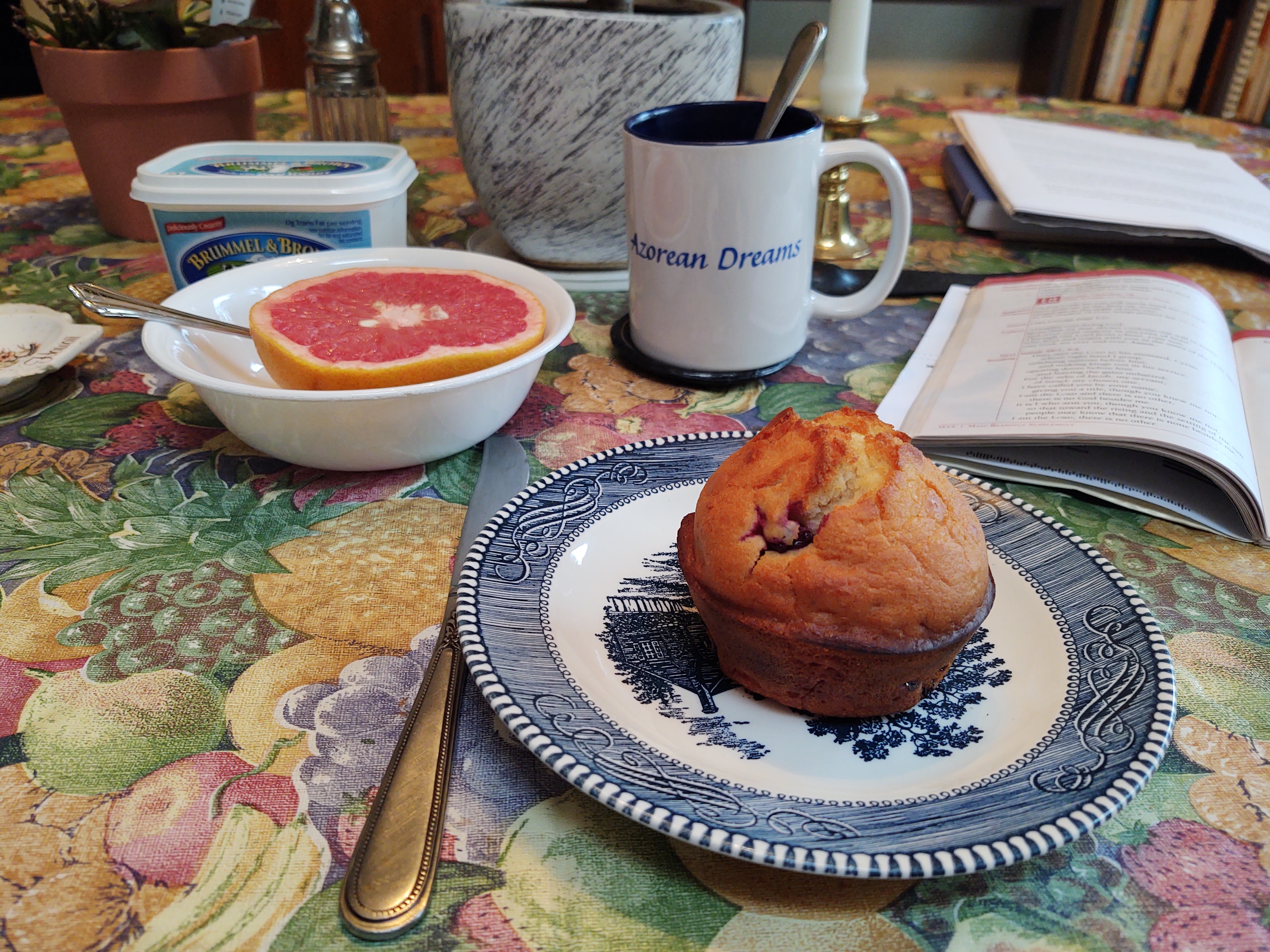
Let’s call my typical breakfast “continental.” Sounds classy. I have orange juice, herb tea, half a grapefruit, and something baked—muffin, coffeecake, banana bread, bagel–with a butter substitute made with yogurt. I get cranky when I have to eat something else. If there is no pastry to look forward to, what’s the point of getting up?

“That’s not breakfast,” my father would say. Until he died last year, I would bring my own juice, tea, fruit and bagels when I visited him in San Jose. I left a tea kettle and a grapefruit spoon in the drawer in my old bedroom.

After Mom died, Dad ate oatmeal every day. He sliced a banana into the bowl, poured oatmeal over it, and topped it with sugar and milk. He ate one slice of white toast topped with I Can’t Believe It’s Not Butter and drank one cup of coffee. He would shake his head at my weird breakfast as I dipped my serrated grapefruit spoon into the tart red fruit. Oatmeal is good for you, he’d say. I know. Everybody says that, but it tastes like cardboard.

When I’m asked out to breakfast, I tell my friends, “I don’t do breakfast. How about lunch?” Not only do I eat different foods from the usual breakfast menu, but I’m not ready for other people first thing in the morning. If Mom were still around, she’d advise you to avoid me till the caffeine and sugar kick in.

This morning around 7:30, I ate half a ruby grapefruit and a homemade blackberry muffin slathered with my yogurt spread. Delicious. My Red Zinger tea cut the sweetness nicely. How many calories? I have no idea, although I’m sure it’s less than I’d get with the Costco muffins I binged on back in San Jose before I learned just how fattening they were. By making my own, I can use healthier ingredients with no mysterious chemicals.

Dietitians would have a fit about what I eat. Someday the family diabetes curse may catch up with me. Meanwhile I’ll keep doing breakfast my way. It makes me happy.

What makes you happy for breakfast? Or do you skip breakfast? How does your breakfast now compare to what you ate as a child? Let’s chat about the first meal of the day.

Additional reading:

“I Broke Breakfast” by Amanda Mull, The Atlantic, May 14, 2019

“Most Popular North American Breakfasts,” TasteAtlas, Oct. 15, 2020

“American Breakfast,” Tasteessence

As a Writer, Who are My People?

Novelist Ayad Akhtar, interviewed in the September/October issue of Poets & Writers, was asked about being expected, as a Pakistani writer, to speak for “his people.” He replied that for him, it’s a mixed bag of all his experiences, including being Pakistani.

I think it has to be that way for all of us. We are not just any one thing. Any one box would leave a lot out.

I think of myself as representing the working class, people who come from families of construction workers, janitors, retail employees, etc., people who didn’t go to college, or if they did, it was community college or a state university. Princeton? Yale? Not in our wildest dreams. Fraternities? Too busy working. Trips to Europe? I didn’t even go to Girl Scout camp.

Our family didn’t fly to Hawaii; we went trailer camping at Seacliff or Donner Lake. We didn’t go to the opera or the ballet; we went to CB “coffee breaks” with barbecue, country music, and raffles of CB radio gear. My dad only wore a suit to weddings and funerals. He drank beer, not martinis. But he was a VIP to me.

Suddenly I remember a song, “Working Class Blues,” that I wrote when I was editor of the Saratoga News back in California and found myself hanging out with a whole different class of people, people who owned million-dollar houses when a million dollars meant something. I remember thinking none of my shoes were good enough.

The chorus: “We’re working class, just ordinary folks./We’ll never be rich, but we’re not exactly broke./We’re salt of the earth, and if nothing else is true,/look out snobs ‘cause there’s more of us than you.”

Simply put, if I lived at Downton Abbey, I’d be downstairs with the workers, not upstairs with the lords and ladies. And I’m cool with that.

I also represent people of a certain age with certain memories and experiences: The Beatles, Vietnam, wearing pantyhose and mini-skirts to high school, typewriters, phones attached to the wall, TV antennas on the roof. My first car was a blue VW bug, for which I paid $500, earned tutoring and giving guitar lessons. My parents did not give me a car for graduation; they gave me a sewing machine because girls were expected to be housewives and do lots of needlework.

Then there’s the ethnic part. I’m half Portuguese, on my mother’s side. On the other side, I’ve got some Spanish, Mexican, Basque, German, and a smidge of Scottish. A recent article in the Portuguese-American Journal cited a New York Times article that referred to Portuguese Americans as non-white. Really? That’s a surprise to me. I always thought we were Caucasian.

When writing my book Stories Never Told: Portuguese Women in California, many of my interviewees told of being harassed for being black or brown when they knew they were as white as any of their harassers. Were they wrong? Does it matter? If you add my Portuguese and Latin influences, can I accurately call myself a “person of color?” That’s fine, but what about the rest of me? Am I “mixed-ish” like on the TV show? Does it matter? If you go back far enough in history, we’re all a mixture.

Setting DNA aside, I’m a typical California blend of the various nationalities that settled there. I have black hair, brown eyes, and olive skin. So what? That’s just genetics. Sure, we tossed around some Portuguese and Spanish words at my house, but I never attended a Portuguese event until I decided to write my book about Portuguese women. Three generations in, my experiences were vastly different from those of recent immigrants.

So who are my people? Working class, part Hispanic, baby boomer women who never had children or grandchildren; widows; people who live alone; left-handed, ice tea-drinking, Honda-driving, guitar-playing, dog-loving, poem-writing, left-leaning, Netflix-watching Oregonians who came from California.

What one person can speak for all that? We are all mixed bags of histories, ethnicities, experiences, and feelings. I’m going to just write, and if it speaks for “my people,” whoever they are, I’m glad. I suppose if I get famous enough, the critics will decide who “my people” are. And they’ll probably get it wrong.

What do you think? Who are “your people?” Do you worry about representing them in whatever you do?