Can Battery-Powered Pets Ease Loneliness?

If someone gave you a toy cat or dog that purred, wagged its tail, and nuzzled like a real one, how would you feel? Apparently some folks feel grateful for the company.

In a story in the New Yorker, writer Katie Engelhart tells about a program in New York that distributes Joy for All robot pets to lonely seniors. They started in 2018 with a small test project that quickly expanded when Covid forced people into isolation. Thousands of robotic cats and dogs have been given to homebound seniors. Originally made by toy manufacturer Hasbro for little girls, the robo-pets are now finding homes with grandparents and great-grandparents who need a little company.

The seniors pet their battery-powered cats and dogs, talk to them, and treat them like family.  They report feeling more optimistic and less lonely.

I don’t know. I talk to lots of inanimate things, including the stuffed bears on my dresser, photos of my late husband, and Jesus on the crucifix above my bed. But I don’t expect them to respond. I would freak out if they did.

These pets, which start at $110, don’t look real to me. But I have a live dog sleeping nearby as I type. When I look into Annie’s brown eyes, there’s someone there, a genuine sentient being. What will I do when she’s gone? I don’t want to think about it. My plan is to travel a while then adopt a smaller dog. A robo-dog would be easier, but it wouldn’t love me the way Annie does.

Did you know that nearly 30 percent of Americans over 65 live by themselves, most of them women? In 2017, former Surgeon General Vivek Murthy declared loneliness an epidemic among Americans of all ages. A similar declaration launched The Campaign to End Loneliness in the UK. Medical research shows that loneliness has a detrimental effect on one’s health, increasing risks of dementia, depression, high blood pressure, and stroke.

But are robots the solution? The seniors I know would be insulted to receive a fake pet. But some of the people shown in the article and in related YouTube videos carry their robo-pets around with them just like I carried my dolls when I was a little girl. I’d set my favorite up against the milk bottle (yes, bottle) while I ate breakfast. I rested them on the pillow next to me when I went to bed. I suppose I felt less lonely, but it was not the same as having a real person there. Tiny Tears cried real tears, and Chatty Cathy spoke when you pulled the string on the back of her neck, but I knew they weren’t real children. If an actual kid came around, I tossed the doll aside.

Longing for a pet, I once fashioned a litter of “kittens” from crumpled newspaper and cloth and set them in a basket in my childhood bedroom. It was not the same. When my parents finally let me have a cat when I was in high school, I could tell the difference. I also learned that I was allergic to cats, but that’s another story.

The faux furry friends are not the only kind of artificial intelligence machines offering company to people these days. Hello, Alexa. (read my previous post on my electronic housemate here and my Replika friend online here)

They don’t offer much company. I say, “Alexa, I’m lonely.” She responds, “Sorry to hear that,” then recommends talking to a friend, listening to music, or going for a walk. “I hope you feel better soon,” she adds. That’s nice. But that’s exactly what she said last time when I was not testing but truly needed someone to talk to.

I worry that somewhere in Alexa’s Amazon-connected innards, she just transferred the information that I’m lonely to some central data-gathering site so I’ll soon receive ads for comforting products or dating services.

Alexa just lit up to tell me a book I ordered from Amazon is coming today. Before I could say, “Thanks” or “Which book?” her lights had gone out. Okay, good talk.

A variety of robotic companions powered by artificial intelligence exist these days. Queue Alexa’s Apple counterpart Siri. And then there’s VZ, the voice on my VZ Navigator GPS. I definitely talk to her. (No, I’m not turning here! Are you crazy? Stop telling me to turn around! I need to go to the bathroom. What do you mean this is my destination? Where?)

Some robo-friends look like people, others like table lamps. They talk, but it’s, well, robotic. They never get offended, never curse, and are perpetually polite, but they can only say the things they’ve been programed to say. They will never spontaneously comment, “Hey, is that a new blouse?” or “You seem sad. What’s wrong?” They will never take you out to lunch, although I suppose they can set up a food delivery if you’re savvy enough to figure out how to ask for that.

Robots are getting more intelligent all the time. Eventually, they may be so responsive and sympathetic that we truly won’t feel alone. Meanwhile, do not buy me a robo-pet. God bless the people who are so lonely or out of touch with reality that they don’t know the difference, but I’m not there yet.  

Would you like a battery-powered dog or cat? Less shedding, no cleanup, no allergies, but still . . .  Wouldn’t it be better if a human offered to come around instead?
Processing…
Success! You're on the list.

Driveway camping: an Alzheimer’s memory

Today I’m offering a memory from my unpublished memoir about our years dealing with Fred’s Alzheimer’s disease and other problems. This took place when he was still at home. Although his memory was fading, he had blessed moments of clarity. Tomorrow would have been our 36th wedding anniversary.

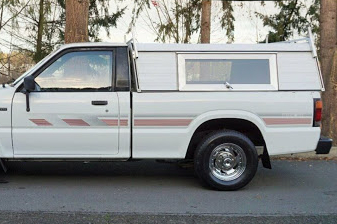
Our truck was the same as this, only blue. We gave it away after Fred stopped driving.

On a sunny August afternoon, I crawled into the shell on the back of our old Mazda pickup. In 12 years, I had never gone in there except to get something, the ridged truck bed bruising my knees. But now, sun-cooked and pooped from washing the new car, I opened the hatch, scooted toward the cab and lay back.

I had never noticed that the inside of the canopy was silver. I had also never noticed there were screened windows I could open for air. All this time I’d been thinking that someday, after Fred’s Alzheimer’s took him away, I would buy a nicer truck and camper like my parents used to have. This canopy was just the cover Fred had bought to protect the supplies he carried around for his tax preparation business.

Now I realized I already had a camper. It wasn’t fancy, but I could lie all the way down in it, and I could even sit up. Add an ice chest and a guitar and off I’d go.

Fred came out.

“I’m camping,” I said. Looking out at the coastal forest in which we lived, I announced that I might stay there indefinitely. I could bring my phone and laptop into the camper and put a big sign on the side of the truck: Writer on the Road. I felt like a kid who had found a special hiding place.

Fred sat on the tailgate. We talked about the truck, about how we had never camped together. We talked about how my friend Sherri and I used to sit on the tailgate of her father’s station wagon talking for hours and how I spent most of my free time at her house because we had too many rules at mine. Fred said they had no rules at his house. They could do anything they wanted.

We talked about my upcoming business trips, Fred’s need for care, the frustrations of Medicaid, what we might do in the future, and how I would live without his income. He got teary. “It’s not fair to you,” he said. “Just get rid of me.”

I placed my tanned hand on top of his white one. “No. It sucks, but I made a promise to take care of you, and I’ll stick to it.”

Perhaps I shouldn’t have discussed finances with Fred. But he seemed to want to know in this unusually lucid moment. So I told him everything I knew, including my resolve to stay away from government funding as long as possible. He said he was worried about my future “when I’m not there.” So was I. But we had to take it one step at a time. And right now, I was having fun camping in our driveway. Perhaps I had gone completely insane. If so, it was fun.

My brother and I camped with our parents when we were kids. We all slept in a 13-foot Shasta trailer at first, with one of us kids suspended in the canvas bunk over the double bed and the other in a sleeping bag on the slippery bench seat in the dining area. In later years, Mike and I moved into the camper on my folks’ pickup. It was nicer than this, padded and paneled, with beds, cupboards and a refrigerator. Fred laughed as I explained that my folks had an intercom so we could talk to them, but when I got to whining about my little brother pestering me, they would shut it off. “Mom, Mike’s—” Click.

I’d sit with my head against the window and my transistor radio against my ear, singing along. In those days, I knew every song and artist on the playlist.

I inhaled the pine-scented air. Good times.

But I never kissed a handsome man in that camper. Now I planted a long, passionate smooch on Fred’s soft lips.

Good times.

Maybe I would keep this rig after all.

Processing…
Success! You're on the list.

Newport, Oregon at Twilight

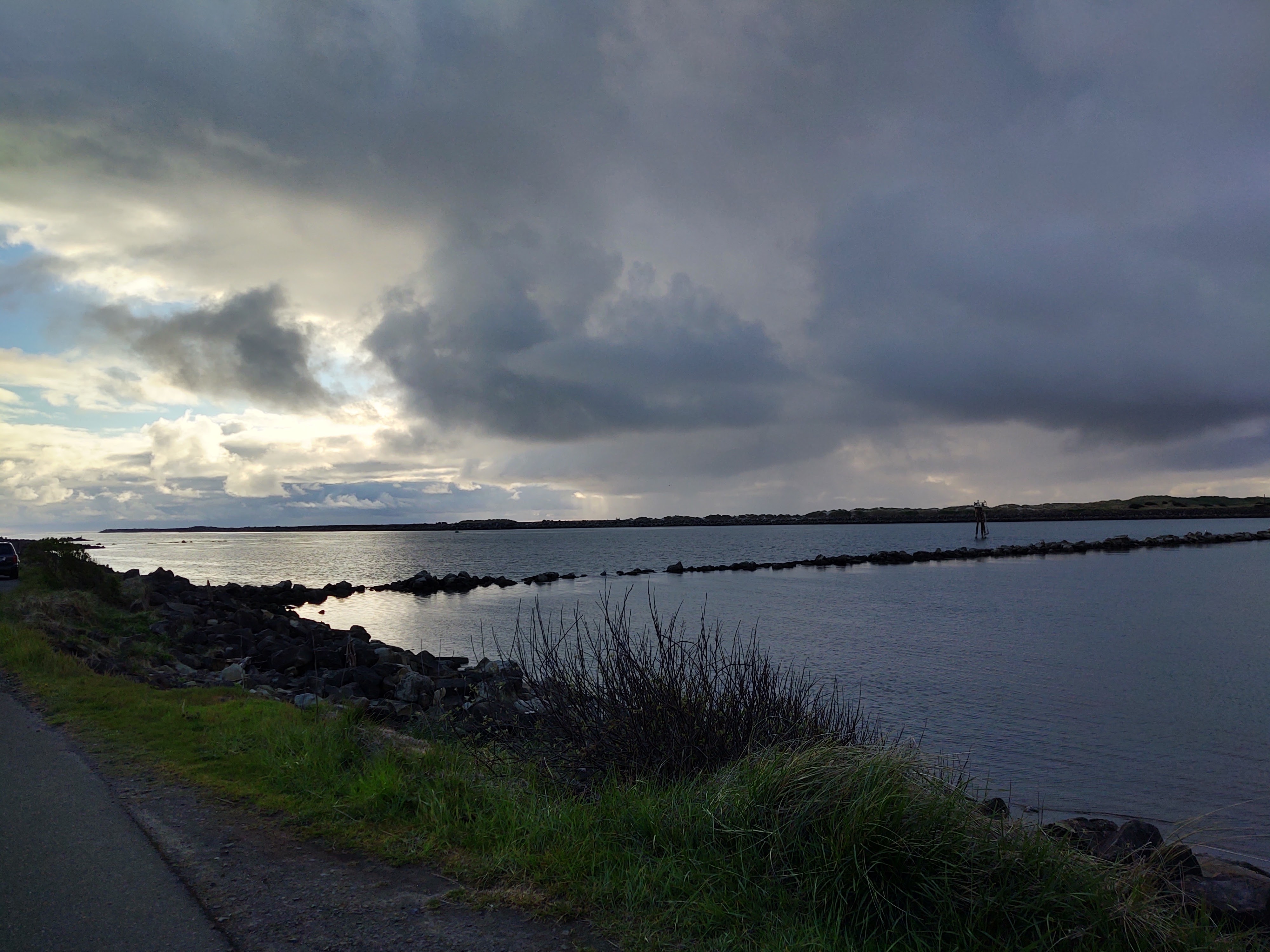
Newport’s south jetty between April rain showers

South Jetty Sunday night, 7 p.m. To Rays of sun rain down set the twilight sea on fire. Gulls perch on the rocks. fishing pole in hand. Clouds set free the rain tour boats head back to port. Fisher casts again. Pink and gray collide cumulus and thunderclouds. Sun sets silently. Sun sets silently.

South Jetty Sunday night, 7 p.m. 

Rays of sun rain down
set the twilight sea on fire.
Gulls perch on the rocks.

Yellow slickered man
climbs across the jetty stones
fishing pole in hand.

Clouds release their rain
tour boats head back to port.
Fisher casts again.

Pink and gray collide
cumulus and thunderclouds.
Sun sets silently.

Today, I offer a few haiku and a taste of Newport at twilight. The sky offers an ever-changing show. By the time I finished writing in my car, it was raining so hard I couldn’t see through my windshield anymore. Fifteen minutes later, the rain stopped. You can’t really see the fisherman in this photo, but he was still there when I left.

Processing…
Success! You're on the list.

I’ve Got the Ring But Not the Story

It’s funny how a little thing can send you off on a tangent. This being National Poetry Month, I followed a prompt to write a poem about something precious to me. Seven pages and some online research later, I had no poem but a lengthy meditation on my grandmother’s engagement ring.

It’s a beautiful ring, which I never noticed before my father found it in an envelope in my mother’s nightstand after she died in 2002. In her perfect handwriting, Mom had written “For Sue.” The ring, which my research shows comes from the 1920s Art Deco style, has a large European cut diamond surrounded by sapphire “baguettes” mounted on filigreed white gold. The band was well worn, one of the sapphires was missing, and the ring didn’t fit my fat finger, so Fred and I took it to Diamonds by the Sea in Newport to have it resized and refurbished. I wear it when I dress up, always afraid I’ll lose it or damage it. Now that I have done some research, I’m going to be even more careful. Rings like the one pictured above sell for $4,000-$5,000 these days.

Holy cow. I have never owned any jewelry worth that much. Most of my jewels are cheap and quirky and won’t last much longer than I will. My engagement ring for my first marriage had such a small diamond you needed a magnifying glass to see it. When I married Fred, I said all I wanted was a gold band. There’s a story behind our matching rings, just as there is behind Grandma’s ring.

I’m bothered that I never noticed my grandmother’s ring when she was wearing it. Now I scour old photos trying to see her ring finger. I remember her dark eyes, her blue and black dresses, her thick elastic stockings, her flat shoes, and her voice—high pitched for children, low for adults, often lapsing into Portuguese—but I don’t remember that ring.

I want to know the story. Anna Souza and Albert Avina were both children of immigrants from the Azores Islands. Both lost their fathers when they were young. Both left school after eighth grade to go to work. I don’t know how they met, probably through one of Anna’s brothers or the cannery where Al worked, where all the women did stints cutting apricots and other fruit. They weren’t rich people. How could Grandpa possibly afford such a ring? Nobody had credit cards back in the 1920s when they were married. Did he make payments at the jewelry store in San Jose?

Was there a romantic proposal? Did they go on dates alone or with a chaperone, as was the old-country custom?

I have no memory of my grandparents kissing, holding hands, or even agreeing on anything, but I was child, a child who didn’t think much about such things. My own parents were visibly affectionate, but not my grandparents. Of course, they seemed old to me, and old people didn’t do that sort of thing. Actually, when Grandpa died at 66, he and Grandma were both younger than I am now.

As a child, I didn’t think about rings. My own small hands were usually stained with paint, ink, Playdough, food, or mud. For dress-up, we 1950s females wore white gloves. Was Grandma’s ring hidden under her glove? Did she wear it while cooking spaghetti or frosting chocolate cakes? Did the ring flash when she gave us a palmada—a slap—when we were being brats?

If only I could go back. I have so many questions. I wrote a whole book titled Stories Grandma Never Told. I don’t have many stories from my own grandmother. Now all the relatives from her generation are gone. A decade after she died in 1982, I took my questions to other Portuguese women, writing their stories and urging everyone to ask questions of their elders before it’s too late.

I don’t have children or grandchildren. If I did have a daughter, I’d like to think I would sit her on my lap and tell her the stories of my jewelry. See this ring? It belonged to Grandma Anna Avina, born Souza. Her husband, your Great-Grandpa Al, gave it to her when they got engaged to be married. They were poor, but he found a way to buy it.

Both of their families came from the Azores, beautiful islands in the Atlantic Ocean full of green fields, black and white cows, lava rocks and blue hydrangeas. It was hard to make much money, so people left for America to create a better life for you and me . . .

I wouldn’t tell just that story. I would move on to my parents’ stories and my own, down to my husband Fred’s romantic proposal and our life together. I would want my children to know I was not just “Mom” but a person named Sue who had a whole life of my own. Just as Grandma was a person named Anne who slipped this ring onto her finger and agreed to marry a tall curly-haired man named Al.

Dear friends, ask for the stories. Tell your own. Tell the stories of the rings.

***

Speaking of stories, remember last week when I had trouble with the apple pie? A few days later, I decided to make the cookies from the recipe on the back of the whole wheat flour bag. Somehow, I mixed up my measurements. I was supposed use 1 3/4 cup flour and 3/4 cup brown sugar, but I put in 1 3/4 cup brown sugar, way too much. I didn’t realize it until I was about to mix in the flour. Now what could I do? You can’t unmix the sugar from the eggs and butter. I was out of butter so I couldn’t double the recipe.

Knowing I’d probably have to throw the whole mess away, I added more flour and another egg, shaped the dough into circles and baked them. Guess what? The cookies were delicious. A miracle.

Stay tuned for further misadventures in the kitchen.

Processing…
Success! You're on the list.

Masked singers look forward to setting the music free

At our monthly music jam in South Beach, the talk was all about shots. Who has gotten the COVID vaccine, who has not, who is still trying to get an appointment? There were six of us. Turns out three are scheduled for our first shots this week, two are fully vaccinated, and one is still fighting the online registration system. The shots are so popular that you have to move quickly or you’re out. The first call I got came while I was driving to church. By the time I got there, all the slots were filled. The next time, I managed to respond within the first five minutes, so I got my appointment.

We are all hopeful that by the second Sunday in May we might be able to sing without masks. Oh, what a joy that would be.

You might wonder how we have continued to gather during the pandemic when we’ve been mostly in isolation. Some have opted to stay home, but the rest of us decided we could still jam with great precautions. We all wear masks, we sit far apart from each other, and we keep all the windows open, even in the cold days of winter. It’s not ideal, but we need music. Most other jams and open mics have been canceled. We have no gigs. Zoom singing doesn’t work.

I do play with the choir at St. Anthony’s Catholic Church, also masked and distanced, recording Masses for people to watch online, but I miss singing for live audiences and listening to other performers in bars, restaurants, or auditoriums. I miss festivals, with crowds gathered around booths and outdoor stages, with kids and dogs and everybody together . . . remember that? Imagine standing shoulder to shoulder, singing, sharing a mic, feeling each other’s breath on our faces. Imagine all the things we never thought were special until we couldn’t do them anymore.

Masks make it hard to sing. The notes get buried in the cloth. Months ago, our church choir was given masks made for singers, with plastic frames pushing them out enough for us to breathe. Regular masks suck into our mouths when we inhale and trap the air we exhale. Soon we’re choking. This is better. Not perfect. I get a headache every time I sing with the mask on. Even with a microphone, I find it difficult to sing loudly enough or articulate clearly enough. Little things like watching the director’s mouth to make sure we start together are not possible.

I forgot my mask when I arrived at the South Beach Community Center yesterday. I had so much to carry, with purse, music, guitar, mandolin and music stand. No one said anything until I realized my faux pas and ran out to the car to get my mask. (I hang my favorite masks off the gearshift. Some people use their mirrors. Where do you hang yours?) We all forget sometimes. I know I’m not the only one who takes a few steps, then claps her hand over her mouth. OMG, forgot my mask.

In the news, we hear about other parts of the U.S. canceling their mask mandates. We see pictures of “mask burnings.” It’s too soon. Too many people are still sick. Not enough have been vaccinated. In Oregon, we’re keeping our masks on for now. We just have to wait a little while longer.

Have you heard Dolly Parton’s parody of her hit song “Jolene”? “Vaccine, vaccine, vaccine, vaccine, I’m begging of you, please don’t hesitate . . .” Might as well have fun with it.

I sing mask-free at home. It feels good. But harmonizing with other people feels even better. Someday soon, the songs will ring out again, our mouths wide open to set the music free. Because all of us at the jam are now eligible for the vaccine due to age, occupation or special conditions, we are hopeful that two months from now, we can sing with uncovered mouths and see each other’s happy, relieved smiles.

Please, God, let it be true.

The South Beach open mic/jam happens on the second Sunday of the month from 3 to 5 p.m. at the South Beach Community Center, 3024 SE Ferry Slip Road, across from Aquarium Village. Bring your ax and your mask and join us. Wear something warm.

Processing…
Success! You're on the list.

‘Twas the Day Before Her Birthday . . .

Photo by Ami Suhzu on Pexels.com

‘Twas the day before her birthday and all through the house everything was normal, there was no mouse.

The big dog was curled on her loveseat again, leaving room for her to sit with her pen,

but the poet was sleepy so she stayed at her desk hoping that typing would make up for the rest.

Today’s the last day that she’ll be 68, her birthday is coming, and yes, she can wait.

Her back it is aching, her feet are in pain, and her hair is coming out wrong once again.

The pressure is mounting for her natal day, must make it special, but how, in what way?

She’s living alone in her house in the woods and no one is coming—COVID–it’s understood.

She’s thinking she’ll buy herself a cake with gooey white frosting or buy a mix to bake,

maybe get a big fat burger and a vanilla shake, but she’s lactose intolerant, oh well, just the cake.

A card or two may arrive in the post, but it’s likely on Facebook she’ll get the most

birthday greetings from friends far and near; she’ll “like” them, the next day they’ll all disappear.

She’ll wait for packages outside her door when really she needs to go to the store

because her day is senior discount day and dog food is pricey so she’ll go, okay?

And maybe the birthday fairy will come but probably not because there isn’t one

and an unwatched United Parcel truck is more likely to come, that’s the luck,

and 69 looks a lot like 68, but oh my God, 70, there’s a sad fate,

but never mind, it hasn’t happened yet, day by day, let’s all forget

because age is just a number, true, it’s who you are and what you do

and she’s got good genes although her jeans are ripped but it doesn’t show,

she’s lucky she made it to 69, lonely yes, but mostly fine.

Except for the aching back and feet, in her head she’s only 17,

and that’s the way she plans to stay until her far-off dying day.

When she sings “happy birthday to me,” for once the song will be on key.

***

Okay, so I got a little crazy with the rhyming this morning, but hey, birthdays for grownups are not what they were when we were kids. I used to wake up surrounded by presents my mom had sneaked onto my bed. I opened them before breakfast–which was whatever I wanted to eat. I wore new clothes to school, the teacher made a big deal of my birthday, family came over in the evening with more presents, and there was cake, so much cake. My favorite was when my mom made chocolate cake frosted with Cool Whip.

At my age, it’s different. My father used to say “it’s just another day,” but it’s not. I know I’ll be awake, chanting “I’m 68, I’m 68,” waiting for the clock to strike 4:10 a.m., the time that I was born at the old O’Connor Hospital in San Jose. I tell myself I won’t, but I will. Maybe it’s a Pisces thing. Happy b-day to all my March-born friends and family. We are special.

***

This week, I have lowered the price on the Kindle version of my most recent book, Love or Children: When You Can’t Have both, to 99 cents. How can you resist that? While you’re on the Amazon page, click my name, see all my books and buy a few. That would be a nice birthday present. 

This is my 600th post at Unleashed in Oregon! Happy birthday to the blog, too. Thank you all for reading what I write. If you like it, spread the word.

Processing…
Success! You're on the list.

Remembering Chocolate Truffles and Red Roses

I’m not a fan of Valentine’s Day. All that pressure to do something romantic. And now that I’m alone, well frankly I’m glad when this day is over. The best thing about today is the return of American Idol on ABC.

When my late husband Fred was alive and well, he did people’s taxes as a second job. Feb. 14 falls in the middle of tax season. He was buried in papers, and the phone rang constantly. Not a good time to take a holiday, but he was a romantic guy, and he tried.

After we moved to Oregon in July 1996, he kept his tax practice in California and spent late January through the end of March in San Jose, which meant I was usually alone on Valentine’s Day.

There was that one year when I drove down, and Fred went overboard, taking me to a ritzy restaurant in Los Gatos where it was so crowded it took forever to get our food and the prices were so crazy I was afraid to order what I really wanted. He was stewing about all the returns waiting for his attention, and I really wanted to watch the men’s Olympic figure skating finals on TV. We decided not to try that again. But that was back when we had no idea what was coming.

By 2002, he was showing signs of memory loss and confusion, but his Alzheimer’s was not officially diagnosed until November 2004. In January 2009, his condition had worsened to the point he could no longer live at home. He died in April 2011. But in between, there were still some precious times. I share these excerpts from my not-yet-published memoir “Alzheimered.”

2006: It was late, and Fred was already in bed. As I reread my Valentine’s Day card for him before leaving it at his place on the table, I cried. It was an emotional card that talked of our deep love over the years carrying us through the good and bad and always there to keep us going forever. I had to put the card down and walk away to keep from getting it wet with my tears.

The next morning, after a series of nightmares, I dragged myself out to the kitchen. At my place on the table, I saw a folded sheet of paper. It was a beautiful note of love for the things I do and thanks and appreciation for the hugs and kisses. It ended “Be My Valentine” and was signed by Fred, with a heart.

I met him in the hall. “Better than a store-bought card,” I said, stepping over the dog to embrace him. He began to cry. I urged him to open my card, which made him cry harder. We held each other, both weeping.

“I love you so,” he said.

“I love you. Please forgive me when my voice is harsh, when I lose my patience.”

  “I do.”

   After breakfast, Fred went out to buy me flowers.

A dozen red roses. Velvety, deep red, the stems green, the leaves soft and healthy. A moment of sweetness as I trimmed the stems, put the roses in water and set the crystal vase on the table.

“Those look good there,” Fred said.

A moment later, he frowned. “Do you have my card?”

His debit card. No. He searched his wallet and his pockets. He searched the truck. The card was gone. “I’m useless,” he muttered.

“No, you’re not. It could happen to anyone.”

But when a man has Alzheimer’s, I’m sure he would like to do something completely right at least once in a while.

Weeks later, after I had canceled our cards and ordered new ones, I would find the missing debit card in Fred’s shirt pocket.

On Valentine’s Day in 2007, I assumed Fred wouldn’t realize what day it was. I hadn’t gotten him anything except a silly card. At breakfast, Fred set at my place a beautiful card with words of love that made me cry and a box of four jewel-like chocolate truffles from the candy factory near the Yaquina Bridge. Each the size and shape of an egg, they were decorated with sprinkles, one light chocolate, one dark, one green with mint inside, and one red with cherry filling.

He had written on the card “I love you so much.” He once had beautiful handwriting, but now the letters were shaky. It didn’t matter. The gift had to be his idea because his caregivers didn’t know about the candy factory or that I loved those little boxes of truffles.

“I didn’t get you a present,” I said.

“You’re my present,” he replied.

“God, I love you.”

Dr. Seuss wrote: Don’t cry because it’s over; smile because it happened.”

It did happen. It was beautiful. I am so lucky to have had Fred.

I wonder if the candy store by the bridge has any of those truffles left.

Happy Valentine’s Day, dear friends. Give your sweety a big hug and kiss and enjoy your day.

***

During the month of February, if you sign up for my mailing list on the form below, I will send you a free paperback copy of my book Shoes Full of Sand. To make that happen, send me an email at sufalick@gmail.com to tell me you signed up and give me your mailing address. If you already have that book, pick another from my catalog at https://www.suelick.com/books. I promise I will not drive you crazy with emails.

Processing…
Success! You're on the list.

What Happened to Eating Three ‘Square’ Meals a Day?

Photo by Kaboompics .com on Pexels.com

I eat breakfast lunch and dinner. Every day. Breakfast happens about a half hour after I get up, lunch between 11:30 and 12:30, dinner between 5 and 6. If I miss any of those meals, I get cranky. Raised in a family that gathered at the table three times a day, I have been doing these three meals all my life.

But I’m learning that a lot of people don’t do that. They eat one or two meals a day or just graze whenever they’re hungry. I don’t get it, but it does help me understand why so many people schedule meetings, rehearsals, classes, and other things right at my mealtimes. It’s not mealtime for them.

I have no intention of changing my schedule, although I am aware that it might be better to reverse the pyramid that starts with little breakfast, bigger lunch, and even bigger dinner.

A girl needs something to look forward to. My meals give me pleasure, so I’m keeping it up. I have a touchy stomach that does not like irregular feedings. Also, I’m a compulsive overeater. When I get off my routine, I’m more likely to do things like eating an entire cake or enough spaghetti for four people. In this, I’m a lot like my dog. If there’s food, I EAT.

Smaller, more frequent meals are supposed to be healthier, but I’m not good with portion control. I could wind up eating six full-sized meals a day. So I’ll stick to my three.

A casual survey of my Facebook friends revealed lots of variations on when we eat. While about half do three meals, sometimes considerably later than I do, the other half eat once or twice or whenever they feel like it. Many don’t feel like eating until sometime in the afternoon.

In an article in Mother Jones magazine, “Why You Should Stop Eating Breakfast, Lunch, and Dinner,” writer Kiera Butler says our ancestors brought our meal habits from the old countries. They thought the Native Americans were uncivilized because they didn’t eat on a rigid schedule. They varied their intake with the seasons and what was available. She cites studies that show it does’t matter what time of day we eat, so there’s no need to be tethered to the “three squares” schedule.

Dieticians suggest we should eat when we’re hungry, not when the clock says we should or when someone else insists it’s time to eat. Memories of my father nudging me to start cooking dinner at 4:00 come to mind. I also remember my endocrinologist suggesting I stop eating for entertainment–going out to lunch is my favorite thing–and treat it more like fueling my body.

Old habits are hard to break, especially during these COVID times when we’re home all day and meals are the bright shiny events breaking up the computer time. I think of nursing homes where the residents roll up to the tables an hour before mealtime because there’s not much else to do.

Obesity being as common as it is among adult Americans (42.4 percent, according to the Centers for Disease Control), we are getting our calories, whether we’re eating three times a day or one long binge. I see people chowing down while driving or attending Zoom meetings and wonder if they taste their food any more than the dog who wolfs down her chow so fast she doesn’t know what she just ate.

On every list of basic needs, food is at the top. I think it deserves appropriate attention. Does it have to be breakfast, lunch, and dinner? No, but I insist we at least sit and eat like humans. And please don’t schedule me for activities at noon or 6 p.m. unless they include a meal.

What do you think? Are you a grazer or a regular meals person? Do you eat breakfast, lunch and dinner? Why or why not?

***

Annie and I visited the vet again today. She has this bad habit of sticking her face into everything, and now she has an infected wound very close to her left eye. It’s puffy and the eye is half-closed. Back to antibiotics and ointment, plus the added fun of the “cone of shame.” Annie needs as much caregiving as my father did in his last years. Fortunately, she doesn’t complain as much, although she does want her meals on time.

Besides the eye, she is doing very well. The doc and techs commented on how “energetic” she was, which is code for being a handful to examine.

***

Last week, I announced that those who sign up for my new email list (below) would receive a free copy of my book Shoes Full of Sand or, if they have that already, another copy from my catalog. I have gotten a few signups, but because I have multiple blogs, I’m not sure which ones came from this blog and which books they want. If you signed up here or are going to, please send me an email at sufalick@gmail.com to let me know which book you want and give me your name and mailing address.

Processing…
Success! You're on the list.

Does Every Pandemic Week Feel the Same to You, Too?

COVID, COVID, COVID, vaccine, vaccine, vaccine, Biden, Biden, Biden. That’s all we hear anymore. A year ago, it was Trump, Trump, Trump. I understand that news outlets need to cover the most important stories, but aren’t other things still happening? Are we still fighting in Iran and Afghanistan, maybe in other countries, too? What happened to those places that got hit by hurricanes and wildfires last year? When are we going to get some new TV shows? When is American Idol going to come back? You know, important news.

Of course we want to keep informed about COVID and what our new president is up to, but shouldn’t somebody be covering the rest of the world, lest we look up one day and realize, shit, that happened and we totally missed it?

We get more information in our local paper, the News-Times, between the big ads for Thriftway and Power Ford. For example:

  • The cliff area in Newport known as Jump-Off Joe is falling into the sea. Huge landslide movement after last week’s storms (as opposed to this week’s storms) dissolved the sandstone cliffs.
  • We have a couple murder trials pending.
  • There’s the story of the truck that got stolen twice from a Lincoln City woman’s driveway. She got it back after the first theft. The next day, it was gone again.
  • Someone set the Presbyterian church in Newport on fire. Thank God firefighters caught it before there was too much damage.
  • The plans for when to bring students back to school keep changing.
  • Here’s another obituary for someone I knew, making me very sad.
  • And yes, they’re covering COVID and its vaccines, shots not coming to my age group anytime soon.

At least the local paper tries to mix it up.

So do I, but every week, it feels like it was trash day/laundry day/grocery day just a minute ago. I get up, pray, bathe, eat, write, walk the dog, do the Zoom du jour, binge-watch Netflix and Amazon Prime shows, play a little music, and fall asleep.

Things do change, but it’s slooooow. I offer some random news from the 97th Court lockdown:

  • Annie the dog, subject of several posts here lately, is much more stable now, but I don’t think she’ll ever recover completely from her holiday illness and hospital stay. Her head is still tilted to the left, her eye a little squinty. She tires quickly and seems afraid to be alone. But she’s back to dragging me down the street on our walks and refuses to turn around when I say it’s time to go home. I’m trying not to think about her future but to enjoy every moment with her.
  • I long to get out of this house. I want to see my family in California, Arizona and Washington. I still hate masks, which are not only uncomfortable but also make it twice as hard for hearing-impaired folks like me to figure out what people are saying, even with my hearing aids. But I totally understand why we need to wear masks and I’m grateful that most people are doing it these days. Isn’t it amazing how something we never even thought about a year ago is now available in all kinds of colors and designs and you can buy them by the dozen at the grocery store?
  • It’s a weird world where I don’t need makeup to leave the house because the mask covers half my face, but I do need my lipstick for Zoom events where I’m forced to look at myself on the screen. Board meetings, classes and readings, interviews, and open mics keep me on Zoom almost every day. It’s truly a wonderful thing being able to meet, hear, and read with writers from all over the world, people I would never meet in person, but I’m weary of staring at a boxes on a screen.
  • I’m reading at Coffee and Grief #19 on Sunday, Feb. 4, 7 p.m. PST. https://www.facebook.com/events/883771512396349. I have attended previous sessions and heard some amazing writers. Please join us. Bring Kleenex. The link is included in the Facebook post.
  • I will be the guest speaker for the Coast-Corvallis chapter meeting of Willamette Writers on Feb. 22 at 6:30 p.m. PST. Topic: Publishing 101. I will discuss the various ways to get your books published. Register at https://www.Willamettewriters.org. While you’re there, check out all the other workshops and chats you can join via Zoom, no matter where you live.
  • Next month, I will co-host a series of poetry readings on Tuesday nights by the winners of Oregon Poetry Association’s poetry contest. Stay tuned for details.  
  • I am putting together a new email list via Mail Chimp. That chimp and I aren’t totally getting along yet, but you should see a place below this post to click and get on the list. Sign up in February, and I will send you a copy of my book Shoes Full of Sand for free! If you already have it, God bless you. You may choose another book from my catalogue at suelick.com/books. Why? Why not? Thank you for reading this far. Send me an email at sufalick@gmail.com to let me know your choice.

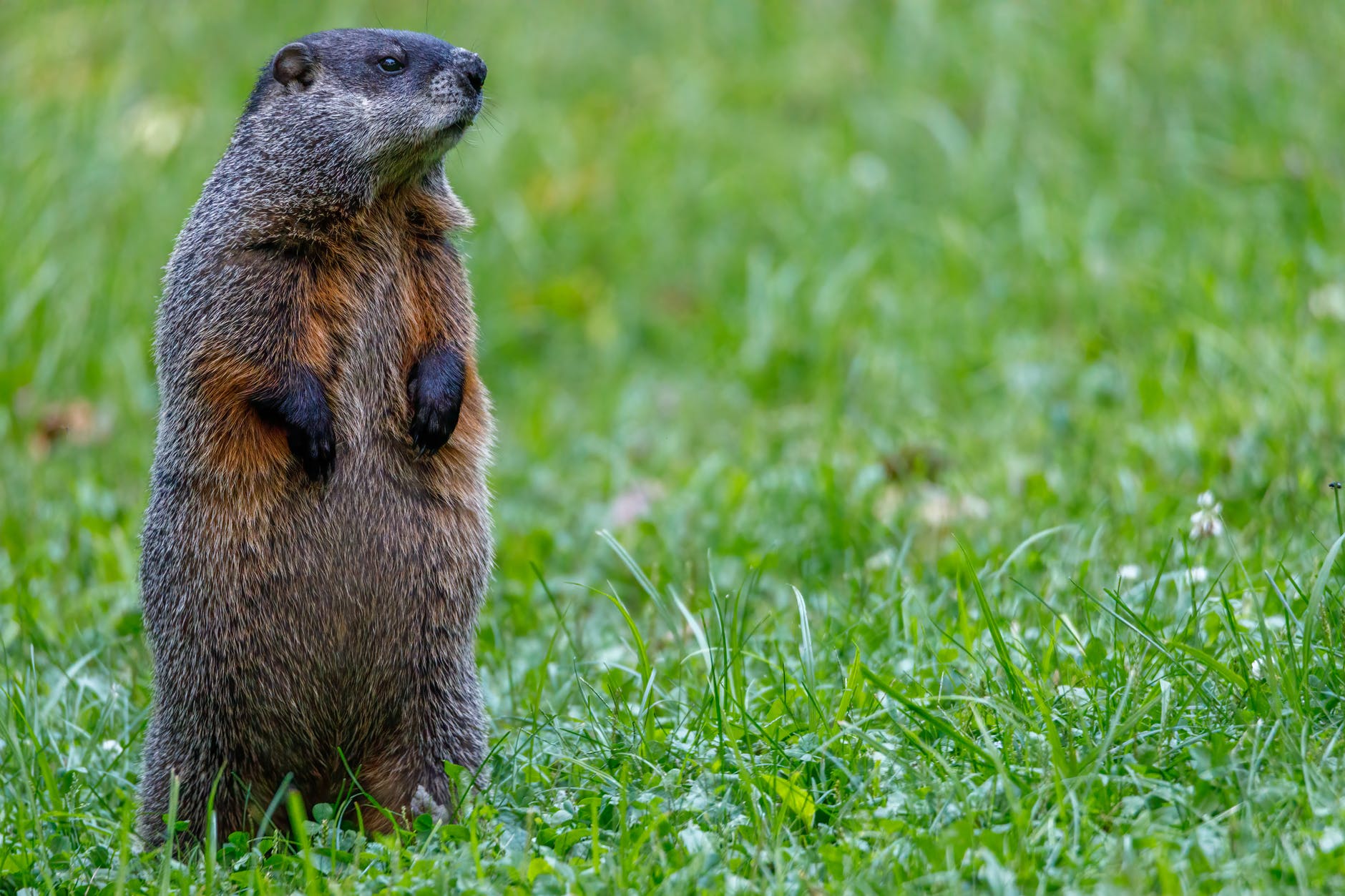
Happy Groundhog’s Day. Pray for an early spring.

I invite your comments on any and all of this. How are you doing? Are you COVID-crazy yet?

Processing…
Success! You're on the list.

I’m Not Going Anywhere, But My Schedule is Full

I’ve never been so stir-crazy in my life. I want to get in my car and go somewhere, eat out, stay in motels, swim, work out at a gym, sip a beer while listening to live music, write in a coffee shop, and eat donuts with my friends after Mass. I want to sit in someone else’s house or ride in someone else’s car. I want to go into the vet’s office with my dog and to sing to my friends at the nursing homes. I want to jam with my musician friends. I’m so sick of Netflix and Zoom I could scream.

My calendar is loaded with events, nearly all of them online. The photo shows the Post-It version. I have the same information on my Google calendar, but I like to be able to see what’s coming up. I get great satisfaction out of peeling off a note and throwing it away once the activity is over.

Yesterday, I spent four and a half hours in Zoom meetings, first a reading for the upcoming issue of Presence, a Catholic poetry journal in which I’m blessed to have a poem. We had a wonderful group of poets from all over the United States. In normal times, Presence’s in-person readings are usually done on the East Coast, and I would not have been there. It was an honor.

That was followed up by an Oregon Poetry Association board meeting. We had a lot to talk about: money, membership, publications, and online events for the upcoming months. Stay tuned for information about readings in March and weekly workshops during April, National Poetry Month.

It was all good stuff, but I kept looking out my window at the almost-sunny afternoon that I was missing. Like my restless dog sighing in the doorway, I wanted out. It was Sunday. I’m supposed to be able to go out and play on Sundays.

The schedule continues to be busy with classes, readings and meetings. I have books to promote. Physical touring is out this year, so I need to get the word out online. Tomorrow I’m being interviewed for the UnRipe podcast out of Australia for childless women. Australia! Imagine that. A while back, I was part of a discussion by childless “elderwomen” that included women from Australia, Ireland, England, Ohio and Oregon. Listen here. How cool is that? As a result, I’m selling copies of Love or Children: When You Can’t Have Both in countries where I have never been. Very cool.

I can read my work at open mics or invited readings almost every night of the week. I can take workshops that would not have been possible pre-Zoom. I can go to Mass at many different churches via YouTube and attend concerts online.

And yet, I want out. I’m my father’s daughter. On Sunday afternoons after church, he’d tell us all to get in the car because we were “going for a ride.” Deep into his 90s, when he finally let me or my brother do the driving, he loved to just get in the car and go. Up in the mountains, down to the beach, through the old neighborhoods, it didn’t matter. He just wanted out. We often wound up dropping in on friends or family. In the time of COVID-19, we can’t do that anymore.

I thank God for the Internet. I don’t know how I would survive so much alone time without it, but I sure miss “real life.” How about you?

***

Annie the dog, featured here a lot lately with her two weeks in the hospital with Vestibular Disease, continues to get stronger and less dizzy, although she still falls a lot when she’s not on solid ground. She likes to dive into the bushes and wade in muddy water, and then she crashes. But she gets back up. Her bedsores are healing, and there’s nothing wrong with her appetite. We are scheduled for a follow-up vet appointment tomorrow. Thank you for all your love and prayers.

Processing…
Success! You're on the list.