No, these aren’t Christmas trees

This slideshow requires JavaScript.

I squinted to read the orange sign up ahead as Annie dragged me up 98th Street. Even with glasses, I can’t always make out the letters. Logging? Wait. Logging?

The road splits by the big house with the twin Blue Heeler dogs who always howl when we pass. The upper road, 98th Court, is graveled and wild. The lower road, dark and tree-shaded, is mostly paved. After a short straight stretch, it makes a 180-degree turn at the blue house where Annie and her siblings were born.

Up ahead, I saw massive trucks and bulldozers. I saw men with hardhats. I saw that the trees enclosed in that big curve in the road were gone or lying in the bushes waiting to be moved onto log trucks and taken away. Jagged stumps remained, some of them several feet in diameter. It smelled like Christmas. The road was several inches deep in mud and sawdust. In shock, I pulled out my phone and took pictures. I asked a flagger stopping traffic what was going on. Something about the airport approach was the most he could say. We live a half mile south of the Newport Municipal Airport. Apparently the trees were in the way.

Tree-lover that I am, I tried to wrap my head around the fact that we grow all kinds of plants and harvest them. Why not trees? These trees are spruce, hemlock and red alder. We cut down evergreens for Christmas trees, put them up in our houses, cover them with decorations and throw them out two weeks later. How is this any worse? People clear space in the forest to build their houses, their cities, and their airports. And yet, this felt so vicious, so lacking in respect for trees that had been in this forest much longer than we have.

Beyond the work site, the forest remains untouched, dark, cool and green. We walked a ways and gazed across Thiel Creek. So beautiful.

It was getting late, and Annie was starting to limp again. This year, she has begun battling dysplasia and arthritis. Her spirit is willing, but her hips disagree.

I saw a tall, slim woman coming toward us. A new neighbor who lives on 98th Street, she was coming to see the trees, too. She was nearly in tears. It’s like killing animals, she said. Trees are sentient beings. She told me about a meeting happening Monday at 1 p.m. at the airport. I said I’d be there.

We gathered around a table in the upstairs meeting room at the airport, neighbors who knew each other and neighbors who were meeting for the first time. We ranged in age from 60s to 90s. Emotions ran high, as they will when one’s property is threatened. I felt for Melissa Roman, the public works official trying to explain the situation. People got red-faced, standing and yelling. Their voices shook with barely contained tears. How could you do this? You’re ruining our neighborhood! How come nobody warned us? It’s all about money, isn’t it?

The poor woman was just trying to do her job. When you mix cities and nature, there’s always a conflict, she said, exhibiting great patience when I would have been in tears. She’s doing her best.

Here’s the deal. One of the airport’s two runways has been remodeled and the navigation system upgraded. Although earlier environmental studies didn’t show a problem, when planes actually got ready to start flying off that runway, the trees on the 3.14-acre section around which 98th Street curved blocked the navigation equipment. That land is private property, owned by a local developer. The city negotiated a plan in which Integrated Resource Management—foresters, not loggers, she stressed–would cut down the trees. Once the logging is finished, they will cover the remaining slash with plastic until spring, then burn it. After allowing time for the land to recover, they will plant new trees. They will also repair the road where their trucks have damaged it.

For those who mourn the death of the trees, at least they are going to a good cause. At the last minute, arrangements were made to send the logs to the Siletz River for a salmon habitat restoration project. Much better than the wood chipper.

I can live with all of this, but my house doesn’t overlook the destruction, nor do I have to drive through the trucks and mud every day to get to work. Plus, well, if you buy a house near an airport, you have to expect to make some concessions. This isn’t half as bad as what I have seen in San Jose and other big cities where entire neighborhoods were leveled.

However, just when people were starting to calm down, Roman dropped a bomb. In the years since the airport was built in 1944, our few blocks of houses have been exempted from the requirements of the “Maintenance Protection Zone” in which we sit. Not anymore. Within the next year, the city will be asking us for easements on our property to cut down trees that rise higher than they should be in the airport area. Although most of us live on county land, because the airport is in the city of Newport, they have power over the situation.

Ooh, that made people mad.

As long as I live on my land, nobody’s cutting down my trees, said one resident.

I’ve been taking care of those trees for over 40 years, said the very old man beside me.

Me, I thought, well my trees need some thinning out, and if the city will pay for it . . . What can I say? I love my trees, but I also worry about them falling on my house.

Throughout the two-hour meeting, I took notes because that’s what I always did as a reporter. I also tried to steer the conversation away from attacks on Roman, who was doing her best. I can see both sides. We need the airport; we love our trees. It’s a bitch being the person from city hall that everybody hates. The old trees were beautiful. The new trees will be, too.

About 10 years ago, I interviewed the previous airport manager for an article for Oregon Business Magazine. He talked about plans to cut down trees. I was shocked. I asked questions, I did research, and I mourned the passing of the forest. Back then, trees were cut, but they grew back, and these will, too. Meanwhile, Santa will find it much easier to get to our chimneys on Saturday night.

Merry Christmas, my friends!

P.S. You can read about the airport-forest situation in the last chapter of my book Shoes Full of Sand. The ebook is only $2.99, and the paperback is also reasonably priced.

P.P.S. This is my first attempt at a slide show here on WordPress. Let me know how it works for you.



The Great Christmas Card Dilemma

christmas-card-pic-2016Clunk. That was the sound of 50 Christmas cards dropping into the box at the post office Saturday afternoon. This morning the staff will be sending them off to Portland for the long, circuitous journey to mailboxes in Oregon, California, Washington, and a few other states. I may or may not receive cards in return. It’s really not a requirement. I don’t want people to hastily prepare a card for me just because I sent one to them. Only send me a card if you want to.
Before I started my cards this year, I put out a question on Facebook. Do people still send Christmas cards? Why or why not? My FB friends responded that they send cards because they enjoy receiving cards and like to keep in touch with people they don’t see very often. But some have quit and others are considering it because it costs too much, takes too much time, it’s easier to send a greeting online, and fewer people are doing it.

So are Christmas cards, the paper kind that travel through snail mail, going out of style? Could be.

I decided to do it one more year and revisit the decision next year. I settled down with my address book, Christmas cards, Christmas mailing labels sent by various charities, and my Christmas stamps at a card table in front of the TV and got to work writing, signing, tucking, and stamping.

I have miserable handwriting. I like to say something personal on my cards, but my pen gets lost just writing Merry Christmas. I don’t know whether it’s arthritis, bad eyes, or a bad sector in my brain. In years past, I have sent elaborate newsletters, pictures and poems. But what do I have to report this year? No big trips, no big prizes, no kids or grandkids to boast about. Just living my ordinary life. So I typed a list of what that entailed and tucked it into my cards.

The highlights of my year included playing music for over 100 Masses at Sacred Heart Church, including too many funerals; getting a few poems published, putting out new editions of Azorean Dreams and Stories Grandma Never Told, being a finalist in a chapbook contest, writing approximately 100 blog posts for Unleashed in Oregon and Childless by Marriage; traveling to Arizona and California, reading 70 books, walking the dog about 300 times, and becoming a great aunt to Riley Kay Fagalde.

You use what you’ve got. Should I mention the numerous friends and relatives who have died? I decided not to.

There are so many other decisions to make. Do I send cards to former students, editors, writer acquaintances, or just family and friends? To the dog-sitter and chiropractor? What qualifies a friend to be Christmas card-worthy? Do I keep sending cards to friends of my late husband whom I never really cared for?

Do I sign the cards as just “Sue” or qualify that with my last name or an explanation that I’m their cousin they barely know? Do I add Annie’s name on some of the cards? (I do). I used to get a charge out of having a family of names to sign when I had a husband and live-in stepson, plus a dog. Now it’s just me. Somehow that feels like a failure.

There’s the choice of card, too. Religious? Carefully non-religious? Dog cards? Let’s see, are they Christians? Do I send cards to my Jewish friends? Oh wait, I don’t have any Jewish friends anymore. But I do have gay friends, divorced friends, widowed friends, and, God help us, Republican friends. Must choose the appropriate card with a sentiment inside that will not offend anyone.

Also must find the correct address. Are you like me, with certain friends and relatives who keep moving or who only connect online so you don’t know where they actually live? I always have a couple of cards that never get sent because I can’t find the addresses.

I also have some cards that go out late after I receive cards from people I never expected to send them. Which takes us back to my earlier comment that I don’t want people to feel obligated to send me a card just because I send them one. Yet I always respond to a card with a card. Am I not keeping the vicious cycle going forever with people I don’t care that much about? What if I just did nothing?

So the cards are in the mail. I have received three for me so far. They’re sitting on the kitchen table because I’m not sure what to do with them. Once cards arrive, where do you put them? Do you hang them on a wall or a door or a mantel? Paste them in a scrapbook? Turn them into craft projects?

I still have all of the cards I received last year. I don’t want to throw them away, but I don’t know what to do with them. Once upon a time, a friend showed me how to make cute little boxes from used Christmas cards. I ended up with 50 paper boxes for which I had absolutely no use. But they were adorable. What do you do with your old Christmas cards? I welcome suggestions. And how will you display the ones you receive this year? Are you still sending them out? What makes you keep doing it? Let’s talk about it.

Oh, and Merry Christmas to all of you. Thank you for being here.

htpix / 123RF Stock Photo

From Jesus to Weed: signs point the way

img_20161121_1608453881I’ve been driving back and forth from the Oregon Coast to San Jose, California for 20 years. My late husband and I left “Silicon Valley” in 1996 for a better life in a small town by the beach. It is a better life. But the family is still back in California, so several times a year I hit the road. Unless it’s snowing in the mountains, I take I-5.
When you drive the same route so many times, you notice the little changes. Also, your mind wanders, especially when you’re sick of the CDs you brought and the radio offers nothing but talk shows and evangelical preachers.

Today I’d like to share some of the signs I saw along the road during my September and November trips:

Politics: There used to be a lot of anti-Obama signs. They’re all gone, no point now that his term is about to end. As I traveled through San Joaquin Valley farm country for Thanksgiving, the signs said, “Make America Great Again” or simply “Trump.” Post-election, one sign had an addendum: “Thank you.”

Also in farm country: “Pray for water.” California has gotten some rain lately but not nearly enough.

“Guided goose hunt. Call now.”

Near Delevan: “The gift of God is Jesus Christ our Lord”

Mt. Shasta: More than a peak experience.”

For Rolling Hills Casino, located in Corning, The Olive City: “Eat! 3 restaurants.” “Tip Top Pit Stop”

Approaching the town of Weed: “Weed like to welcome you.” Not a typo.

Five miles south of Yreka, there’s a metal-sculpture cow, now with a calf. For Christmas, someone usually drapes a garland around the cow’s neck.

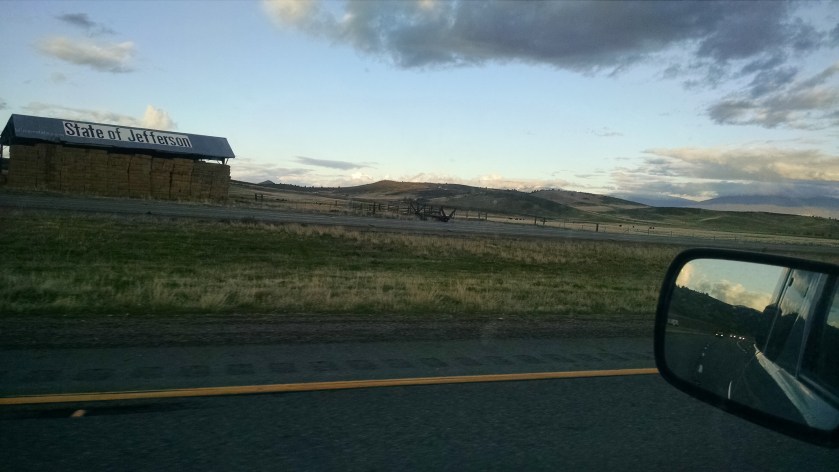
The State of Jefferson sign. At one time, folks in southern Oregon and northern California were planning to create their own state. Considering how things have been going lately, they’re considering it again.

In a pasture just south of the Oregon-California border, black-faced sheep gather around a big white cross and a hand-painted sign that says, “Forgive them.” I wonder who and for what?

The road goes up and up, signs marking the altitude in 500-foot increments to the peak of 4,310 at Siskyou Pass. Other signs tell drivers where to chain up or take off snow chains. Hope I never have to. I have chains, but I have no clue how to put them on.

Northbound just before the Oregon border: “Puzzled? God has answers.” And just past it, a giant liquor store sign.

Also approaching the border, a green and yellow billboard: Need Weed? Take Canyonville exit. Ah, we’re back in Oregon.

Honk the horn at the Welcome to Oregon sign and watch the milepost numbers start fresh with Number 1.

Save

Holiday travel: torn between home and ‘home’

img_20161121_160813536_hdr1

When your family lives far away, you have three choices for the holidays: go to them, have them come to you, or stay home without your family. Frankly, all three choices suck. Number two is not an option for me due to old people, young children, and people with full-time jobs being less portable than I am. I have tried option three, and I do not like being alone on the holidays. Right now, on an ordinary Tuesday with Annie, it’s fine. But Christmas or Thanksgiving? A little turkey loaf for one? How sad is that? Too sad.

So that leaves option one: I go to them. That means another long drive to California. Why not fly? Have you heard about the airports during the holidays? The train is a little better, but expensive, overbooked during the holidays, and it never arrives on time. Also, I need a car when I get to San Jose to drive my dad to my brother’s place, which is three hours from where he lives—unless you take a wrong turn which I did last week. Oooh, you should have heard my father’s reaction to that. Anyway, we made it.

img_20161125_095800469_hdr1
Dad, Hazel, and my brother Mike


I hate leaving home. I hate leaving Annie especially in the winter, but she doesn’t travel well. The last thing I need on the wet winding roads of winter is a giant dog in my face, a dog that I can’t leave anywhere to eat, walk or visit family members with cats, a dog that is definitely not going to let me take a much-needed nap at a rest stop while other dogs are perusing the “dog area” nearby. So Annie stays home. She’s such a nervous Nelly that I gave up on the kennel. All those other dogs freak her out, plus I discovered they don’t give the dogs any exercise. Eight days in a cage. Not for my baby. So I hire a dog sitter, who is wonderful, but spendy and who is not here during the long cold nights when Annie sleeps in her crate in the laundry room, quivering when it thunders during yet another storm.

It’s not just the dog, of course. I also leave my work, my piano, and all the comforts of home, such as bathtub, TV, Internet, and food of my own choosing. If I lived nearby, I could just go for a day and come home to sleep in my own bed, but no, I moved to Oregon, so I have to pay the price.

Sometimes it physically hurts to detach from my home and my dog, but once I get on the road, I love the first day of the trip. Oregon is so beautiful, and it feels great out on the open road, music playing, mountains and pastures flying by, towns to explore, restaurants to enjoy.

img_20161125_0955515511
Baby Riley

The second day is not as much fun. The “Bay Area” seems to expand more with every trip. This time, the traffic backup started at Dunnigan and hit a peak at Vacaville, where I endeavored to get lunch and found all roads so clogged with traffic it was nearly impossible to get to a restaurant or to get back on the freeway afterward. In fact, by the time I finished driving in circles and managed to get back on I-5, I was in tears and feeling sorry for myself. Too hard. All alone. Why don’t they come see me? Now I need a bathroom and there’s no place to stop. Etc.

The traffic in the Bay Area is horrific. So many cars driving so fast, zipping in and out of lanes with no warning, clogging up to stop and go, breathing smog, my hands, elbows and shoulders aching from white-knuckling it for a hundred miles. This is why we moved to Oregon! I had left Mt. Shasta at 8 a.m. and should have been at Dad’s house by 2:00. It was nearly 4:00 when I parked in his driveway and oozed out of the car with knees threatening to give out. Dad immediately started nonstop talking, and the visit was on. So good to see him, so hard to get there.

Saying goodbye at the end of the trip makes me cry again. Dad is 94 ½. I don’t know how many more visits we’ll have, how many more times he’ll be waiting for me to call when I get home, how long before he can’t live on his own. The guilt sits on my shoulders like wet cement as I head east on Stevens Creek Boulevard to the freeway, conscious of the now-empty passenger seat beside me.

I’ve been doing this for 20 years, and it gets harder all the time.

So why don’t I move back and reunite with father, dog and family? Money is a big part of it. I can no longer afford to live where I grew up. The cost of living is insane. Those 65-year-old tract homes on Dad’s street are selling for a million dollars. A million dollars! A studio apartment, if you can find one, costs more than my mortgage on this four-bedroom house with its massive woodsy yard. Yes, I could stand less rain and fewer gray days, but I don’t want to deal with the traffic and crowds in San Jose. My brother, living on a hill near Yosemite, feels the same way. Dad says he likes both of the places where we live, but he’s not going to leave his house until he has to, preferably never.

So I drive and drive and drive. I swear I’ll never do it again. I take the coast route when it’s snowing in the Siskyous and it takes forever. Miles of winding roads with rain making it hard to see. I pass all kinds of vacation destinations but can’t stop because I need to get to my destination before the traffic, before it gets dark, before Dad panics. Maybe someday, I promise myself, but not now.

I spent $900 on my car before I left. New brakes, everything checked, fluids topped off. The service guy said I needed new tires, but I didn’t get them. I hoped these would last another trip, and they did, thank God.

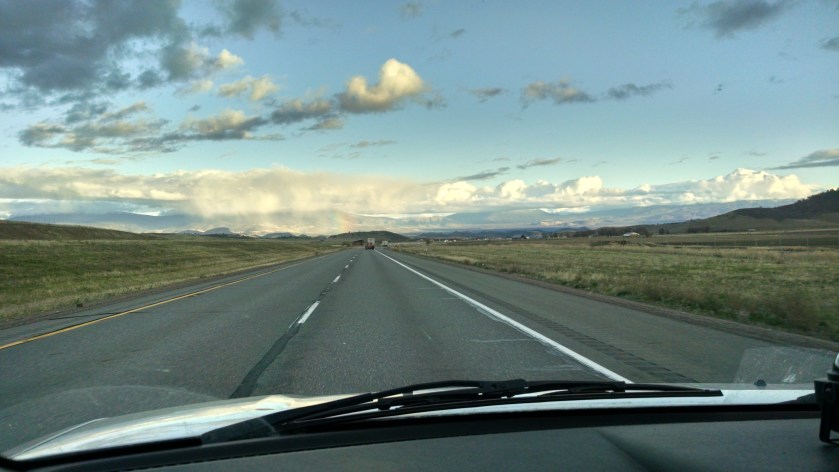
So was it all misery? No. I had a great time at my brother’s house. I enjoyed listening to Dad’s stories and just being with him. It was wonderful seeing the sun. I ate delicious foods and saw gorgeous sights, including a rainbow over the mountains and another one extending into the ocean. I got away from all of my usual chores and worries and felt my mind open up to new ideas and possibilities. I ate a marionberry muffin in Gold Beach and wrote a poem near Roseburg. I got to hold Riley, my 5-month-old great niece and feel her tiny fingers gripping my big hands. I got to talk face-to-face instead of Facebook to Facebook with my niece and nephew, my brother and sister-in-law, and her extended family. I ate a ton of pumpkin  pie. I played the 1880s cabinet grand piano at Dad’s house, feeling its mighty power under my fingers. Memories came flooding back, and I slept better in my old bedroom than I sleep here at home.

The day before Thanksgiving, a writer friend had surgery for a brain tumor. The doctors couldn’t take it all out but hoped to buy him a year, maybe two if he is lucky. This is a man at the height of his career, a brilliant writer, beloved teacher, devoted father and husband. Suddenly he has to quit his job and doesn’t know what he’ll be able to do in the short time left before he dies.

None of us knows what’s going to happen. So we hit the road and take what it brings, whether it’s rain and bald tires or a giant slice of pumpkin pie and a chance to hold a baby.

How about you? Do you travel for the holidays? Are Christmas and Thanksgiving always at the same places or do you trade off? How do you make the travel tolerable? Any experiences you’d like to share? Please comment and let us know.


Facing the Elephant in the Room

Do I dare write this post? Maybe. Am I typing on eggshells? Definitely. I’m a peace-loving, piano-playing poet. I had something silly planned for today’s post. But we have to talk about what’s happening.

In case you were unconscious last week, Republican Donald Trump won the presidential election. Democrat Hillary Clinton, who would have been the first woman president, won the popular vote but failed to win enough electoral college votes. In other words, Trump won more states. As the night progressed, I watched in disbelief as more and more states on the TV map turned red. At the end, the map showed most of the country Republican red while a few eastern states and all of the western states—California, Oregon and Washington—were blue.

Forget what you think about either candidate or their various scandals for a minute. Forget about sex and emails. Trump has never held any political office. Who wins the most important job in the land with no experience? How could that happen? But it did.

Before the election, many of us were sure that Clinton would win. We worried about how Trump’s followers would react. We worried about riots and assassination attempts. We figured if he won—well, we didn’t think he would win.

Two days after the election, I walked across the driveway to visit my neighbor, who recently broke his ankle and has been stuck in the house. He’s 74, a strong fireplug of a man who is used to being active, working as a mason, doing projects on his property, fishing and hunting. I know better than to talk politics with him, but as I sat on his couch surrounded by the stuffed heads of animals he has killed, he lit into Hillary Clinton. He talked about the crimes she has committed, about how she’s foul-mouthed and immoral, and how she won’t go to prison because President Obama will pardon her before he leaves office. Etc. I just kept petting his massive Labrador retriever Harley and muttering about how there are lots of rumors and it’s not all true.

My neighbor is a good man. He doesn’t swear or drink or cheat on his wife. He has helped me so many times over the years with Fred, with Annie, and with home repairs I couldn’t do by myself. He always tells me that if the big earthquake comes, I can stay with him and his wife. They are fully prepared for Armageddon. And I will. We’re alone together at the end of this forest road. We cannot be enemies. So I listened and let it go. I urged him to call me if he needed anything.

Meanwhile, a writer friend of mine in Wisconsin was attacked while walking her dogs down the street. A man walking toward her refused to give way. Instead, he kicked at her dog, kicked her and shoved her off the sidewalk, saying, “You need to get back in your place now, woman.” Police are still looking for him. He was wearing a red “Make America Great Again” baseball cap. Her physical injuries were minor, but she’s traumatized and afraid this is the new order of things in Trump’s America.

The country’s going crazy. The riots I feared if Trump lost are happening anyway in Portland and many other cities. Some of them have turned violent.

I have seen reports of children bullying other children, white kids telling Mexican kids they’re going to be deported, other white kids beating up black or Muslim kids, “Make America white again” spray-painted on a high school baseball dugout,” middle school  students chanting “Build the wall” (to keep Mexicans out), and more. Trump says, “Stop it!” but they’re not listening. Today someone hung a black doll on a college campus. Gays are afraid they will lose all the rights they fought so hard for. Read about the hate crimes here. It feels like all the civility that held people in check is gone.

Facebook friends are “unfriending” friends because of their political views. Two of my co-workers are not speaking to each other since the election. I don’t dare bring up the election at Thanksgiving next week.

I published a poem about Hillary Clinton on New Verse News last week, thrilled at the publication but nervous about how people would react. So far, nothing negative, but I no longer feel secure. And I think that’s true of many of us. With each news report, I grow more fearful for our country and the people I love. I swear not to watch anymore, to focus on my peaceful life with Annie here in the woods, but then I feel compelled to look, to see what else has happened. After all, I spent many years as a journalist, and this is one hell of a story.

This year, we had two flawed candidates in an election filled with scandals, rumors, and lies. Or was it all true? How can we know for sure? How many of us wished for different choices? How many of us stared at the TV screen on election night in utter disbelief, whether we were thinking, “Holy shit, we did it!” or “Dear God, it’s the end of the world?”

My father, who was born when Warren G. Harding was president, has seen a lot in his 94 years. He voted for Clinton and shakes his head at the idea of Trump as president, but he’s not rattled. He knows things will work out. Life will go on. He’ll still eat oatmeal for breakfast every morning, go to church on Sundays and buy groceries on Mondays.

All we can do is pray, believe that America is still a great country, and go on.

I am uneasy about posting this. I have seen in the past how people can react beyond all reason. If you feel moved to comment, know that I moderate all comments and will delete anything hateful. That said, how are you feeling this week? Will we ever be able to talk about this stuff?

Book nerds gather at Wordstock

img_20161105_134332574_hdr1You know all those socially-challenged people who would rather read a book—or write a book—than anything? Well, about 8,000 of them gathered in Portland, Oregon Saturday for the mega-event known as Wordstock. Unlike at the famous rock concert with the similar name, folks at Wordstock were stoned on books instead of drugs. The stage performances were all about words instead of music, and the only naked people were the sculptures at the art museum. Still, it was pretty mind-boggling. Alice Hoffman over here, Sherman Alexie over there, Richard Russo across the street, workshops all day, books to buy everywhere, oh my God.

img_20161105_122427661_hdr1Wordstock’s hub was the Portland Art Museum, but within easy walking distance, other events happened at seven other venues on the South Park blocks, including the Arlene Schnitzer concert hall, the glorious First Congregational United Church of Christ, and the Oregon Historical Society. Red Wordstock signs appeared everywhere. The people I met leaving the parking garage were also going to Wordstock. Of course. Everyone was going to Wordstock. Well, there was that guy yelling in Spanish at a mannequin in a store window. But everybody else.

I was a Wordstock virgin, compelled to go this year not only because I always wanted to but because I’m now co-coordinator of our Willamette Writers chapter in Newport. We had a table at the Wordstock book fair. If I volunteered a couple hours, I could sell my books.

Portland is a long drive from here. Three hours each way if I’m lucky. Much of it was in the dark, and it was raining the whole time. Blinded by the deluge, I prayed my way home and still can’t believe I survived. I also can’t believe the guys in pickups who passed me going 75 mph on Highway 20. God watch over the people in their path.

So, as a newbie, I had a lot to learn about Wordstock. For example:

* Once you pay your $15 (do it in advance online) and get your red wristband, you can attend any of the talks in any of the many buildings. Just walk in. This blows my mind. I thought you needed to pay more for an extra ticket. Nope.

* Get the program online at Literary Arts or in the Willamette Week newspaper and plan ahead. There is way too much to see and do. Picture a massive buffet at which everything looks delicious, but you can only choose one plate-full. Which do you want more, the lobster or the raviolis?

* Don’t open that door to the stage balcony between shows. I decided I wanted to sneak a peek at one of the theaters and got locked in. Locked double doors on each end of a concrete-floored hallway. Luckily there were stairs. Eventually I wound up in an alley. As the doors shut behind me—locked—I gazed at the wrought iron gates that separated me from the street. What if they’re locked, too? I pictured myself gripping the bars like a prisoner and hollering for help. But they opened.

* Expect to get wet. It’s November in Oregon. You will get wet walking between buildings. You will get wet acquiring food from the food carts. You will get wet trying to find a place to eat that food. Wear your raincoat; think about bringing an umbrella. And don’t even think about complaining about the rain.

* It will be crowded. Did I mention there were 8,000 people there? That’s almost the whole population of Newport. Most of these people are too busy gazing at books, authors, their programs or their phones to watch where they’re going. If you try to take an alternate route, a red-shirted volunteer will herd you back into the stampede. Note that many of the attendees are kids, who get in free.

* If you live far away, stay overnight so you can start Wordstocking the minute it opens and stay to the end. None of this sneaking out to beat the traffic and the darkness, neither of which is actually possible.

* You’re in an art museum. Take time to enjoy the art, too. Featured this year was the work of pop artist Andy Warhol, famous for his Campbell’s Soup Cans and prints of famous people. Wild and colorful stuff.

It’s all pretty amazing and a little daunting for this small-town author who skipped her church bazaar to attend Wordstock (which my phone keeps autocorrecting to Woodstock). Of course I spent more money than I made selling books. I thought I was going to die on the road. But will I go next year? As long as Literary Arts keeps putting it on, I plan to be there. Unless it’s snowing. Maybe even then.

Despite Death, Halloween Goes On

Today in honor of Halloween, I’m sharing an excerpt from my book Shoes Full of Sand. Only five days before the holiday, my father-in-law, Al, had died suddenly of a stroke. But my mother-in-law, Helen insisted we carry on with Halloween as usual. Almost two decades later, Helen and my husband Fred are gone, but the memory remains. Here’s how it went:

helen-and-al-lick
Helen and Al Lick

Halloween found us at Helen’s front door, watching as my sister-in-law Harriet handed out candy, making a fuss over each child and each costume. She crouched down, creating a physical barrier so our dog Sadie couldn’t get out. Fred stood watching from between the stuffed monkeys his mother had placed in the window. His brother Condé sat in a chair in the corner, brooding and drinking. I moved between the door and the kitchen, where I was cooking chicken for dinner. Helen sat in the back room, watching “Jeopardy” and “Wheel of Fortune” on TV. During the commercials, she came out, squeaking with laryngitis, laughing at the kids.

Every year, the police blocked off the neighborhood east of the Fred Meyer store for Halloween. Hundreds of children came through. Although her husband had just died, Helen didn’t want her house to be dark on Halloween. So we carved pumpkins, helped decorate the house and gathered in the living room to hand out candy.

About 7 o’clock, Janet from my church showed up at the door with her daughter Heather.

“Janet!” I called over Harriet’s head.

She looked confused. She had heard that my father-in-law had died, but we lived on the other end of town. She had no idea that my mother-in-law lived on Crestview or that we would be celebrating Halloween. Now she didn’t know what to say. “Um, Shirley told me what happened,” she said.

“I know. Hi, Heather.” The shy three-year-old clung to her mother’s pants. Just the Sunday before, we had had lunch together after church with Shirley and Georgia, all complaining about our aging parents. At the time, my in-laws needed a little help, but they were in comparatively good shape. Now the cloud of death hung over the house in spite of the Halloween decorations.

More kids were coming up the driveway, so Janet went on down the street. I felt guilty. Guilty for making her think of death in the midst of trick-or-treating, guilty for not mourning quietly instead of celebrating Halloween.

A teenage girl came to the door when Helen was nearby. “Didn’t you and your husband just move in?” she asked.

Helen nodded but didn’t elaborate. They had only lived there for two months.

Sometimes I missed the old-fashioned mourning customs. I didn’t know what was appropriate. Should I dress normally in my usual reds and pinks or wear dark colors to church? Should I play the piano or be silent? Dared I laugh? I longed for the comforts of everyday life, but was I dishonoring my dead father-in-law if I watched my favorite TV show and enjoyed it? If I went out to lunch with my friends as usual? If I talked about what happened and didn’t cry?

The stages of grief are muddled. On that first day, we wept and then we went numb. I felt neither hunger nor the need to use the restroom. I know only that when a masseuse came through the hospital cafeteria offering massages, I kept thinking, no, I don’t want anyone to touch me. A human touch might have broken through the wall I had built around my feelings.

Helen accepted a massage. “Ah, that feels so good,” she said as the woman kneaded her neck and shoulders. With her husband dying upstairs, was this wrong? Would saying no to the massage have changed that sad fact?

We held no funeral or memorial service for Al. His body was cremated, the ashes destined to be placed at the Newport cemetery. Instead of a service, Helen held an open house, but only a handful of people came. My in-laws hadn’t lived in Newport long enough to meet anyone except their landlord, Al’s doctor and a few of my church friends.

But on Halloween, hundreds of children came to the door, with no idea that there was anything different at this house where grownups stood in the doorway passing out candy than at any other house on the block.

Somebody egged our car outside the folks’ house that night, probably the teens that Helen had turned away at the door after she ran out of candy. We had left the car window open, and egg was dripping down the back of the seat. Sadie jumped in and licked it up. Dogs and teens figured it was just an ordinary night.

For the rest of the world, it was.

Al would have gotten a kick out of the little kids in their costumes. He might even have chuckled at the teenagers and their eggs, remembering his own youthful adventures. He loved life and wanted more of it. Our best tribute would be to enjoy our own lives, every single day of them.

I hope Janet understood that we weren’t being crass on Halloween. We who are still alive have to take the comforts that life gives. Sometimes those comforts include a cherry Tootsie Pop and a six-year-old girl in an angel dress yelling “Trick or Treat!” at the front door.

Copyright 2011 Sue Fagalde Lick


Authors, lunch and antiques=heaven

img_20161020_1205444691
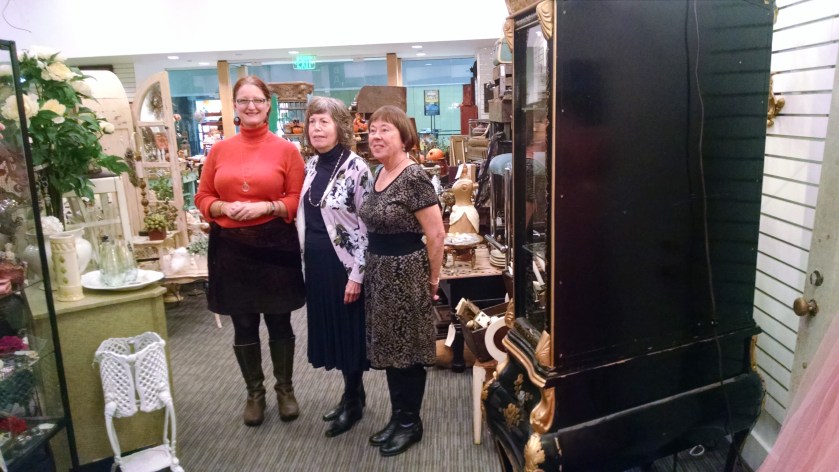
Authors Valerie Ihsan, Janet Fisher and A Lynn Ash pose among the antiques

An authors’ lunch in an antique store? How strange, but it happened last week at Indulge Antiques in the Gateway Mall in Springfield, Oregon, and it was good. Amid the elegantly set tables, I found authors and book lovers gathered around a long table where books were spread from one end to the other, along with book-related cards and fancy pens. Introductions were made, and we settled in.

The paper menu seemed to list every possible concoction—I went with the sweet turkey wrap—and the dessert tray held more than a dozen cakes and tortes while the waiter described other delicacies that didn’t fit on the tray. Yes, we ate well amid the antique dressers, baskets and Halloween decor.

But it wasn’t all about food. Amanda Bird, proprietor of The Book Nest bookstore, has been hosting lunches with authors for the past two years. The program was on hiatus for a few months while Indulge moved to its new location in the mall, but now she plans for monthly gatherings. The next one is Nov. 17.

It’s casual. You order whatever you want and pay for your own lunch. You sit at the table with the featured authors, eat, chat, ask questions, and learn about their books. You can also buy the books, of course.

This month’s guests were Janet Fisher, who in her books A Place of Her Own and The Shifting Winds writes about Oregon history through the lens of her ancestors who came via the Oregon trail; A. Lynn Ash, whose books The Route from Cultus Lake: A woman’s Path to a Solo Camping Lifestyle, and Vagabonda, tell the stories of her adventures camping alone all over the U.S., and Valerie Ihsan, who wrote about her experiences as a young, pregnant widow in Smell the Blue Sky and has since written a novel titled The Scent of Apple Tea. Wonderful women all, and the casual setting made it possible to not just admire but to become friends.

I love antique stores. I love to wander among the old things and imagine the lives of the people who owned them. In some cases, I don’t have to imagine because I’m old enough to have owned things that are now deemed antiques or collectables. I also love books and authors and lunch.

I may not be able to attend these lunches often. It’s nearly 200 miles round trip, and it was raining so hard on the way there that I felt like I was driving through a river. But I got to try out the new stretch of Highway 20—truly beautiful—and escaped everyday life into a wonderland for writers.

If you are interested in attending an authors’ lunch, follow the Book Nest Facebook page and RSVP if you’re going. The restaurant portion of the Indulge Antiques is open to everyone, but you’ll need a reservation. Visit their web page for details.

I want to figure out how we can do this in Newport. Ideas? Volunteers?

I’m moving back to where I started

img_20161017_094617032_hdr1Got your attention, didn’t I? Especially those church people who just panicked for fear I won’t be there to play the piano. No worries. I’m just moving down the hall.

You see, when my late husband’s Alzheimer’s got bad, I couldn’t sleep with him anymore. My insomnia and his hallucinations were a bad match. So, in November 2007, after nine years sharing the master bedroom, I moved into the guest room. I moved my furniture in there, bought new linens, and decorated the room in bright oranges, reds and yellows, anchored in brown. Warm colors. My colors. I hung my crucifix over the bed, something I had not done before because Fred was not Catholic. I filled the closet and drawers with my stuff. After Fred moved to the nursing home, I stayed in the guest room and filled his closet with suitcases, memories and empty hangers. It was cold in there, farthest from the pellet stove. Some of his shoes and ties had mildewed. I threw them away.

After Fred died, I hung his photo  from the funeral above his nightstand. I set up a little shrine with my Lady of Fatima statue, a prayer book, a candle and our matching wedding rings.

I only entered that room to pack for trips and to get to the bathtub in the master bathroom. I tried sleeping there a couple times, but the memories made me weep. That was OUR bed, OUR room. Fred slept beside me with our old dog Sadie at the foot of the bed. I couldn’t do it.

My bedroom, the former guest room, was a busy place. I not only slept and dressed there–wary of the neighbors who might see me through the street-facing window–but watched TV, paid bills, read, wrote, sewed and played music. Something loud was always on–TV, radio, cell phone with its games, music, texts and occasional calls. It simply got too loud in there. I couldn’t sleep.

My bed, purchased cheap, had sunk down on the side where I slept. I flipped it over and wore another trough into the other side. With my restless legs, I rubbed holes in all my fitted sheets, so I turned them upside down, too. Eventually I bought another set.

Light was a problem in the guest room. The street lamp pushed through the blinds and lace curtains. The moon, when it was full, shone in like a spotlight. Adding to the light show were the red numbers on my clock radio and the yellow and green lights on the Wi-Fi box.

In contrast, the master bedroom started calling out to me as a quiet oasis in cool whites and pastels. No electronics. No phone. Firm queen-sized bed. Because it was at the back of the house, no lights intruded, just the darkness of the woods.

While the master bedroom was vacant, I offered it to my dad, who always declined, to guests who chose hotels, and to other guests who never come. I have considered renting out the room, but I want my bathtub and my privacy. I have never liked to share. I’m also afraid of who I’d get.

Now I think the room was waiting for me to come back. The memories are still there, but they are often sweet. I remember snuggling in that bed after making love. I remember times when Fred and I shut ourselves in there away from guests, feeling safe and happy together.

It’s time. No one else is taking that room, so I’m taking it back, making it my room, moving as few of my things as possible. I want to keep the volume down. No more red numbers screaming the time. No more reaching to turn on NPR news in the middle of the night or checking my phone the second I wake up. Just sleep. If I can’t sleep, I’ll take a bubble bath or read a book.

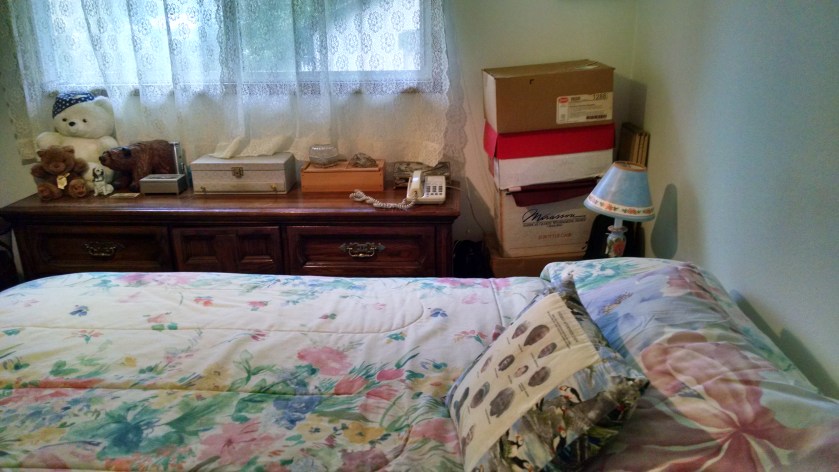
I’m still transferring stuff. The stacked-up boxes in the picture all hold quilt fabric, which I plan to use now that my sewing machine has been relocated to the former guest room.  Annie discovered my new hangout last night. Frightened by thunder and lightning, she decided she had to sleep with me. It was nice. New dog, new start.

Rocking the Book Table in Newport

Did you write all this? Which book is your newest? What are you working on now? Behind the book table again at yesterday’s  Celebration of Women in Newport, I felt like the old veteran as I watched people pick up my books, study the covers, and put them back dofbbc5-dscn2584wn—or sometimes even buy them. I have been doing this since Stories Grandma Never Told came out in 1998.

I have sat at book tables all over Oregon and California, including many stints at the annual Dia de Portugal in San Jose, bookstore signings, book fairs in the rain in Lincoln City, and street fairs in Stockton where the only person who bought a book was the fellow author sitting next to me. All too often, sales are sparse, the only purchasers being the other authors.  The truth is, if the event is not specifically about books or about the subject of your books, most of the people attending are not looking to buy books. They’re going to spend their money on food, carnival rides, and souvenirs. The writers are just a roadblock on the way to the fun.

Because I have published three books about Portuguese Americans, my books sold like linguica sandwiches—hundreds—at the Portuguese festival. At the Lincoln County Fair, not so much. Yesterday? Two.

So why go? Exposure. People see you and your book, maybe they’ll take a flyer or postcard, and maybe later they’ll think, hey, I should buy that book by what’s her name. Maybe you get a little free publicity in the newspaper. Plus it’s fun to hang out with other authors, people who understand what you do and can exchange information on how to do it.

Yesterday, I sat between Lee Lynch, author of more than a dozen novels and longtime booktable partner, and Lori Tobias, whose first book, Wander, just came out. Lee and I traded war stories while Lori gathered information and advice and vented about how this was not as much fun as she expected. No, but it could have been worse. We were warm, dry, and the wind wasn’t blowing. At the fair in Medford where the photo above was taken, it was 35 degrees inside and snowing outside. Nobody came.

You learn things over the years. Don’t bring every copy of every book. You only need a few. Have something for people to take: cards, bookmarks, candy, or trinkets related to your topic. Get a cart or a strong person to help you carry the books because they are heavy. Get there early so you don’t get the table least likely to be seen. Bring sunscreen and a hat if it’s outside. Don’t hog your space. Bring dollar bills and coins for change. Keep your book money separate from your personal money. Acknowledge every person who approaches with a greeting and a smile. Resist the urge to read or stare at your cell phone, even if nothing seems to be happening. Wear comfortable clothes; nobody cares what you’re wearing. Etc.

Lori kept saying she’d rather be writing. I was content at the table. It was Sunday afternoon. I had played three Masses at Sacred Heart Saturday night and Sunday morning, so I was too tired to do anything useful anyway. I was among friends.  There was music, wine and chocolate. You learn to ride the writer waves of private time and public time.

Besides, I had new editions of two of my books on their virgin outing. Stories Grandma Never Told, that book about Portuguese women that launched my book table career, has been updated, with a new cover and, for the first time, an e-book version. Azorean Dreams, my Portuguese American romance novel, also has a new look. What’s next? Another novel, a memoir, and perhaps a poetry book. Got to keep adding new merchandise to the table. Also, I’m going to move into the 21st century and start taking credit cards at in-person events for those customers who wind up emptying their purses and pockets to come up with enough nickels and wrinkled dollar bills for a book because they don’t carry cash.

Next time you see somebody sitting at a table with books, walk up and say hello. We’ll be glad for the company and delirious if you buy a book.