writer/musician
California native, Oregon resident
Author of Freelancing for Newspapers, Shoes Full of Sand, Azorean Dreams, Stories Grandma Never Told, Childless by Marriage, Now Way Out of This: Loving a Partner with Alzheimer's, and the Up Beaver Creek novel series. Most recently, I have published three poetry chapbooks, Gravel Road Ahead, The Widow at the Piano: Confessions of a Distracted Catholic, and Blue Chip Stamp Guitar, plus a full-length collection Dining Al Fresco with My Dog. I have published hundreds of articles, plus essays, fiction and poetry. I'm also pretty good at singing and playing guitar and piano.
I grew up going to the Santa Clara County Fair in San Jose. Even got one of my first jobs there. That fair was HUGE. You could walk all day and not get to the end of it. Top-name acts played in the bandstand, giant halls were filled with needlework, baked goods, and people selling things like kitchen knives and Magic Fingers massage chairs. The food, the rides, the horses, the tractors, it went on and on. There were fireworks every night of the fair. It was also hot, smelly, expensive and crowded but that’s the county fair. You eat junk food, drink beer, dance to the music, play the games and pet the goats.
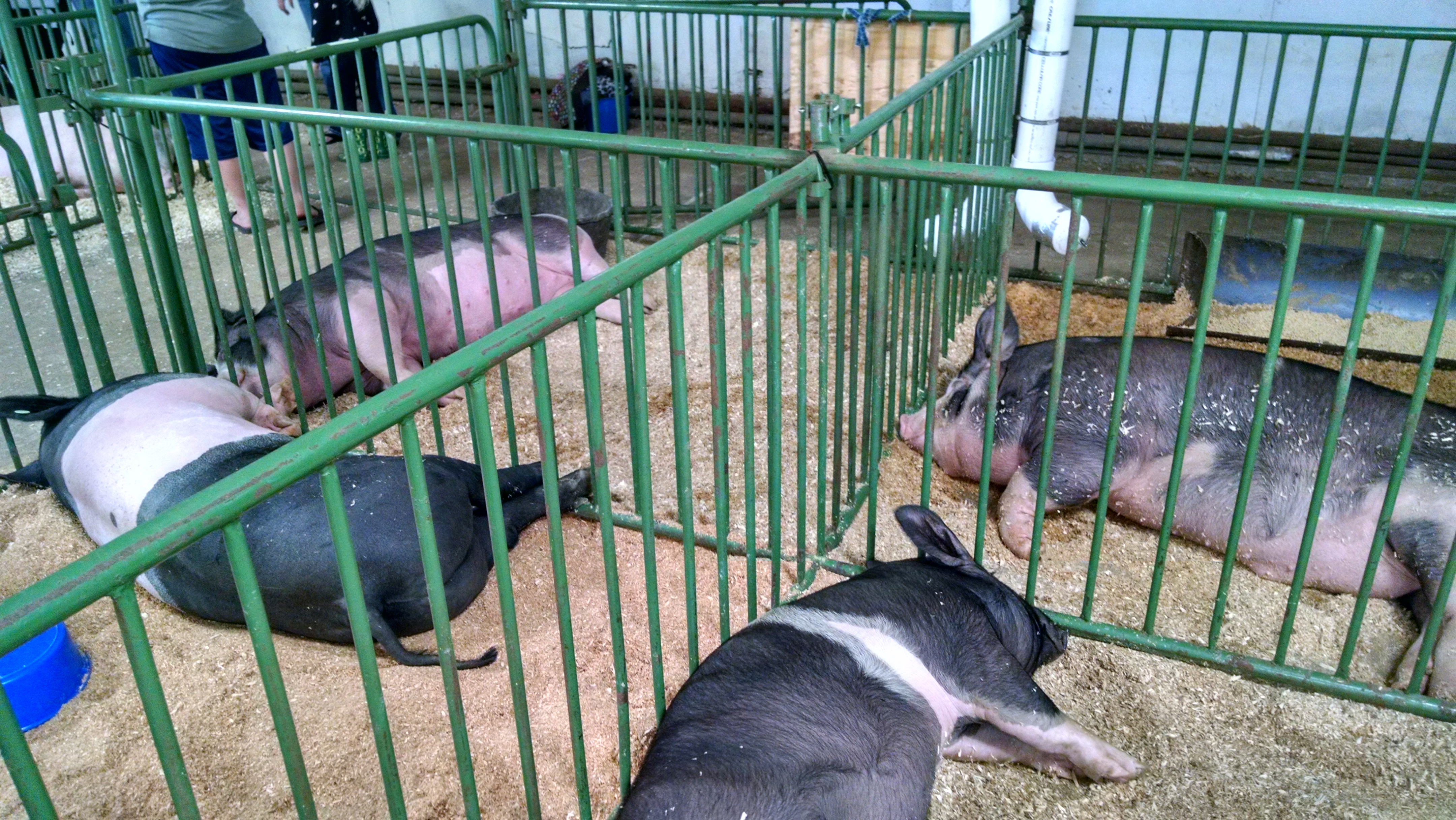
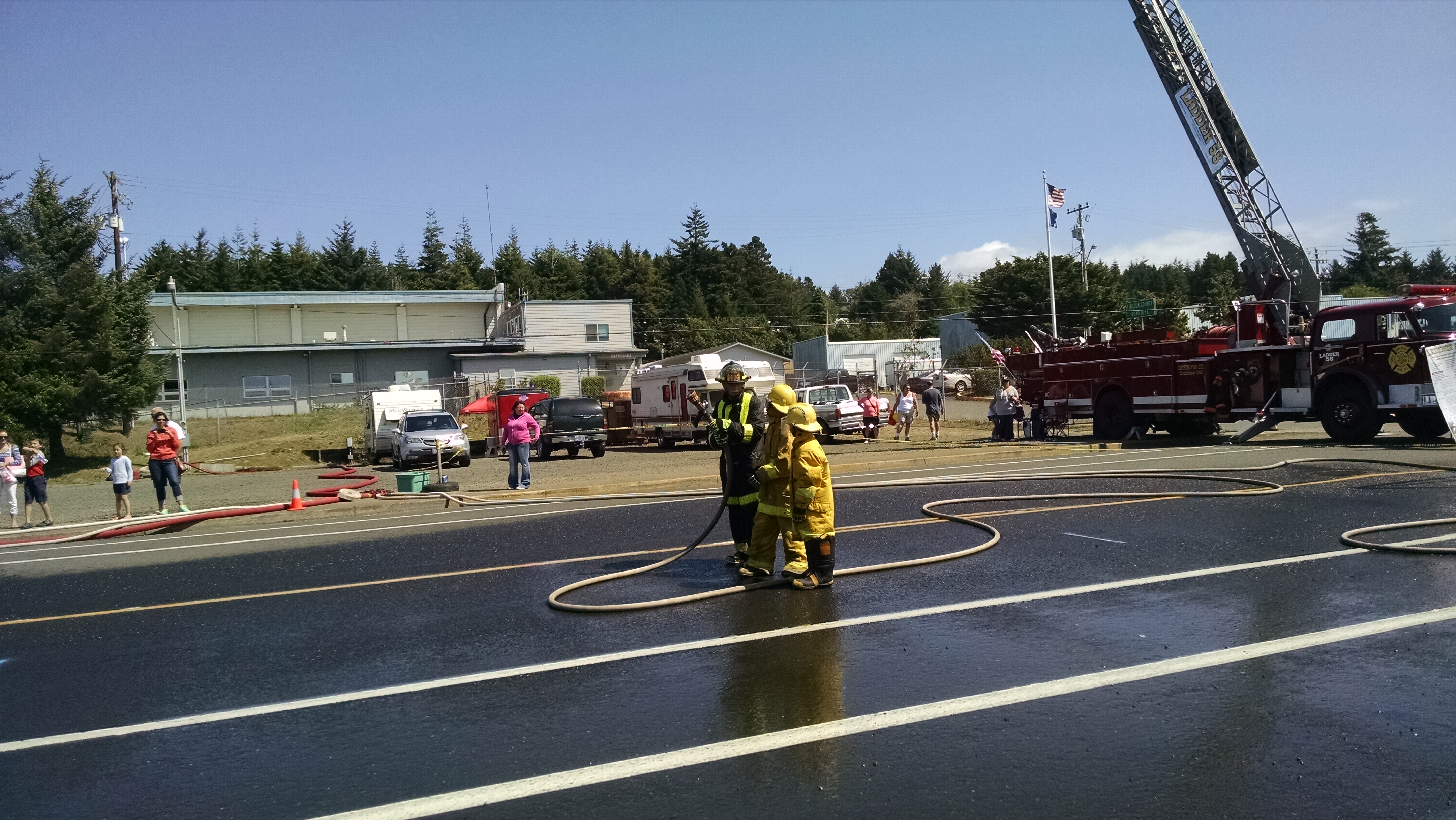
The fair here in Lincoln County is a little different. Billed this year as the all-new fair, it wasn’t much different from before, except that admission was free. Still no place to park, same booths selling corn dogs and elephant ears–big floppy sheets of sugared pastry, same old tacky rides, same goats and chickens, same guy playing guitar on the main stage to a sea of empty chairs. The big featured act was a couple who impersonate Johnny Cash and June Carter Cash. But as they used to say in San Jose, Fair Time is Fun Time. I’ll let my pictures say the rest.
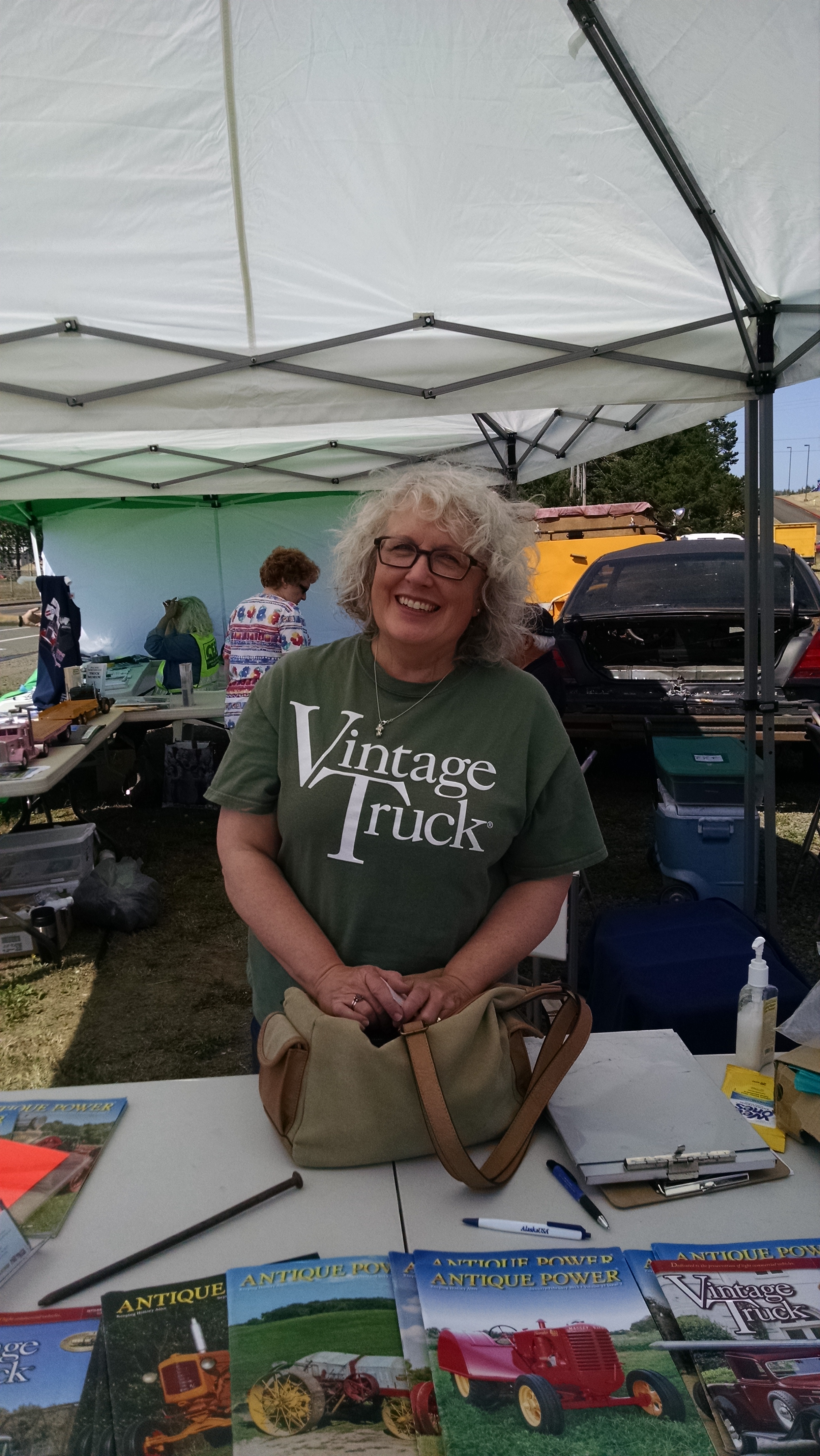
You’ve got to have a guy selling kitchen tools.A new feature this year allowed kids to put on firefighter clothes and operate the big hoses.Writer Candace Brown, a longtime long-distance friend, came down from Washington to represent the truck and tractor magazines she writes for.
On normal days, I juggle several lives at once. I’m a writer with new writing to write, old writing to sell, and published books to market. I produce three blogs that require my responses to a steady stream of comments, especially my Childless by Marriage blog. I seem to have become the Dear Abby of the childless set. But I’m also a musician with a “day job” as a church choir co-director, plus numerous solo gigs, jams and open mics, and a constant need to practice on the piano and guitar. I also have a massive house and yard to maintain in addition to taking care of myself and my dog—and she’s not much help. Bills, laundry, groceries, doctor appointments, walking the dog, worrying long-distance about my elderly father, trying to find time for my friends . . . you know, real life. Sometimes I get all tied up in knots trying to do it all.
But sometimes I get to run away. Sometimes I get to focus on just one life. That’s what I did last weekend when I drove to Portland for the Willamette Writers conference. I have been part of Willamette Writers since shortly after we moved to Oregon. I co-founded the Oregon coast branch with my friend Dorothy Blackcrow Mack. This year, as part of the new Timberline Review staff, I was there to represent the magazine and celebrate our first issue, to teach a poetry class, and to pitch my unpublished books to editors and agents. I helped judge the Saturday night open mic, too. In between, I participated in workshops that got me inspired, educated and anxious to write, write, write. Tom Robbins was there. I got to study with Jennifer Lauck. I hobnobbed with Bryan Doyle. As equals! Well, almost. I also ate, ate, ate. Those cookies with peanut butter in the middle? OMG!
It was all writing all the time. I could forget everything beyond the Doubletree Hotel. Yes, I kept getting text messages about church choir, and yes, I had to play a funeral Monday morning, and yes, I needed to call the vet, take the car to the shop and a dozen other things, but for three days, all I had to do was eat, sleep, write and talk about writing.
It’s amazing and a bit alarming how many people want to be writers. Hundreds of writers attended this conference, most paying a big chunk of money in the hope of getting that nugget of information or that successful meeting that would rocket their manuscript onto the bestseller list. It happens. Every year, we have success stories, people whose careers were launched at the Willamette Writers Conference. That’s why people keep coming.
It’s a weird conglomeration of folks. Writers are not necessarily social people. They’re more comfortable alone with their books and their computers. The conference setting forces them to “network” and we don’t all do it well, but we do our best. We sit down next to another writer and ask, “What do you write?” Thus the conversation begins.
A central activity all weekend is “pitching” our books to agents and editors. People walk around looking like they might throw up or faint because they’re so nervous as they approach the “pitch marketplace,” a room full of “buyers” sitting at little tables waiting to hear their pitch. This year, we had eight minutes. We were herded in one door and escorted out the other when the organizer shouted “Time!” Handed an evaluation sheet on the way out, we staggered down the hall, some euphoric, some suicidal, most somewhere in the middle. Three out of four agents wanted to see my work. But this is not my first conference. It’s just like speed dating. Maybe there’s a spark, but it might fizzle the next time you meet.
Eventually the conference ended with a last speaker who urged us to “never give up.” Then it was time to take off my lanyard with the card that identified me as part of Timberline Review, as teacher, editor, author. I felt so naked without that identity when I finally walked to my car and left the hotel. I immediately took a wrong turn because I couldn’t read the street sign until I got too close to turn back, then ran into a five-mile backup behind an accident on I-5. Ah, reality.
Yes, I got weary of lining up at buffets and in the ladies room. Yes, I was sick of taking the elevator up and down. Yes, my body was starting to whine about sitting too much. But oh it was nice to live just one life at a time.
I live in a vacation paradise. People travel thousands of miles to visit the Oregon coast. And with good reason. It’s gorgeous here. We’ve got forests, beaches, parks, fine restaurants, lighthouses, the aquarium, fresh air, moderate temperatures, and more. But those of us who live here frequently find that we rarely pay attention to all of that. We’re too busy taking care of business at home and at work. Beach? Oh yeah, that’s nice. Maybe tomorrow.
But some days are just too fine to sit in an office staring at a computer. Plus a girl just gets tired, you know? So one day last week, I joined the tourist parade and took a vacation day. Leaving Annie sleeping at home, I got in the car and drove south, turning where the muse led me. You might want to try this trip yourself someday.
Heading south on 101 from South Beach, I turned east on Beaver Creek Road, across from Ona Beach. When I came to the fork with South Beaver Creek, I turned right. Many of the scenes in my not-yet-published novel Being PD take place in this area, and I found myself reliving some of those scenes as I drove through miles of estuaries, pastures, forests and farms. The road was smooth and curvy, the scenery beautiful, and the traffic non-existent. I had heard this road led to Waldport, but I had never tried it for fear of getting lost. No problem. Ultimately I came to a T intersection at Bayview Road and turned right. This road ran along the north side of Alsea Bay. Ultimately it came out at Highway 101.
Over the bridge and through Waldport, I came to Gov. Patterson state park and joined the tourists at the beach. I spread out my blanket, sat on the sand in the sun and wrote in my journal, looking up to watch people passing with their dogs and kids, the waves breaking white and full, the sand dotted with driftwood forts. And the woman walking along talking on her cell phone all the way to the end of the beach and back. Luckily, I had forgotten to charge my phone so it was turned off.
When I got hungry, I drove south to Yachats, a tiny town with a lot of great restaurants. Bypassing the Drift Inn, Leroy’s Blue Whale and the Green Salmon, I decided to try Ona. It’s a little expensive, a little pretentious, but the view of the Yachats River and the food are worth it. My crabcake sandwich with curry sauce was delicious. Unlike at my usual hangouts, I didn’t see a single person I knew. Everyone was visiting from somewhere else. Why not me?
After lunch, I drove around the corner to park beside a car just like mine—silver Honda Element—and take pictures. What a place. It’s got to be a sin to ignore it. When the owners of the other Element came up the path from eating their lunch on a bench overlooking the surf and saw our cars together, they did a double take. We compared years and features and shared our mutual love of the vehicles some folks call “toasters.”
Time to return to reality, but first I stopped in Waldport at Well-Road Books, a well-stocked used book store with bountiful shelves and soft music playing. One book after another called to me. I came out with a stack of novels I can’t wait to read.
This morning, looking out at blue skies and everything in bloom, it’s hard to believe it will be gray, raining and windy in a few months. Now is the time to enjoy this place. Isn’t this why we moved here?
Nineteen years ago, Fred and I moved from San Jose, California to the Oregon Coast. Literally driving off into the sunset, we caravaned north with a rented truck carrying most of our possessions and a Honda Accord carrying me, the dog and my instruments. We had some problems along the way. You can read about it in Shoes Full of Sand. (Only $2.99 for the Kindle version.)
I have been here almost a third of my life. When we arrived, I was only 44, had all black hair and no arthritis. Fred was a youthful 59, and our dog Sadie was only a year old, full of energy.
So much has changed over the years. Fred and Sadie are gone. It’s just me and a dog named Annie, who is already 7 ½ years old. Both of Fred’s parents and my mother have died. So have both my uncles and all of the older generation of my family, except my father, who by some miracle is still going on his own in San Jose at age 93. My brother, who started as a recreation leader the kids called Mr. Mike, became a lawyer and then a judge in Mariposa County Superior Court. His kids are adults now.
I have often thought about going back to California. If I were on my own that first winter, I would have. The rain and wind never stopped. I was cold, miserable and homesick. But Fred loved it here, and we stayed. Now, in this unusually dry summer, I crave the rain. When the temperature gets over 65 degrees, it’s too hot for me. But when it’s in the low 60s, I lie out on the deck and soak in the sun. Come December, the days will be short and sunshine will be only a memory.
Much has happened since we sold our house in San Jose and moved to Oregon. In the U.S., we’ve gone from President Clinton to Bush to Obama. The attacks on 9/11 made terrorism a household word and led to wars in Iraq and Afghanistan, as well as undeclared conflicts in other parts of the Middle East. We started a new century. The Internet took over our lives. We got e-mail, Facebook, Twitter, and Pinterest. We bought Kindles, Smart phones and iPads. TV screens became flat and wall-sized. Gluten-free became a thing. Saying “a thing” became a thing.
Back in San Jose, the population zoomed to over a million people, crime soared, and traffic became an impenetrable wall. The house where I grew up, a three bedroom, one-bath house with no dishwasher, no central heating and no WiFi, is valued at more than $700,000. Studio apartments there cost more than my mortgage here. Santa Clara Valley became “Silicon Valley.” It’s too crowded, and more people keep coming.
I have kept busy over the years: Five books, an MFA, transitioning from writing articles for newspapers and magazines to writing essays, poems and blogs, something no one had dreamed of in 1996. A job playing, singing and leading church choirs. More new friends than I can count, friends who feel like family. I co-founded the coast branch of Willamette Writers and am now president of Writers on the Edge.
Did it turn out the way we planned? Not all of it. I wanted to write, play music and walk on the beach. We wanted to live in a small town with no crowds where people get to know each other. We got all that. I am blessed. But I never expected to do it alone. With Fred gone, maybe I should have gone home. But to what? To who? The Oregon coast is my home now.
What will happen in the next 19 years? I don’t know. I don’t think I want to know. Today the trees are standing tall, there’s blue in the sky, I have a meat loaf sandwich waiting for lunch, and Annie’s asleep on the couch. Later today, I’m going to jam with other musicians, and later still, I’ll watch the finale of the Bachelorette. Will she choose Nick or Shawn?
What were you doing 19 years ago? Where did you live? What has changed for you since then? Please share in the comments.
Longtime journalist Rinker Buck, suffering from a late-middle age slump, got a wild idea. He would travel the Oregon trail the way the pioneers did in the 1800s.
Longtime journalist Rinker Buck, suffering from a late-middle age slump, got a wild idea. He would travel The Oregon Trail the way the pioneers did in the 1800s. He would outfit an authentic covered wagon, hitch up a team of mules and traverse the country, starting at St. Joseph Missouri, traveling through Nebraska, Wyoming and Idaho and ending in Oregon. This being the 21st century, he would have to figure out how to deal with the freeways, shopping centers and homes that had been built over the old wagon ruts, but he was determined to do it. The result is Buck’s new book, The Oregon Trail: A New American Journey, published this year by Simon and Schuster.
Rinker Buck had planned to go alone, but when he asked his brother Nick for help getting ready, Nick insisted on going, too, and bringing his little dog Olive Oyl.” Both men were dogged by demons from their past and sought the “Oregon Trail Cure.” The result is a tale that’s a blend of Cheryl Strayed’s Wild: From Lost to Found on the Pacific Crest Trail and Bill Bryson’s A Walk in the Woods: Rediscovering America on the Appalachian Trail. It’s funny, poignant and suspenseful. The Bucks have their share of mishaps, along with a big dollop of luck, and I find myself riding with them all the way, falling in love with the men, the mules and Olive Oyl.
Of course in modern times when a covered wagon shows up on the road, people lean out of their minivans to take pictures with their smart phones, but there are still long passages of pastures, mountains and deserts with no one around for miles. Their days on the trail fill the brothers with a joy I can feel right through the pages.
Buck writes in an easy-reading style that carries the reader along. When justified, he lets the f-bombs fly. When they screw up, he says, “I really screwed the poodle this time.“ But he also describes the scenery in lines that sound like poetry. Throughout the book, he includes information about all aspects of the pioneer journey. We learn about mules, wagons, the people who died on the trail, and the entrepreneurs who gathered at the “jumping off” places to sell the travelers all kinds of necessities and junk for the journey. We learn about the Indians and the Mormons and the big role they played on the trail.
They had their share of adventures, but of course the Bucks’ trip in 2011 wasn’t as rugged as it might have been back in 1850. They had planned ahead and had contacts waiting for them. They had transcontinental communication as long as they could charge their cell phones. Trail enthusiasts rushed to help them, feed them and honor them as celebrities. They were unlikely to catch cholera or smallpox. There were no Indians. But there were still long sections with dust, mud, broken wheels, no cell phone reception, no water and nothing but Hormel chili to eat. They could have called it off at any time, but they didn’t.
Most of my ancestors came from Europe. They either came directly to California by boat, took the train across, or traveled up from Mexico with horses and wagons when the Spanish ruled the land. There’s one branch of the family that might have crossed the country by wagon, but I haven’t found any information on that yet. Me, I’d never have made it out of Missouri. As soon as they told me I’d couldn’t take all my stuff and couldn’t have iced tea with my lunch, or maybe not even have lunch, well, I’d be going home. I like my creature comforts.
My husband, our dog Sadie and I did our own migration from California to Oregon, detailed in my book Shoes Full of Sand. We did it in a Ryder Truck. On a freeway. But there were breakdowns, hunger, heat, and desperation. For all three days. And sometimes all we had to eat were donuts. I retrace that trail several times a year in my Honda, and I keep meeting new Oregonians who have followed the same path, perhaps completing the migration that began long ago when their ancestors moved to California. We’re all pioneers in our own way.
This is the time of year when the Oregon coast is flooded with tourists. Suddenly it takes twice as long to drive through town. We have to wait for tables at our favorite restaurants. They wander the aisles at J.C. Market in groups, carrying beer and tortilla chips. I look out at the people in the pews at church, and see mostly unfamiliar faces.
Among ourselves, we curse the tourists, especially those slowing traffic with their RVs laden with bicycles, kayaks and little perfectly matched cars. But in public, we call them visitors to be polite. After all, most of us were once tourists, too, before we became born-again Oregonians. And we know, in our hearts, that we are just as clueless when we go on vacation.
How can you tell the tourists from the locals?
1) License plates from elsewhere, mostly Washington, Idaho, California, Arizona, New Mexico and British Columbia. But we get people from all the other states, too.
2) They walk around in shorts when it’s 50 degrees out—with an Oregon Coast hoodie they just purchased for $50 at a gift shop because they were freezing. OR they bundle up for the Arctic when it’s 65, which we consider warm.
3) They dawdle on the roads because they’ve never seen an ocean before or don’t know where they’re going. If from California, they drive 10-20 mph over the speed limit, not realizing cops actually do give speeding tickets here.
4) They’re not white, and they’re under 60 years old.
5) They say freeway. We don’t have one. They say mall. We don’t have one of those either.
6) They want to know where Main Street is. It’s Highway 101.
7) They mispronounce Yachats (YA-hots), Yaquina (Ya-QUIN-a), Siletz (Si-LETZ) and Willamette (Wih-LAM-ette).
8) They come in bunches, filling the whole car or the whole booth at the restaurant, and they go ga-ga over clam chowder.
9) They use a GPS when all you need to know is you’ve got the ocean on the west and the hills on the east and can’t get lost. Just follow the numbers north and south or the alphabetic tree names east and west.
10) They go IN the water at the beach.
I know there are more. Feel free to add your own tourist clues in the comments. Although they clog up our traffic, our visitors keep our economy going, so we’re glad they’re here. We like to share our beautiful home. After all, Newport’s slogan is “The friendliest.” Besides, most of the visitors will flee when the rain starts. If we had spent the winter here before selling our house in California, we would have fled, too.
I spent a lot of the Fourth of July weekend in hand to vine combat with wild berries. I believe in letting wild things grow, but when they attack my house and make it difficult to walk through the yard, I have to attack back. My garden pretty much consists of plants that planted themselves. Invasive plants, the rest of the world calls them, plants that grow wherever they want and keep expanding their territory. Blackberries, thimbleberries, salmonberries, huckleberries. Salal, sword ferns, foxglove, poppies, ivy. And honeysuckle. Just when I learn what those flowers are and start thinking I’m lucky to have them, I discover that they too are invasive plants. Looking more closely, I see that they’re already battling for space with the berries out front.
Real gardeners would get in here with a chain saw or a tractor and cut all this stuff out so we could plant something pretty that knows its place in the garden. But why cut out plants that are hardy and attractive just because we don’t think they should be there? Okay, I’m a little angry at the berries that are choking my big hydrangea plant to death. But in most of the yard, I have neither the time nor energy to clear, plant and tend a garden, so why not let Mother Nature take care of it? What gives a human being the right to clear a rectangle in the forest and kill anything that threatens to come in? If you can’t beat ‘em, let ‘em grow, right?
However, just like they’re choking the hydrangea, the berries were also threatening to overwhelm me and my house. They were pushing against the fence and the deck to the point where I had to fight back so that I could walk the path to my gate without thorny branches grabbing my hair and my clothes. I suffered endless thorn pricks to my hands as I cut and cut, trying to take back my one-third acre of land. I cut enough to fill the 96-gallon compost cart and more, yet it’s hard to tell I did anything because there is so much plant life.
Back in California, they’re suffering from the drought. Only the hardiest plants will survive. My father’s planted berry vines have dried into brown strings with a few berries shriveled up like raisins. We’re short on rain here in Oregon, too. Numerous counties have declared drought emergencies. But on the coast, even after a month with no measurable rain, everything is blooming, growing, and threatening to break down the fences.
With my little clippers, my loppers and my yellow wheelbarrow, I fight to protect my space by cutting a little here and there and claiming the rest as my bountiful garden. As for the sore muscles and the bloody cuts where the thorns got me, I consider them badges of honor. I held the enemy off again.
Meanwhile, my dog Annie is already eating blackberries on our hikes. To her, the world is one big smorgasbord. Who’s to say she isn’t smarter than we are?
When I woke up at 4:45 a.m. to go to the bathroom, it was already light, as if the world was saying, “Get up, let’s go.”
I replied, “No, it’s too early.” Darned daylight savings time.
I’m a person very much affected by light. Dark=sleep. Light=wake. I fall asleep at movies, plays and planetarium shows, but I have a hard time sleeping in motels where lights shine from the microwave, TV and smoke alarm, and there’s always a streak of light shining through a crack in the curtains or under the door. I drape towels over every light source I can reach and see the light still shining through the white terrycloth. And those little night lights some places put in the bathroom? No, thank you.
At home in the woods, it was dark in my bedroom at night until the hedge got trashed in a storm and I had it trimmed. That night, I got into bed, turned off the lamp, and thought, What’s that light? I opened the curtains and peered out. It was the streetlight at the far corner of my driveway. Blinds and lacy curtains barely muted it. A couple weeks later, I thought, What’s that light? The moon. You can’t turn off the moon. Shut my eyes, face the other way, try to sleep. We’ve got some bright moon around here. When I’m out in the hot tub at midnight, it’s like a football stadium lit up for a night game.
When my mother-in-law lived here, she covered her bedroom window with duct tape. I haven’t gone that far yet, but this morning I finally unwrapped the sleep mask I got at a seminar on sleep problems over a year ago. I was always nervous about covering my eyes. Might miss something. But I was desperate. I slipped it on. It felt soft, silky. It was dark. I went back to sleep until 7:00. Much better.
This close to the 49th parallel, our light and dark cycles are different from back home in San Jose. Our Fourth of July fireworks don’t start until 10 p.m., when it’s almost dark. And it’s light about 4:30 a.m. right now. The farther north one goes, the more pronounced the change. When we vacationed at Whistler in British Columbia a few years back, it barely got dark at all. I can’t imagine living in the parts of Alaska where it stays light in summer and dark in winter. I’d have to get out the duct tape for sure.
I love light–in the daytime. I hate winter, when we have 16 hours of darkness, and I appreciate not having to drive to church in the dark for early Mass on Sundays, but this daylight at 4:45, that’s crazy. Give me my mask. It’s not morning until I say so.
Scott Rosin takes us into the swells with his surfing poems
The coldest winter I ever saw was the summer I spent in San Francisco,” Mark Twain said. Apparently he hadn’t been to Newport, Oregon in June. Waiting for the delayed start of the “Surf and Turf Poetry Slam” yesterday in the tree-shaded patio outside the Café Mundo restaurant, one after another of us ran to the car or home to get a coat. It was just after noon in late June, but it was overcast and cold. When I called California to wish my dad a happy Father’s Day, he said it was cooler there, too—down to the low 90s. Oh, brrr.
But being Oregonians, most of us wrapped up and stuck it out.
Only in Newport, specifically in the Nye Beach neighborhood, would you have a weekend of surf and turf poetry and art. In this case, Surf and Turf does not refer to dinner but to surfing and skateboarding. It was the brainstorm of Tom Webb, director of the Newport Visual Arts Center where we hold the Nye Beach Writers’ Series. Relatively new to the area, he thought: beach=surfing. He added skateboarding to the mix. Apparently, in addition to Father’s Day and summer solstice, June 21 was Surfing Day and Go Skateboarding Day in some alternate universe. So, the featured exhibit in the main gallery was Surf and Turf, presenting painted and decorated boards of all sorts along with sculptures and paintings about surfing ocean or concrete.
Upstairs on Saturday night, we welcomed two old favorites to Nye Beach Writers, Matt Love, author/publisher of countless books, and wildman poet Andrew Rodman. The room was packed, the readings drew smiles, laughter and applause, and fans swarmed the book sales table. I emceed the open mic, and the list was full. Poems, stories, locals and visitors, reading off phones, tablets and sheets of paper that shook with their nerves.
On Sunday, as if some people just can’t get enough, the party moved to Cafe Mundo at 2nd and Coast streets. I had had two hours sleep. My head was buzzing so fast after Saturday’s festivities that I couldn’t go to sleep despite a 6 a.m. wakeup call to go play piano and lead the choirs at church. With a visiting priest from Tanzania. Thick accent. Long sermon. God bless caffeine.
I reported to Mundo in my church clothes, climbed the steep stairs to get lunch and ran into three friends from my weekly music jam in Waldport—hammered dulcimer, pennywhistle, ukulele. They invited me to join them. Everybody knows everybody in this town. Later they joined me for the poetry.
Café Mundo restaurant used to be outside, which would be warm enough maybe 10 days out of the year. So they built a place that looks like a treehouse. You walk in, there’s a stage to the right, a counter straight ahead and stairs to the left that lead to the dining room proper. The room circles around a big opening so you can see the festivities downstairs.
Service is a little spacy, so it’s not a place to be in a hurry. The food, which leans toward healthy and natural ingredients, comes up from the bottom floor via dumbwaiter. It is unlike any other restaurant’s grub, at least in our area. My friends ordered eggs, bacon and toast, pretty normal, but their eggs were cooked with pesto and feta cheese, and their slabs of bacon were huge. You could roof a house with them. The toast carried on the Paul Bunyan theme. I ordered the “Cheeses of the World” sandwich, three kinds of cheese with tomatoes on the same mega bread, served with garden salad with a fruity poppy seed dressing.
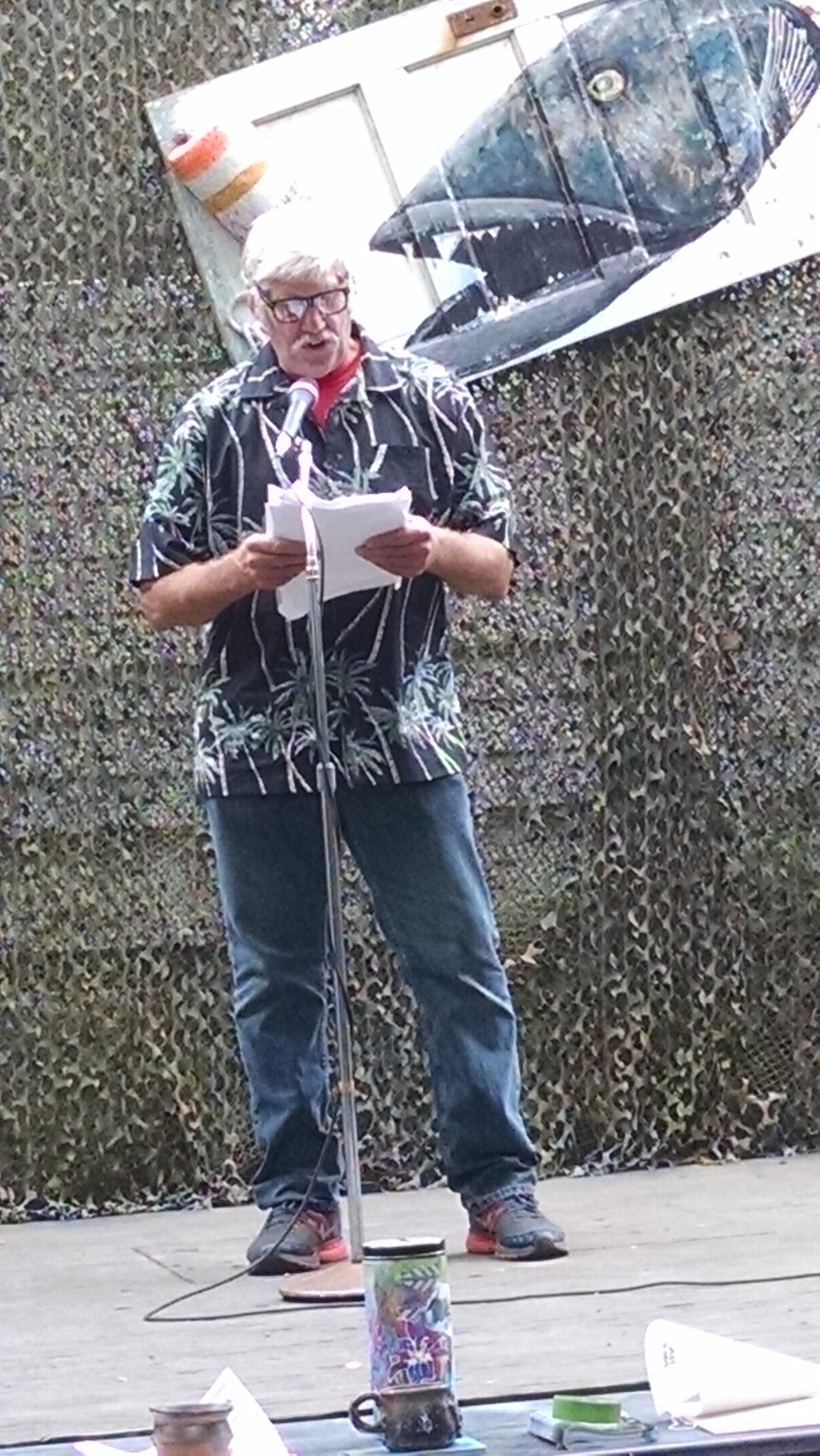
Downstairs, the poets gathered. The event was supposed to start at 1:00, but it was more like 1:30. Coastal time. We bought raffle tickets. I won a tee shirt with surfboards on it—wearing it now. Perfect under fleece or over thermal underwear. The poets and their fans gathered. We huddled on polished stone perches, patio chairs, and weathered benches as Scott Rosin, Andrew Rodman, Mike Kloeck, Catherine Rickbone and others proclaimed poetry on the outdoor stage, a giant fishing net and shark in the background. I could hear them several blocks away as I finally gave in to cold and weariness and headed for the car. People reciting poetry outdoors on a Sunday afternoon a block from the beach? It’s so Newport—and one of the reasons we moved here. You won’t find this in San Jose.
I’m in love with my compost bin. I know that’s strange, but it’s true. I’m also mighty fond of the big blue recycle bin. The garbage bin, eh. But you should see me on Thursday nights rolling my full carts to the curb, lining them up like Papa Bear, Mama Bear and Baby Bear, and the happy dance that follows on Friday when they’re empty again. I get so excited watching those big trucks roll up, stretch out their mechanical arms, raise my bin up high and dump everything in the back of the truck.
It was just a mild affection until the compost bin arrived a couple months ago. I finally had someplace to put my yard waste. I became a lawn-mowing, bush-trimming, food-composting maniac. I can’t wait to get the bins emptied so I can fill them up again, except for the garbage bin, which doesn’t get much in it anymore. Ooh, and last week I picked up this cool black food waste pail to hold things like my grapefruit rinds, tea bags and chicken bones until I can get them out to the Papa Bear bin.
My neighbor across the street does not compost or recycle. He burns his yard waste and throws everything else in the garbage. He sees no point in recycling. Add that to the list of topics we can’t discuss, a list that includes gun control, religion, politics, yoga, taking one’s dog to obedience school, and all the rest of my yuppie ideas. But he’s a good guy and has been helpful to me in my solitary life in the woods. Annie adores him, so we know he’s not all bad.
But I’m sticking to my stand on recycling. Have you ever been to a landfill? I have. As part of my reporter life, I have stood at the edge of these stinking piles of refuse and watched lines of garbage trucks dumping more and more. It’s horrible. The average American throws away four pounds of trash a day. That’s seven tons a year. We can recycle about 75 percent of our waste, but only about 30 percent actually gets recycled. All that stuff that goes into the landfill just stays there. A fact sheet from California State University Sacramento notes that it takes approximately 1 million years for a glass bottle to break down in a landfill. Plastics take at least 100 years, maybe as long as 400 years. Things like microwave ovens, iPads and tennis shoes, God knows how long it will take and what chemicals may be leaching into our air, soil, and water.
Think about how much you and I throw away every day and multiply it by the more than 7 billion people in the world. We are going to suffocate in our own garbage one of these days. We don’t have to. So much can be recycled and reused if we just do our part.
Our parents didn’t recycle, but they also didn’t produce and discard so much crap. We used to think we were doing our part if we tossed our stuff in the wastebasket or garbage can instead of on the ground. I remember our old Shasta camping trailer had a decal in the window that showed a picture of a bee and said, “Don’t bee a litter bug.” We weren’t. But now we know there’s more to it than that. If my 93-year-old dad can learn to recycle, anybody can.
I pray that someday we can find a way to reuse everything so that we no longer have any need for landfills. Meanwhile my neighbor thinks I’m an idiot. Too bad. It occurs to me I could sneak into his garbage can on Thursday night after he goes to bed and take out the recyclables, but then again he has a whole room full of guns and has told me that if a bear shows up, he will shoot it. So, maybe not. He might think I’m a bear.
I don’t usually get so preachy here, but as I said, I’m obsessed with my bins right now. I’d love to know how you feel about recycling and what you do about getting rid of your debris. Please comment.
The following websites offer some great information on recycling.



![IMG_20150729_131430517[1]](https://unleashedinoregon.com/wp-content/uploads/2015/07/img_20150729_1314305171.jpg)



 Unleashed in Oregon