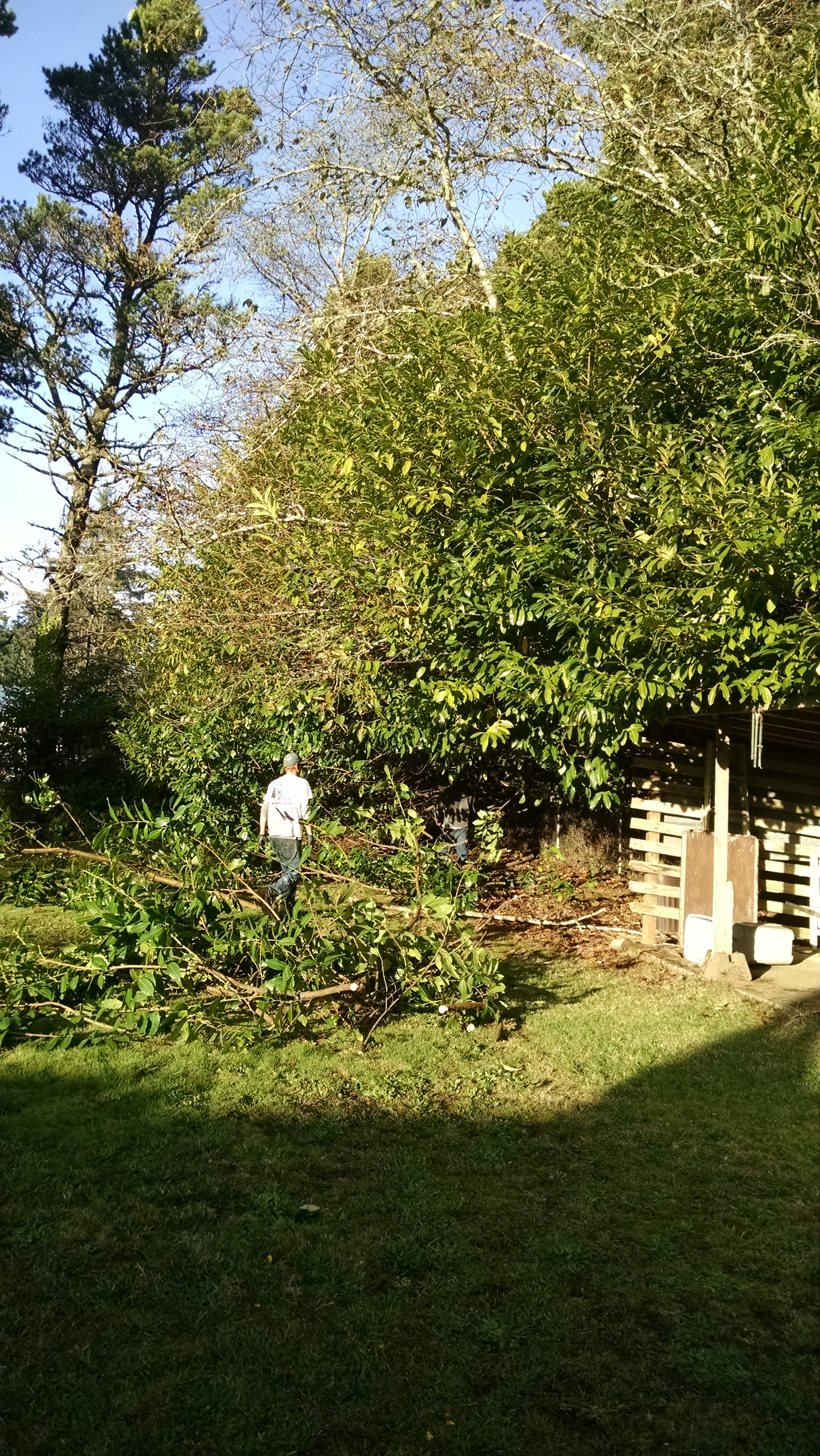
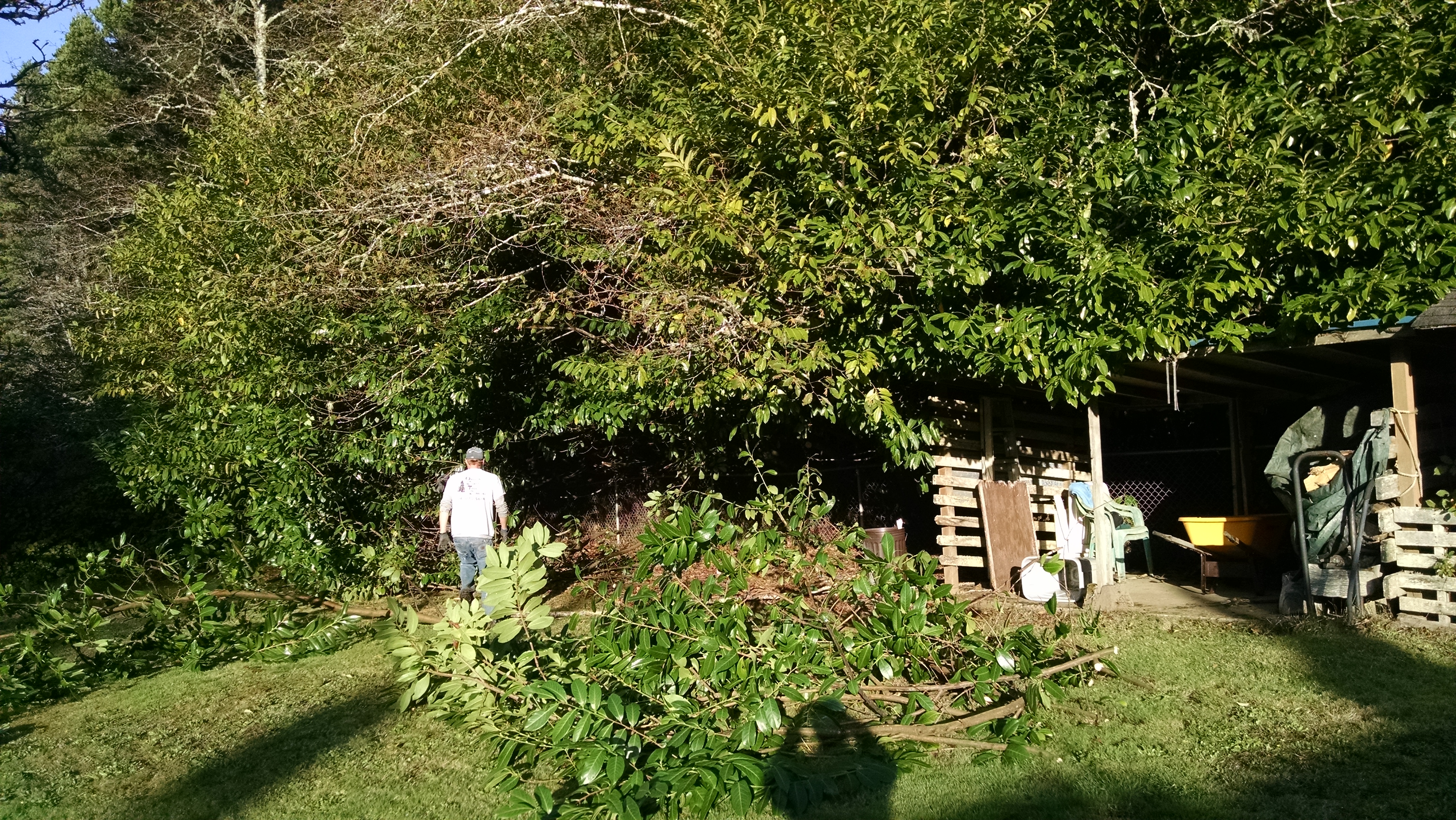
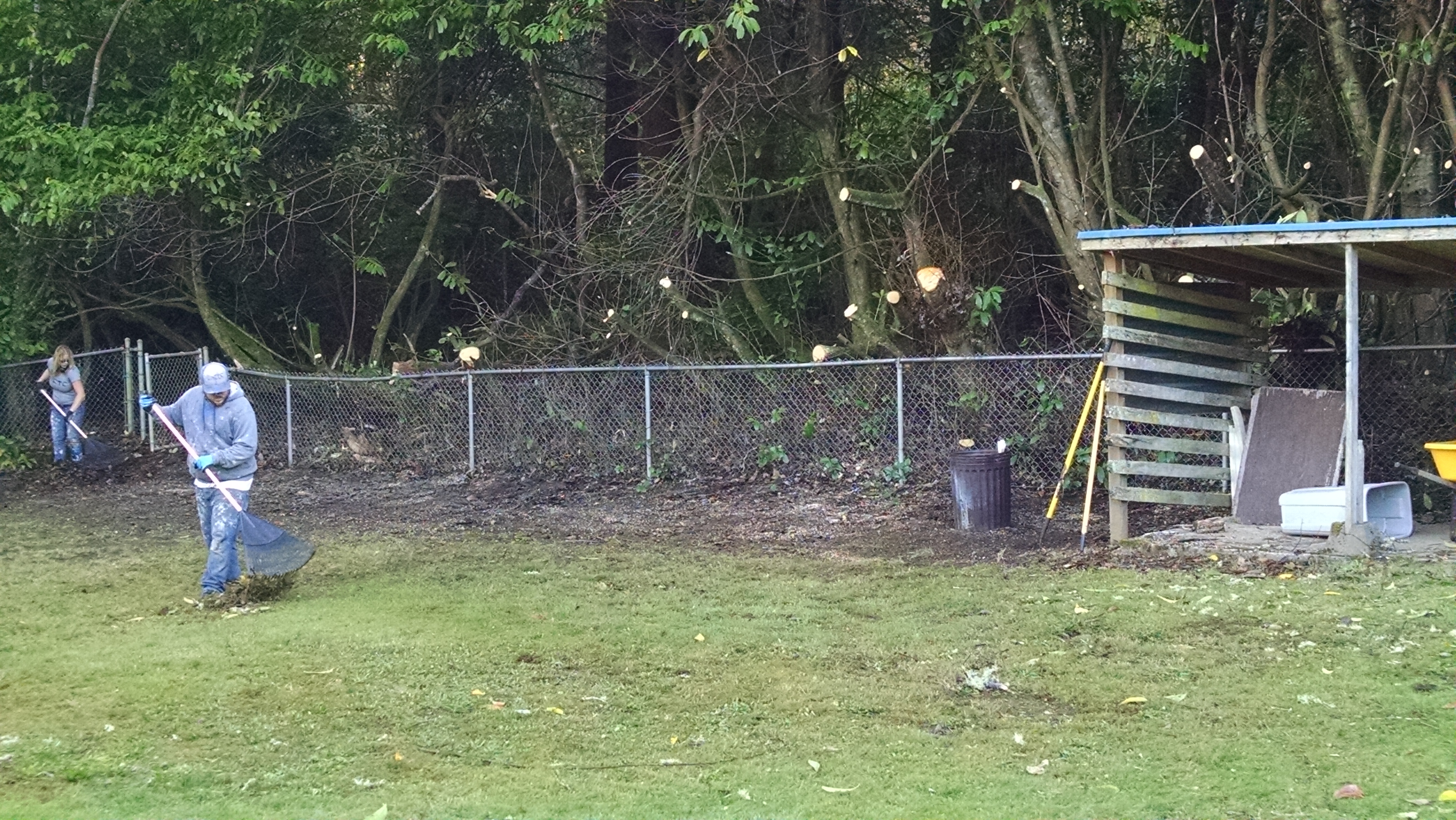
Chain saws roar in my back yard. Usually occupied by birds, newts, and the occasional rabbit, today it’s filled with people. Five workers from Oregon Coast Tree Company, four men and a woman, have trimmed the wild laurel off my fences and woodshed, opening up a six-foot-wide stretch to the sun. They’re cleaning up now, cutting last chunks of wood, raking leaves and scraps, feeding branches into the wood chipper. Kip Everitt is up in my giant Sitka spruce, cutting dead branches.
They did most of the work yesterday, leaving stark cuts all
along the fence. Amputations. It’s not that I didn’t like the laurels. Their
leaves were beautiful, with pretty flowers in the spring. They were home to
birds, bees, and squirrels. I feel bad for what we had to do. But in the
rain-soaked ground beyond the fence, their roots let loose, and the trees fell
against the fence and the woodshed. Soon their weight would push these
structures down.
The laurels had been leaning for a long time, some of the
branches bent nearly to the ground but beyond my ability to trim with my
loppers and my pole saw. I’m terrified of chain saws, of anything with blades.
I have a bad back and funky knees. My arthritic wrists hurt just sitting here
typing. These workers are young and strong. They pick up giant hunks of wood
like sticks. They’re also fearless. They stand on roofs and fences and perch in
trees, their chainsaws like extensions of their arms. Plus, they have the gear
to deal with what they cut. It would take me years to dispose of that much
wood.
And Lord, they are fast. In about four hours, they have
transformed my yard. They have to be fast. They are booked two months in
advance, interspersing painting, power-washing and other jobs between tree gigs.
Things will not slow down when the winter storms start knocking down more
trees.
I hear a “Woohoo!” as Kip drops a big branch off the spruce. It bounces on the lawn.
I love having this drama to watch out my office window. Soon the crew will be gone, and quiet will return. Annie and I will walk around the yard, absorbing its new look. For years, the area under the laurels has been covered with leaves. I gave up raking, declaring it a newt habitat. But now I’m thinking about planting something in the newly open space, a hedge perhaps, maybe rhododendrons. The newts have plenty of habitat outside the fence.
I don’t want to compete with nature, but sometimes I have to
defend my space. Trees still surround my home like tall, wise guardians. With
luck, they will remain standing when the big winds come again, and the robins
will build new nests in the spring.
Kerry Blaisdell, Jack Estes, John Dover, and Sue Fagalde Lick at the Portland Book Festival Photo by Gail Pasternack
It’s 5 p.m., and the Portland Book Festival is winding down. Where once one couldn’t move for the crowds, now there’s space between the bodies. Formerly known as Wordstock, the festival has once again drawn thousands of book lovers to the Portland Art Museum and surrounding venues. Everywhere you turn, someone is giving a talk, reading from his or her books, offering services for writers, or selling books. People bring their babies and their kids, hoping to turn them into readers. Food carts line up selling tamales, pizza, donuts, and other goodies.
In a world where half the people say they never read books, it’s wonderful to see so many celebrating the written word, even if they wander around in a word-stoned daze, making it hard to move. We stand in line for the readings and talks, for food, for coffee, to buy books, and to use the restroom.
Now, with the festival ending in one hour, it’s getting easier to breathe, but it doesn’t bode well for sales. With several other Willamette Writers authors, I have drawn the last shift for selling and signing my books. My book bag is heavy coming in, but I hope it will be much lighter going out.
We stand behind the table, behind our piles of vastly different books and exercise our best selling techniques. Debby Dodds flashes her technicolor smile and plays her connections with seemingly everyone in Portland to sell her young adult novel, Amish Boys Don’t Call.
Jack Estes, whose wonderful books are about soldiers, shouts out, “Do you know any veterans?” because, well, who doesn’t, and tomorrow is Veterans Day. Sometimes the question backfires. People are like “What? Why?” Plus, people don’t give Veterans Day gifts. Maybe they should.
John Dover, creator of the “jazz noir” Johnny Scotch series, plies his local connections and offers readers a good time with his books and stories. Kerry Blaisdell hands out free calendars to lure people to her urban fantasy novel, Debriefing the Dead.
Me, I pass out postcards with the cover photo from Up Beaver Creek. “Would you like a pretty picture, something to look at and de-stress?” Mostly women accept it. A few turn it over, read my pitch and come back to take a look at the book. Success.
Since our table sits under the Willamette Writers banner, we give out information about the organization, about the various branches, our program for young writers, and our literary magazine the Timberline Review.
But it’s a tired crowd, with going home on their minds. It’s getting dark outside. Their bags of books are already too heavy. Many don’t even glance in our direction. Some dart in to grab the leftover Halloween candy set between the books. And some stop to chat. And chat. And chat. I want to scream, “Move on. You’re blocking my books. I don’t want to carry these damned things home.” Just as I wanted to scream when I was on the other side perusing the booths, “Pass on the right!” and, “If you’re going to stand still, get out of the way.” But I don’t scream any of those things. I smile and offer up pretty pictures.
My photo technique works. I sell a book. The buyer hands me a credit card. It’s the first time I’ve used the credit card app on my phone. Will it really work? It did when I practiced at home, but . . . Look! It works! I hand her my phone. “Finger sign here, please.” How crazy is that? In a minute, I get an email saying $15.00 has been deposited into my account. Magic. Somebody else buy a book. Let’s do it again!
Up until this year, I have not accepted credit cards. Cash or checks only. But that’s old-fashioned. Now we all have our little card readers on our phones. Zip, zoop, sold.
That one sale is it for the night, which is as good as any of us except Debby does, but as John Dover notes, this is not about sales. It’s about shaking hands and making connections. It’s about getting people to take our cards and our swag so that they might go home and order our books or at least remember our names.
It’s also about being with other authors after the solitary process of writing our books. We compare notes. Best and worst selling experiences. Bookstores that treat authors well or treat them badly. Places we might give talks. Favorite flavor of Ghirardelli chocolate squares. (Mine is mint.)
And it’s fun. I think of myself as shy, but I have spent the day talking to strangers, putting myself “out there.” “Hey, you need another book!” I hear myself shouting. I’ve turned into a huckster.
Afterward, walking the six blocks to the parking garage, my bag is no lighter than it was coming in. I couldn’t resist purchasing one more book from a Facebook-only friend I finally met in person. I don’t mind. My feet hurt, but my heart feels good.
It has been a long day, which started with standing in line with approximately 2,000 people for over an hour in 36-degree weather outside the Arlene Schnitzer Concert Hall to see and hear Tom Hanks talk about Uncommon Type, his new book of short stories. The ticket price included a copy of his book. We grab our books from the thousands piled on tables in the theater lobby and cuddle them like kittens. Tom Hanks does not have to stand behind a table with postcards and chocolate bars trying to get people’s attention. It helps if you’re an Academy Award winning actor.
Tom Hanks’ hour-long talk was fabulous. It was funny, sweet, loving, and wise. I’m in love. We all are. Last night, I dreamed about Tom and his big gray dog walking up my driveway. I greeted them like old friends, casual, not star-struck at all—until my sweet Annie dog turned into Cujo and attacked his dog.
I’m so sorry, Tom. Would you like a pretty picture of Beaver Creek?
***
Fun fact: Back in the early 90s, Tom Hanks spent a night camping in an Airstream trailer on my grandfather’s property at Seacliff Beach, California. Or so says my father, who is not impressed with all this book nonsense, but thought it was pretty nifty that I got to see Tom Hanks.
The Coast branch of Willamette Writers meets this coming Sunday, Nov. 18 at 2 p.m. at the Newport Library. Rachel Barton will lead a free poetry workshop. Everyone is invited to join us for lunch at the Chowder Bowl at 11:30 that day where we can chat and fill up on chowder. PM me or email me at coast@willamettewriters.org if you’re coming to lunch so we can save you a seat.
I just discovered this is my 500th post! That’s a lot of blogging.
Last night I realized I have been writing and submitting my work for publication for 50 years. At least. I wrote my first poem when I was seven. By eighth grade I was writing a novel. (It was about a little girl named Emily whose house burns down, killing both her parents. She hits the road by herself and embarks on a series of adventures.) My first non-school publication was a short poem I sold to a magazine when I was a junior in high school. There was never any question I was going to be a writer.
My Grandma Rachel, who wrote poetry herself, gave me my first copies of Writer’s Digest. I followed the instructions given there for submitting my work to magazines and newspapers. I got plenty of rejections in the mail on little slips of colored paper, but I also won some prizes and got some things published. I still have copies of those early publications.
I would have stuck with poetry and fiction, but a girl needs to earn a living, so I majored in journalism and went to work for a series of newspapers in the Bay Area, starting with the Milpitas Post in 1973. Name a South Bay newspaper, and I probably wrote for it, either as a staff writer or freelancer. Most of those papers have now either folded or merged into one big company owned by Bay Area News Group, but I had a good time back then. Before and after work, I was still doing my own writing and sending stuff out because I was a writer.
After Fred and I moved to Oregon and I wore out all the Oregon Coast papers, I went back to school, earning my master of fine arts degree in creative nonfiction through Antioch University Los Angeles’ low-residency program. Today I’m still writing, seeking markets, and sending stuff out. My God, the reams of paper I have sullied.
I have no idea how many articles I have published. Lots. Plus eight books and numerous poems, essays, and stories. (See my book page. Buy one or two.)
A lot has changed. Instead of rejection slips that come in the mail, we get emails offering the same message: “Sorry, we can’t use this. Good luck with your writing.” Some publications exist only online, living in cyberspace only as long as we have electricity, WiFi and compatible formats. I like the way people all over the world can read them immediately, but I still treasure the smell of paper and ink, the heft of a book in my hand, and a page that has my name and my words on it.
One thing that hasn’t changed is the pay. Literary magazines pay mostly in copies of the magazine. Some pay a few dollars, but not much more than they paid 50 years ago. Journalism paid better until the Internet ate the newspaper business. If you need lots of money, become a plumber.
In the end, none of that matters. It’s the writing, capturing the moments and the ideas that would otherwise slip away, writing things that make readers stay up all night to find out what happens or that make them nod their heads and say, “Yeah.”
I’m still submitting my work. My odds have improved, although I still get rejections. I belong to a Facebook group of poets trying to get 100 rejections in a year. As of this moment, I’m up to 71. But it’s not all rejections. You can see some of my recent publications on my website, and I’ve got a couple other things coming out soon. It’s a gamble. I tell people I don’t need to go to casinos or play the lottery; I’m a writer.
Fifty years. Wow. I thought of this while reading an interview with the new editor of The Paris Review. She wasn’t even born 50 years ago, but I remember sending my baby poems to The Paris Review way back in the early days. Rejected, of course.
Rejected or not, I’m still scribbling. I was always going to be a writer—except for that one year in high school when I decided to become a home economist because writing was too hard. But then I published that poem . . .
Thank you for reading what I write. Forgive my absence last week. I was back in San Jose visiting my dad, but was writing in my notebook the whole time. The ideas kept coming.
Here’s what it’s like to be a writer: I was on my way to the hot tub last night when I saw that article in Poets and Writers about The Paris Review and got this idea. I grabbed my journal. Four pages and 45 minutes later, I was still on the floor by the pellet stove wearing nothing but a terrycloth robe, writing as fast as I could.
Sometimes people ask me if I’m still writing. Silly question. Fifty years, and I’m just getting started.




![IMG_20181107_095243272[1]](https://unleashedinoregon.com/wp-content/uploads/2018/11/img_20181107_0952432721.jpg) Last night I realized I have been writing and submitting my work for publication for 50 years. At least. I wrote my first poem when I was seven. By eighth grade I was writing a novel. (It was about a little girl named Emily whose house burns down, killing both her parents. She hits the road by herself and embarks on a series of adventures.) My first non-school publication was a short poem I sold to a magazine when I was a junior in high school. There was never any question I was going to be a writer.
Last night I realized I have been writing and submitting my work for publication for 50 years. At least. I wrote my first poem when I was seven. By eighth grade I was writing a novel. (It was about a little girl named Emily whose house burns down, killing both her parents. She hits the road by herself and embarks on a series of adventures.) My first non-school publication was a short poem I sold to a magazine when I was a junior in high school. There was never any question I was going to be a writer. Unleashed in Oregon