Post-cataract: writing without glasses

I’m writing this without glasses, and I can actually see what I’m writing. That’s an amazing thing for someone who has worn glasses or contact lenses full-time for 40 years. I keep raising my hand to adjust my glasses and discover they’re not there. Just before I turn out the light at night, I go to take off my glasses, and in the morning, I reach for my glasses on the nightstand. They’re not there. And I don’t need them.
I had my second cataract surgery a week ago today. It had been almost a year since the first surgery. That surgery on my multi-troubled left eye increased my distance vision but decreased my close-up vision. I still needed glasses to function. We waited a year for the cataract in the right eye to progress enough to qualify for insurance coverage. By October it was there.
I reported for surgery early on 11-11-11, which seemed like an auspicious date. The process was familiar, as were the scrubs-clad folks in the surgery department at Samaritan Pacific Community Hospital in Newport. Inevitably, I run into people I know from church, music and writing groups, all doing their day jobs. Lots of smiling faces.
They led me to the bed fully dressed, covered me with a warm blanket, put a blue bonnet over my hair, took away my glasses, hooked me up to monitors and an IV, put drops in my eye and asked me many times who I was and which eye they were doing. Dr. Haines came through and wrote his initials in blue ink under my right eyebrow.
With my right eye taped shut and wires running all over me, I signed a consent form and waited for my turn. Dr. H. does cataract surgeries all day on Fridays, one after another. Now that I couldn’t escape, several people warned me that this time I would be more aware of what was happening. I knew that technically they didn’t put us all the way to sleep, but I didn’t remember being aware of anything during my first cataract surgery, and I didn’t want to know what was happening this time either.
They were right. I was considerably more awake but sedated enough not to be afraid. I don’t remember everything, but I do remember being wrapped up like a chimichanga. I remember Dr. Haines coming in. I remember seeing bright lights and what looked like blue and red squares. Then I remember Dr. Haines telling me it was over and I had done well. Thank God I don’t remember them removing the old lens and inserting the new one.
Afterward I was up and eating a cinnamon scone in no time. My friend Pat drove me home, where I started the laundry and took a nap, then woke up and started seeing what I could see.
The bad news is that I still need glasses for distance. I’m less nearsighted but not nearly enough to drive or watch TV. But I can read, play the piano, work at the computer, and tool around the house minus specs. I haven’t been able to do that since my teens. Colors are brighter, and I can see things like little scars on my hands and dirt around the bathtub that I didn’t know were there. It’s fascinating.
I won’t be able to order my new glasses for a few weeks because it takes the eye time to adapt to the new implanted lens. That part is frustrating. Also, I have had to go without makeup for a whole week now. Talk  about revelations. But when I wake up in the middle of the night and the numbers on the clock are clear, I think it’s pretty cool.
Annie the dog is confused. To her, my glasses were as much a part of me as my nose or ears. She keeps staring at me with a look that says, “What happened to your face?”
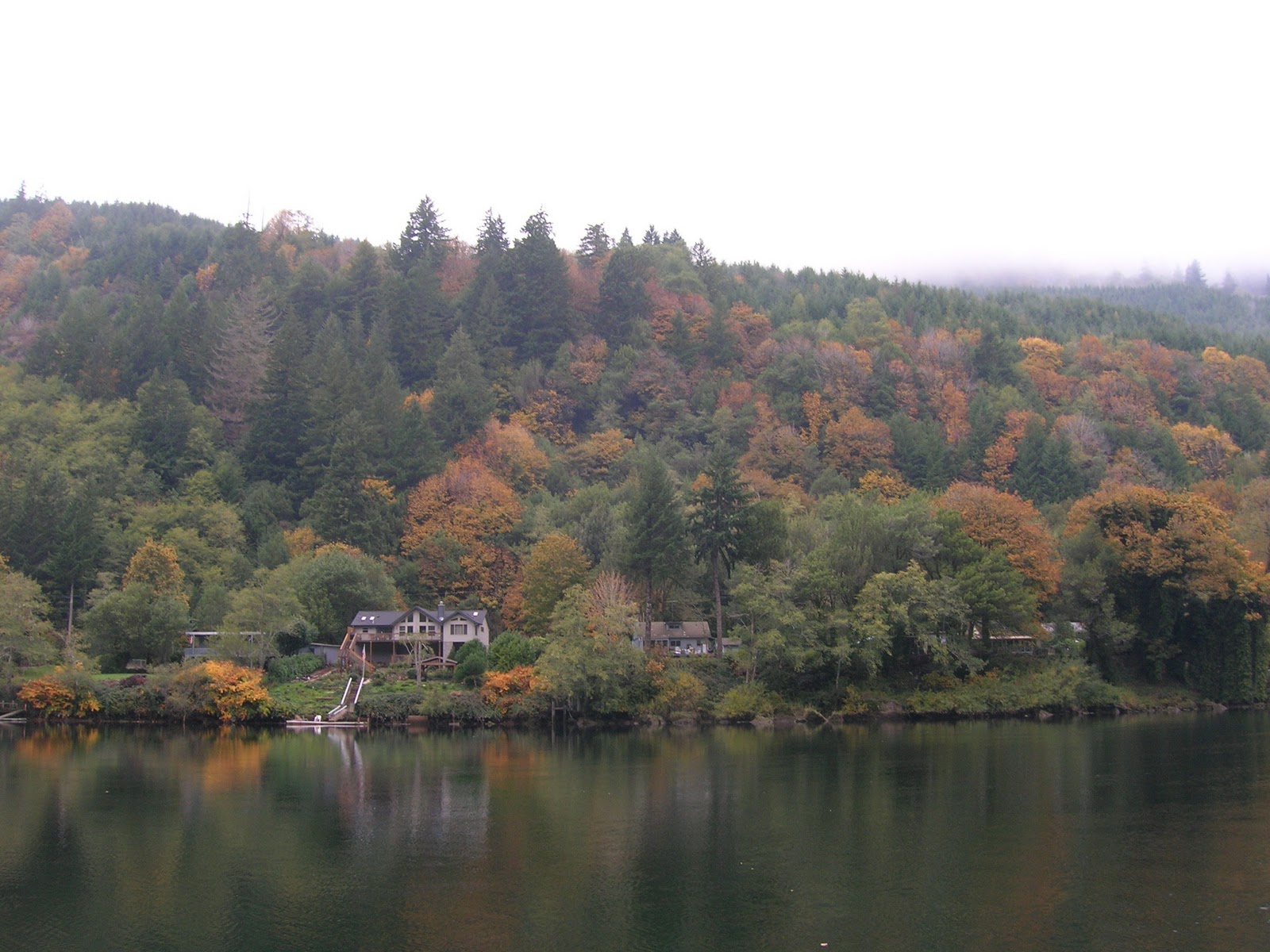
Autumn reflections in Scottsburg

Driving along the Umpqua River between the coast and I-5 last weekend, I just had to stop and take pictures of the fall colors. Where I live in South Beach, recent storms have already wiped out the red and gold leaves, but here, 20 miles inland, I found a glorious multi-hued patchwork of trees reflected in the water.

This was taken at Scottburg Park, a boat launch and picnic site about 2 1/2 miles west of the tiny community of Scottburg. Founded in 1950 by Levi Scott, it was once a bustling shipping port. The advent of the railroad and bigger ports took business elsewhere, but it’s a still a sweet little river town with one market, one restaurant, a bait and tackle shop and an “elk crossing” sign.

copyright 2011 Sue Fagalde Lick

The Glamorous Life of the Writer, Again

So here I am in Medford, OR, wearing nothing but my bathrobe because my clothes got all wet between the exhibit hall at the Expo Center and my car. But I kept my books dry, of course. The plan was to not have any books left over, to go home with a lot more space in my car, but no, this fair was a bust. In fact, we quit two hours early, and by then a third of the authors had already packed up and left.

Wouldn’t you know I’d try the Oregon Book and Author Fair on its first year at the Expo Center? The previous venues, hotels and libraries in town, not only attracted crowds, but they were actually warm. We had been warned about the heat being inefficient in the exhibit hall, but actually it was nonexistent. It was about 50 degrees inside, colder and raining outside. The concrete-floored hall was vast and ugly.

We were arranged at long tables with dozens of authors, who gamely put out books, postcards, brochures, bookmarks, pens and candy. One guy, who writes haiku books, wore a clown hat. Another wore a sweatshirt that said, a “Ask me about my book.” One author brought a model of a spine for her book on scoliosis. Another had model wagon trains. One had balloons.

All to no avail. There were no customers, except the authors themselves. I did my part; I bought five books and a hot dog. But I did not sell a single book. Even the one lady who assured me she would buy a book failed to show up at my table.

I did trade one of my books for another woman’s book. There was a lot of that going on. And I made some good contacts, I think. This Portuguese woman promises to get me on her TV show. Another author plans to invite me to her upcoming book fair, which she promises will have a lot more going on.

My tablemate, Jim Henson—not the Muppet guy—is a delightful man, full of jokes, stories and encouragement. We made plans to meet in Newport for the open mic at Café Mundo.

It’s not all a loss, unless you’re counting dollars. Let’s see, miss a weekend of work, drive 500 miles, pay for the dog to stay in the kennel . . . no, it doesn’t pencil out. But if you think of it as a life experience, it’s not so bad. I talked to lots of people, got to see the fall colors here in Medford, and I’m still enjoying the amenities of a really great hotel: giant-screen TV, microwave popcorn, pool, spa, fitness center, hot buffet breakfast, free newspapers, a heavenly bed, and an escape from the responsibilities of home. Of course, I have to eat breakfast with strangers, and the clock radio suddenly burst into loud music at 4:10 a.m. And there was that flat tire near Roseburg, but hey, it’s an adventure. I’m writing, I’m reading, I’m swimming, I’m watching TV, I’m going out to dinner. And I have a new badge that says I’m an author.

Anybody want to buy a book? Or two or three? Christmas is coming. Visit https://www.suelick.com–or the back of my Honda.

It’s mushroom time again

It’s mushroom season here on the Oregon coast. Last weekend, we had the giant Yachats Mushroom Festival, which offers speakers, mushroom hikes, mushroom tasting, slide shows and more, but I think the mushrooms are even more abundant now than they were last week. All it takes is a little rain and they pop up everywhere. Did you know mushrooms are just the fruit of plants that mostly grow underground? True.

Mushroom fanatics, called mycophiles, head to the woods this time of year to collect bucket-loads of mushrooms. The fungi come in all different shapes, sizes and colors. Some of them are fabulous to eat while others are toxic. It’s important to know the difference before you pick, cook and eat them. For example, King Boletes, which look like pancakes on a stick, are great to eat. Fly agaricas, those pretty red ones with white spots, can be deadly.

Even if you don’t like mushrooms, they’re fun to look at. On our walks, Annie and I are seeing boletes, russelas, chanterelles, amanitas, and other mushrooms. (Actually, I’m seeing them. I was looking at a new patch of mushrooms yesterday when Annie almost took my leash-holding hand off streaking after a cat.) Along the edge of one neighbor’s yard, a crop of mushrooms that look just like oyster crackers appeared overnight. I just want to dig in with a spoon, but I know better.  Never eat mushrooms raw and never eat them if you don’t know whether they’re safe. Plus my neighbor might think I’d lost my mind.

A good pocket guidebook is David Arora’s All That the Rainfall Promises and More. Arora was the keynote speaker at last week’s festival. His book is full of great color photos and descriptions of all kinds of mushrooms.

Around here, the Lincoln County Mycological Society meets the second Saturday of the month in Otter Rock. Call 541-765-3191 for information. You can also learn more about mushrooms through the North American Mycological Association, http://www.namyco.org/.

This is why we moved to the Oregon Coast

Yesterday was one of those days when it was easy to remember why we left Silicon Valley for the Oregon Coast. The day had its challenges (rejections, home repairs, computer woes), but it certainly had its consolations. Let me share a quick list:

  •  The weather was spectacular, in the 70s with a sky far brighter than so-called “sky blue.” More like royal blue.
  • A screw fell out of my glasses. Within a half hour, I was able to drive to the optometrist’s office without traffic, get it fixed immediately and have a nice visit with the ladies there. Add a stop at the South Beach post office and a trip through the drive-through window at West Coast Bank and I was still home in less than an hour. That would never happen in San Jose. I’d still be sitting at a stoplight.
  • Annie and I went to the dog park and met a great group of friends with terrific dogs who played until their tongues were hanging out. A dog named Buddy adopted me and rested at my feet. Instead of being jealous, Annie adopted Buddy’s owner.
  • After a great pasta dinner, I headed out for a meeting of the Oregon Coast chapter of Willamette Writers and saw the most spectacular sunset, with layers of red and yellow and white that had me fumbling for the camera on my phone.
  • At Willamette Writers, which branch I co-founded a few years back, I was asked to tell about my new book, Shoes Full of Sand, and welcomed to sell copies. The guest speaker, Valerie Brooks, remembered me from other WW events. They don’t call Newport “the friendliest” for nothing.
  • Fifteen minutes after the meeting ended, I was home in my hot tub looking at a sky full of stars.

This is why we moved to Oregon.

It’s Great Being a Famous Author–or Is It?

This afternoon Annie and I were walking on our usual route down 98th Street pondering the deer leg Annie had just pulled out of the weeds when a gray sedan came up from behind us and stopped. Through the open window a woman in a tie-dyed tee shirt called, “By any chance are you Sue Lick?”

“Why, yes, I am.”

It turns out she had just finished reading my book Shoes Full of Sand and she and her husband had decided to explore the areas where I wrote about walking with our old dog Sadie. When she saw me and my yellow dog, she thought that just had to be us. Of course my picture is on the back of the book, so that’s a big hint.

I was flattered that someone would read my book and want to see the areas I described and that they were excited about meeting the author.

After I introduced Annie, she said, “Don’t tell me that Sadie passed away.”

I sighed and said, “Okay, I won’t. But she’d be about 30 years old now.” Actually she wouldn’t be that old, but older than most dogs get.

Well, they were all excited to meet me in person, and I was all excited to have such avid fans–especially fans who are not my friends or relatives, but later I got to thinking. What if people read my book and came to my house? What if they weren’t nice people? There’s a danger in being recognized and having people know where you live and what you do.

There’s another complication in that whatever you say in a book is out of date even before the book is published, unless you’re writing history. A memoir is a slice of life from a particular time. A lot has happened since I wrote Shoes Full of Sand. Sadie and Fred are both gone. Some of the trails we used to hike have become so overgrown you can’t walk there anymore, but there’s a new trail I’d love to show folks. I have published two other books, and I work as a music minister at the church now. And of course now I have Annie.

It’s a real argument for writing fiction, although I’m having trouble with the 1999 novel I’m revising for the Kindle right now because my photographer heroine was still using film, which she developed in a darkroom, and her pictures were in black and white. Suddenly this once-contemporary story is a period piece.

A body can’t keep up these days. But if you see a dark-haired woman with a big yellow dog walking down 98th Street aka Thiel Creek Road, yes, that would be me. We can pretend that nothing has changed.

Celebrating the Yaquina Bay Bridge

Usually what locals want most from driving over the Yaquina Bay Bridge is to get over it quickly. We mutter at tourists who take their time, gawking at the ocean to the west and the bay to the east. Yeah, yeah, it’s pretty, but move along.
Some days it’s so foggy you can’t see anything on either side. Other days, it’s so windy, you’re just trying to stay in your lane. And on other more benevolent days when the sun shines, and you see hills in the distance and sailboats bobbing in the bay, you think, I’m so lucky to live here.
Yesterday, Sunday, Oct. 3, the scene on the bridge was different. The people of Newport and surrounding towns turned out en masse—and on foot—to celebrate the bridge’s 75th anniversary. Our art deco masterpiece opened in 1936, part of a chain of bridges by architect Conde McCullough that finally provided a way for people to drive the Oregon Coast without having take a ferry across the waterways.
It really is a beautiful bridge, painted a soft green, its arches swirling into the sky, its pillars artful reminders of an earlier time when life moved more slowly and nobody was tempted to use a cell phone while speeding across the bridge.
The celebration has been going on for a month, with talks, displays in the historical museums, and big banners across the bridge and in front of Newport City Hall. Two friends, Matt Love and Judy Fleagle, published new books about the bridge.
It all crescendoed in yesterday’s festivities. First, everyone was invited to walk across the bridge at noon. The Newport High School Marching Band led the way, followed by pedestrians, a fleet of 1930s-vintage vehicles, and bicycles. Some folks dressed ‘30s-style while most put on their fleece and slickers. Rain was coming. Fortunately, it held off until the bridge had been crossed.
Under the bridge, folks gathered for a community picnic, complete with hot dogs, music, vendors and speeches. What a great feeling when people come together like this. It’s one of the things I love most about living on the Oregon Coast.
My photos were shot while I was driving southbound across the bridge on the way home from church.The next time I cross the bridge, I’ll probably be looking around like a tourist. What’s the rush?
By the way, it’s pronounced Ya-KWIN-na. We former Californians all have to learn that it’s not Spanish. It’s a native American name.

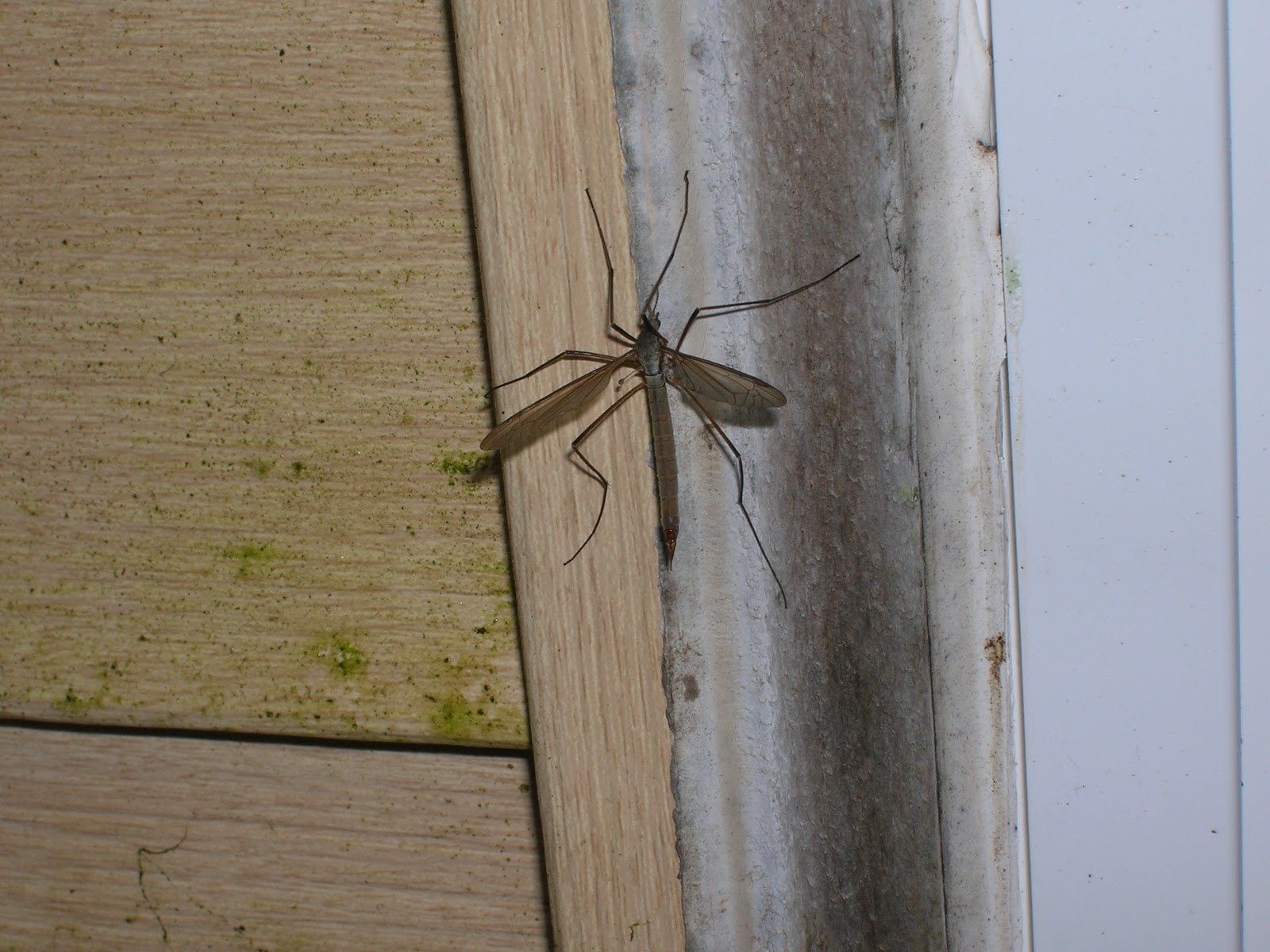
Crane flies invade South Beach

I was just drifting off to sleep when I felt something whoosh past my ear. Crane fly. It had been flying around the bedroom while I was reading, but I had assumed that once it got dark, it would mind its own business. Wrong. It was doing fly-bys like a drunk hummingbird.
Suddenly awake, I swatted at it, but it was gone, and I had no idea where. I turned on the light and looked around my bedspread, my walls, even inside my nightgown. No sign of my intruder. I assumed I had either maimed it or scared it enough to make it fly away.
It was late. I was sleepy. I turned off the light, and scooted down under the covers again. Fifteen minutes later, whoosh. Again, it buzzed my ear. Again, I swatted at it.
Again, I turned on the light, looked all over my room and found nothing. It’s not easy to sleep when you know something is about to buzz your head, but I dozed off anyway.
This morning, I still have not found it, but I did find three of its cousins clinging to my back door. It’s crane fly season in South Beach.
When I was a kid, we used to think these were giant mosquitoes. All it took was one to turn a classroom into a riot of shrieking children. But we didn’t see them nearly as often as we do here.
In September 1999, a year after we moved to this house, my yard was suddenly a sea of these giant mosquito look-alikes. Everywhere I stepped on my lawn, another one flew up. They clung to the walls and windows outside, and sometimes got inside. I decided it was time for some research.
That’s when I discovered these invaders were crane flies. They lay eggs in the grass, which hatch around this time of year. The bad news is that the larvae eat your lawn. The good news is that they won’t eat you. They really do look like mosquitoes, right down to what looks like a stinger hanging down, but they are not mosquitoes. They do not bite people.
Over the years, I have developed a live and let live policy with these big bugs. My lawn is no prizewinner anyway. But when they start buzzing me at night, it’s war. Look out, Mr. Crane Fly. I will find you before the lights go out tonight.

No gender confusion at the dog park

Males and females are different. That has never been more obvious to me than when I have watched Annie interact with the males at the dog park. I don’t know if I have mentioned here before that Annie is in love with a Dobie named Frisco. He’s tall, dark and perfect, a studly unneutered dog who wags his stub of a tail and comes running when he sees Annie.

Together, Frisco and Annie run and sniff each other, and Annie does this flirtatious dance I have never seen her do anywhere else. She keeps flipping her rear end at Frisco.

Enter another male, Buddy. Buddy is an Australian cattle dog mix, a bit smaller than Frisco, about Annie’s height. Suddenly the males bond and go off running while Annie tries to follow but can’t quite keep up. Occasionally, Frisco takes a break to lick her rear end. Buddy takes a minute to sniff her girl parts, too. Then he goes off running with Buddy again. Clearly females are only good for one thing in their eyes.

Another female arrives. Uh-oh, I think. Surely the girls will get jealous and fight. But no, Buddy takes a shine to the new female, and Frisco sticks with Annie. Suddenly everyone’s paired up. Isn’t this the way of the world?

What follows is an orgy of running, peeing, licking and attempted humping. Dogs don’t worry about trying to be polite. They act like animals. Watching this, it’s hard to ignore the obvious roles given to males and females in nature. I wonder how this applies to people, especially as I sit next to the male dogs’ male owners and feel as if I come from a different tribe. I’m grateful I put on makeup, and I worry about how my rear end looks as I walk away, regretting the gym pants with keys and cell phone making the pockets bulge. The men are probably too busy talking to each other to look anyway, but maybe . . .

Usually Annie lets me know when she’s ready to leave, but this time I had to drag her out. Frisco licked her ears in farewell. She staggered to the car and climbed onto the passenger seat, wet, stinking of urine, worn out and utterly in love.

You can’t argue with that.

Can Dogs Laugh? and other burning questions

I spent yesterday at the beautiful Sitka Center for Art and Ecology north of Lincoln City. What a gorgeous place, all trees, grass and wood-shingled buildings, paintings and sculptures everywhere, a stunning view of the ocean, and profound quiet. I can see why creative people apply for residencies there.

I was there with 29 other fans to attend a writing workshop taught by Brian Doyle, author and editor of Portland Magazine. If you have never read his work, please look him up and read some. It will be good for your soul. His most recent book is Mink River. As he puts it, “I committed a novel.” It’s a masterful work but a little bit tough, especially at the beginning, so you might want to start your Doyle explorations with something else.

Meanwhile . . . Doyle kept insisting that he is not a teacher and cannot teach people to write. What he did instead was help us find story starters in our own minds and experiences. We didn’t have to share what we wrote; they were for us to keep and “take for a walk” later when we went back to our computers.

One of many exercises had us asking “what if” questions. I’d like to share a few of mine and invite you to come up with your own. Let yourself be crazy. Write down whatever comes to mind.

So, can dogs laugh?

What if we all stopped wearing clothes?
If the big tree in my back yards could talk, what would it say?
What if paper was food?
What if we sang instead of talking?
What if my family all lived in one big building? Who would cook?
What if God showed up right here, right now?

It’s fun. Give it a try. You don’t have to answer these questions, but you might.