I missed the BIG Oregon Coast storm

It’s raining sideways. I’m not even dressed yet and we have already had thunder and hail. The weather guys are predicting high winds through tomorrow and rain for the foreseeable future. Apparently the Oregon Coast has not gotten the word that it’s spring.

A little over a week ago, I was in San Jose, California with my father. I experienced rain and wind most of the trip down, but it felt as if the weather stopped at the Santa Clara County line. No rain in San Jose. The clouds threatened to break loose, but they didn’t until just before I left and then only a few reluctant drops. 

Shortly after I arrived, I got online and discovered that I had made it out of South Beach just in time. A huge storm had walloped the coast, not only with rain and gale-force winds but snow. I wasn’t here to see it, but we had six inches in our yards. Six inches at the beach! Insane. Schools were closed, events cancelled. Electricity, Cable TV and Internet connections went down. People were stuck on on Cape Foulweather for hours. Some had to abandon their cars overnight. All the roads out of here were closed by snow and fallen trees. I could not have gotten out if I left a day later. I couldn’t believe what I was reading. Was my house okay? Were my trees down? I would have to wait a week to find out.

After lots of Dad time and a visit to my brother’s house near Yosemite, I drove home through sun, then snow, then rain, determined to get as far as I could the first day. I white-knuckled it over the Siskyou Pass, where the snow made it hard to see but the road was still clear. I assumed that I once I hit lower ground, the snow would be history. But in Medford, where I stopped for the night, it was snowing hard as I checked in and went to dinner at the Black Bear restaurant next to the Best Western (nice place, but don’t order the stuffed chicken).

By morning, the weather had turned to rain. It dogged me all the way home. On the coast, trees and pieces of trees littered the roadsides. New cuts on the branches showed where workers had chainsawed them enough to let traffic go by.  As I turned onto my street, I saw that a fallen tree at the corner blocked half the road, leaving just enough room to pass. I held my breath as I approached the end of the block, then let it out in relief My yellow house was still standing, its gutters a little more bent, but the roof and walls intact.

My neighbor rushed out to greet me. “You missed it,” he said. He told me how he lay awake listening to trees snapping and falling all night. A huge branch just missed his house. He spent all day cleaning up his yard.

Branches hung limp from my 10-foot-tall juniper hedge, broken from the weight of the snow. My hebe bush hung out over the sidewalk, and sections of my rosemary bush lay on the ground. My daffodils had wilted, their one bloom in shreds. But my blue hydrangeas, on their way to blooming, looked fine. Inside, the house was cold, but otherwise as I left it. Out back, small branches covered the lawn. Annie would have lots to play with. The hot tub cover had sailed across the yard, the wind tearing its straps right off. But overall, things were okay.

As rain pattered on the skylights above my kitchen, I knew that it would soon feel as if I never left. And now, with today’s rain and wind, I feel right at home.

California trip renews old memories

I have just returned from a trip to San Jose, California to visit my father. It was a journey through two lifetimes of memories, mine and my dad’s. Now that I’m home, I’m still trying to believe that my long-awaited trip has come and gone.
My father, Ed Fagalde, is 89. I just turned 60. We are both widowed. We both order senior meals now, and we had a fun conversation comparing our prescriptions. We are lucky that Dad is still able to live on his own and doesn’t seem nearly as old as he is. Wherever we go, memories of our spouses go with us. I can see Mom in her chair by the window, hear Fred laughing at a joke.
Dad is a storyteller. Boy, does he like to talk about the good old days. We both grew up in San Jose. Dad grew up on the Dorrance Ranch, where his father was foreman. They raised prunes, cherries and other crops. Driving down Curtner Avenue between Monterey Highway and Meridian Road, he noted that we were in the middle of the ranch, which extended for hundreds of acres. He pointed to trees that were there long before the area became a suburban housing tract.
Everyplace we went, I had my own memories to match my father’s. “We had a big well here,” he said as we crossed the intersection near St. Christopher’s Church. I went to church here the first couple years Fred and I were married. He wired that building over there when he worked for Sure Electric. I interviewed the people who worked there for the San Jose Sun.
We drove through Saratoga, where I was editor of the Saratoga News, and Los Gatos, where I wrote for the Weekly-Times, had cheeseburgers and fries at a Burger Pit just like the one we went to almost every weekend when I was a kid, then headed east to Almaden, which brought back memories of my days writing for the South Valley Times. Dad’s memories went back much farther.
In the late 1800s and early 1900s, San Jose had two working quicksilver (mercury) mines, the Almaden and Guadalupe mines. Dad’s grandfather and father worked at the Guadalupe mine, and his mother taught at the school there. Both mines are long closed now. In fact, the Guadalupe mine site is a landfill site now. As the road narrowed, we drove through miles of oak trees along Los Alamitos Creek, past the houses of the wealthy and the eccentric, past a dam and a county park with trails leading to the mining sites. Dad recalled riding that steep road on bicycles with his cousin Irene. Going up was tough, but going down was really exciting. He pointed to where there used to be a dance hall, a picnic area, a swimming pool. He told how his grandfather, who was more comfortable with horses than cars, took driving lessons from a local guy in exchange for breaking two horses.
These days, the road leads to a big white building that has been a dance hall, a bar, a theater, and a restaurant. I did a story there, too, can’t remember which paper it was for. Now it’s a museum.
The sign said the museum was closed, but there were cars in the parking lot, and Dad insisted we knock on the door. Surely they’d just send us away, I thought, but no. When Dad shared some of his history, Ranger Mary Berger let us in for a private tour of rooms decorated to look like 1850s parlors and other rooms full of information about the old days of Almaden. She described a busy schedule of activities we might enjoy. Meanwhile, Dad told her a few things she didn’t know about Almaden.
It was the highlight of a week full of memories. We visited my brother at his hilltop estate near Yosemite, talking, eating and watching basketball on TV as the rain cascaded down outside. I had lunch at an ultra-modern restaurant in Newark with my stepdaughter and dinner with my aunt at La Paloma in Santa Clara.
All too soon, it was time to say goodbye, warmed by memories made new by sharing them.
For more information about the Almaden Quicksilver County Park and Mining Museum, visit www. parkhere.org and click on “History Here.”

Don’t Tell Me I’m Too Old for a Birthday Party

It’s all Mom’s fault. Every birthday, I woke up to find my bed covered with gifts and cards. I got to wear new clothes to school and eat whatever I wanted for dinner. We had company, cake and singing, and I felt like a princess.

Somehow, now that I’m a grownup, it doesn’t happen quite that way. The plumbing backs up, clients want their work on time and don’t care if it’s my birthday, and most of the family kind of forgets that hey, it’s my special day.
Hello! It’s March 9th. It’s my birthday.
It seems as if once you pass a certain age, you’re not supposed to celebrate birthdays. At least not so that anyone would notice. Just another day, says my brother. Don’t you dare tell anyone it’s my birthday, says a friend at church. One year closer to death, says another gloomy friend. I don’t have birthdays anymore, yet another friend responds when asked if this might possibly be her birthday.
Not me. I want to celebrate. I’m still alive, still healthy, still doing what I want to do. Sure, I’m older, but I don’t feel any older. I think a birthday is an important occasion, time to look at yourself and your life and thank God for the good things and resolve to get rid of the bad things. It’s a time to say, “Hoorah, I have passed another milestone.”
 It’s the beginning of a whole new year of life.
I still have fantasies of the family gathered around, torn wrapping paper and presents at my feet, and chocolate cake on a plate in my lap–with big frosting flowers so sugary they make your teeth hurt. I want to see the lit candles in the dark and hear everyone singing to me.
Me, me, me. I recently discovered that large groups of Christians and others don’t approve of birthdays. There’s the “me, me, me,” factor, selfish, spoiled and ungodly. But also, the whole cake-and-candle tradition began as a pagan rite to ward off evil spirits thousands of years ago. Since Jesus never mentioned birthday parties in the Bible, we have no scriptural basis for having them. Furthermore, keeping track of birthdays smacks of astrology, a kissing cousin of witchcraft.
Holy cow, but my saintly Catholic mother started it. If Mom baked the cake with her own hands and lit the candles and sang “Happy Birthday” to me, how could it be bad? She wasn’t singing to chase away evil spirits; she was singing about how she loved me. And maybe celebrating having gotten this accident-prone offspring through another year of life.
In our American culture, kids get birthday parties. We also throw parties for adults celebrating the so-called milestone birthdays: 21, 40, 50, 65, 80, 90, 100. For the years in-between, things sort of fall apart. You don’t get a party, unless you’re like our departed friend Robert who used to throw himself a whopper of a fiesta every year, with tons of food, a huge crowd, and hangovers that lasted for a week.
The rest of us mark our birthdays with sedate lunches, cakes at the office, and a few cards–some of which arrive a week or more after the actual birthday. Now we also get e-mail cards from those family members who will never get their act together enough to actually buy, sign and mail a real card. Last year, I received one with three pigs singing “Happy Birthday” to the tune of “Funiculi Funicula.” I read it, I laughed, it was gone.
Over the years, I have developed certain birthday rituals. My favorite is to run away for the day, then go out for dinner and cake that evening. On a typical birthday when Fred was still here, I drove north up the coast. I did some shopping at the outlet stores in Lincoln City, took myself to lunch, visited the quilt museum in Tillamook and walked on the beach. At Cape Lookout, I stood high over the Pacific Ocean and blew soap bubbles from a red plastic bottle of Mr. Bubble, watching them float into the sky and disappear into the clouds. I thought about my life, counted my blessings, and made some plans. Then I came home and pigged out on chocolate with my faithful husband, whom I had programmed for a month to either honor my birthday or sleep with the dog.
Aside from lunch with friends, I don’t know what I’ll do this year, but I do know that it’s supposed to be a special day. Mom always said so.
Perhaps it’s unseemly to celebrate one’s birthday as if one were still a child. Perhaps it’s even sinful. But I don’t believe it. God gave us this life, and if he grants us another year, I think it would be ungrateful not to celebrate as hard as we can.

Walking the Bayfront in a post-tax haze

Almost all of the snow had melted at the edges of Bay Street as I walked the Bayfront yesterday in a daze. I had just come from having my taxes done. It was the first time I had ever paid someone to do my return. My late husband Fred was a licensed tax preparer and started doing mine shortly after we met. When he became incapacitated, I used Turbo Tax to do it myself.

But this year, with Fred having died and a trust, Medicaid and other issues to deal with, I decided I needed help. As it turns out, this year’s return wasn’t much different from the others. This would be our last joint return, but otherwise it was money in and money out as usual.

I was in shock for a lot of reasons. It was hard doing this without Fred, talking so much about him being dead and going over the expenses from the early months of 2011 when he was so sick. It was difficult having to enumerate all of my writing expenses, medical expenses, and charity deductions, to pull together a whole year of life that was often fogged by grief. And then I was gobsmacked to discover the preparer’s services would cost me $550. I have to pay $350 to the state of Oregon, less than I paid last year. But I am getting a refund from the federal government. Next year, as a single woman with a lower income and fewer pieces of paper, the whole process will be simpler. I think I’ll go back to doing it myself.

Doing taxes is a profitable gig. Tax money took Fred and me on many wonderful vacations to places like Portugal, Costa Rica, Canada, and Hawaii. Our trips, like our wedding, always happened after tax season. During tax season, Fred worked like a madman, rarely coming up for air. Our phone rang constantly with tax clients wanting to set up appointments, ask questions, or find out when their returns would be ready.

I have often wished I had the aptitude to prepare other people’s tax returns myself. There’s money to be made, and I like numbers, but they just don’t behave when I deal with them. I’m a words and music girl. Besides, tax returns are stressful. I used to feel the tension in Fred’s clients, just like I felt it in myself yesterday as I sat in the tax office, anxiously watching the preparer type numbers into her computer. Would I have to pay? Would they accept my deductions? Would I have all the numbers and forms I needed?

Coming out of the tax office, I gulped air and headed for the Bayfront. Despite the morning’s surprise snow shower, the sun was out. The street was fairly deserted, but I passed a family staring into the candy shop, men smoking outside the fish plant, and a young woman smoking outside the Bay Haven tavern. Glass art, kites, tee shirts and geegaws of all sorts sparkled in the gift shops. Late afternoon diners lingered over pizza and beer at Rogue Ale and shrimp melts at Local Ocean. I stood at the rail outside the Noodle Cafe and stared at the big white NOAA ships anchored across the bay. Cormorants and gulls glided by in the bright sky. I noticed an empty crab shell on the deck and wondered how it got there. Then I walked past Port Dock I restaurant, closed for storm damage repairs, to where the sea lions usually congregate on floating docks. They weren’t there. It’s winter on the Bayfront. I zipped Fred’s old jacket tight around me against the cold wind and walked from one end of the Bayfront to the other, the sun in my eyes slowly burning away the post-tax-appointment haze.

In my mind, I have already spent my refund four different ways. May your taxes turn out as well.

Our First Seafood & Wine Festival

Last weekend, thousands of visitors invaded Newport for the 35th annual Seafood and Wine festival. Imagine being crammed in an oversized tent where the temperature is 40 degrees, everyone is drinking, and you can barely move. Fun! Like many locals, I usually stay away, but I appreciate the big boost it gives our local economy as festivalgoers pack our hotels, restaurants and shops.

Once upon a time, my husband Fred and I and our friends Larry and Jennifer Anderson were visitors, too. It was February 1996. The Andersons had already moved from San Jose to Bay City, up the coast just north of Tillamook. We agreed to meet in Lincoln City, taking rooms at the Ester Lee Motel on Friday night and driving down to the festival in Newport on Saturday.

Locals remember the winter of 1996 for its epic storms. We were not prepared. Oh yes, we brought some light waterproof jackets, but we must have figured this would be like Hawaii, where it rains but it’s not very cold. Uh, no. That first night, we ordered pizza and congregated in the Andersons’ room as the storm ramped up. Rain turned puddles into lakes in the parking lot as the window blew so hard we could see the our ocean-view windows bowing in and out. It took over an hour for the pizza delivery guy to get there, and he looked absolutely drowned. We tipped him ten dollars for his efforts and settled in with lots of wine. Surely in the morning, the weather would be better.

No again. Yes, the rain and wind had eased up. Now we had snow. It drifted down from the sky and piled up on the windowsills and on the sand. We decided against our planned walk on the beach. Even in our cozy suite with fireplace, kitchen, living room and bedroom, we were freezing. We had shivered all night. Instead of going to the beach, we drove to the outlet stores for warmer clothing. Then we piled into our car and drove to Newport.

I’ve never been much of a wine drinker, but Fred and our friends loved the stuff. In fact, Fred had started working part-time in a tasting room at a winery in San Jose, and he was building quite a collection of vintage reds. When we got to the festival, they dove in, despite being surprised at having to pay to taste. Wine-tasting was generally free in California. Here they wanted a dollar for a few drops in what looked like a Nyquil cup. But they drank and got happy while I searched out the seafood and Tillamook chocolate. This was a cultural experience, far different from the many outdoor art and wine festivals we had attended in the Bay Area, where you could sprawl on the grass in the sun with your wine and listen to live bluegrass or jazz.

After a few hours, I grew anxious to go someplace warm where I could move my arms without touching a stranger and regain feeling in my frozen toes. But oh, they were getting very happy. Finally, as the daylight waned, I convinced my group that it was time to go. They had tasted and talked and were ready for naps. “You drive,” they said. Was there a choice? I had not driven in snow before, and it was a good 45 minutes or windy two-lane roads back to the Ester Lee. Except for when I was cursing, I was holding my breath, hoping the tires wouldn’t slip.

We made it, stumbling into our rooms with our commemorative wine glasses. By morning, the snow had melted. Locals assured us this weather was a freak occurence. Six months later, Fred and I moved to Oregon.

R.I.P. Scott Paterson, musician and friend

Scott Paterson looked like an old hippie, long-limbed and bony, with a brown ponytail, bad teeth and sunken cheeks. He was a Vietnam vet, a surfer, a cowboy, a logger, a sometimes hermit, a six-time husband with several estranged kids and grandkids, a recovering alcoholic, and a musician. He played guitar and wrote songs unlike anybody else’s songs, with titles including “Up Country,” “Slow Wind” and “Psychotic Love.”
In other words, he was the kind of guy my dad would dismiss as a bum. But Dad would be wrong. Scott died on Feb. 7 at age 64. I had heard he had lung cancer, but the newspaper said it was chronic obstructive pulmonary disease. Either way, his diseased lungs killed him off. We gathered at the Newport Senior Center on Saturday to honor his memory.
It was quite a mixed gathering. Scott had been leader of the Lincoln City VFW post, so old people all dressed up occupied the center table. A gray-haired trumpeter blew taps and presented a triangle-folded U.S. flag to Scott’s tall, skinny, tattooed, red-haired, blue-jeaned daughter Darsea. Scott had been musical partners with Renae, a tiny gay lady with a mullet hairdo. Renae picked up her flute and played “Amazing Grace” like liquid silver.
Scott and Renae, who called themselves Sea Changes, had hosted an open mic for years. That’s how I happened to be there. I would come play my guitar and try out new songs on Sunday afternoons. So the audience included musicians of all sorts. Gus played his saxophone. Debbie played her mandolin, accompanied by her husband Randy on guitar.
Unlike the many religious services I have attended, this was just a steady stream of memories. Renae and Darsea had laid out hundreds of photos of Scott from the various stages of his life, from little boy to soldier to father to musician. Among them, they placed pictures of us playing our music at the open mic and encouraged us to take them home. I’ve got a picture on my refrigerator now of me sitting in a chair playing classical guitar. I can picture Scott off to the side, cheering me on. The display also included the article I wrote about Sea Changes for Northwest Senior News back in 2007, when the band included mandolinist Kate Scannell, and the three never stopped teasing each other.
One person after another came up to talk. Many, including some of the musicians, knew Scott well from the sobriety community. The only prayer we prayed was the serenity prayer. Tears filled my eyes as we said, “God grant me the serenity . . .”
So many losses lately. I’ll miss Scott.
As I said, Dad would have dismissed Scott as a bum, although in truth he worked most of his life. There were those times when he took to a cabin in the woods and disappeared, but he worked at all kinds of jobs, and he worked hard until illness forced him to go on disability. He had all those wives and all those kids and was estranged from nearly all of them. He struggled with substance abuse and PTSD. But the constant theme from every speaker at his memorial was Scott’s kindness. Everyone had a story of how he loved and encouraged them and helped in times of need.
There were tears and laughs. Debra Lee, his last girlfriend, told how Scott had asked her to be wife number seven, but he lived way up a muddy road in a cabin with no running water and she was a city girl, so she said, “No.” But she loved him, and his last words to her were “I love you.” Those were our last words to Scott, too, as we adjourned to take another look at the photos and visit over cupcakes and cookies as his music played in the background.

Under the Depoe Bay Bridge

When I was Depoe Bay last week to do a story on saltwater taffy, I headed across Highway 101 to use the restroom at the whale watching center. Usually you can visit the facility downstairs, then head upstairs for a great view of the ocean and a chance to see a whale. Or you can stay on the main floor and peruse the whale museum and the gift shop. But not this time. A sign on the door told me the building is closed for renovations.

Sigh. Behind me stood a big tan port-a-potty. It was like going to the bathroom on the freeway, but when you’ve gotta go, you’ve gotta go.

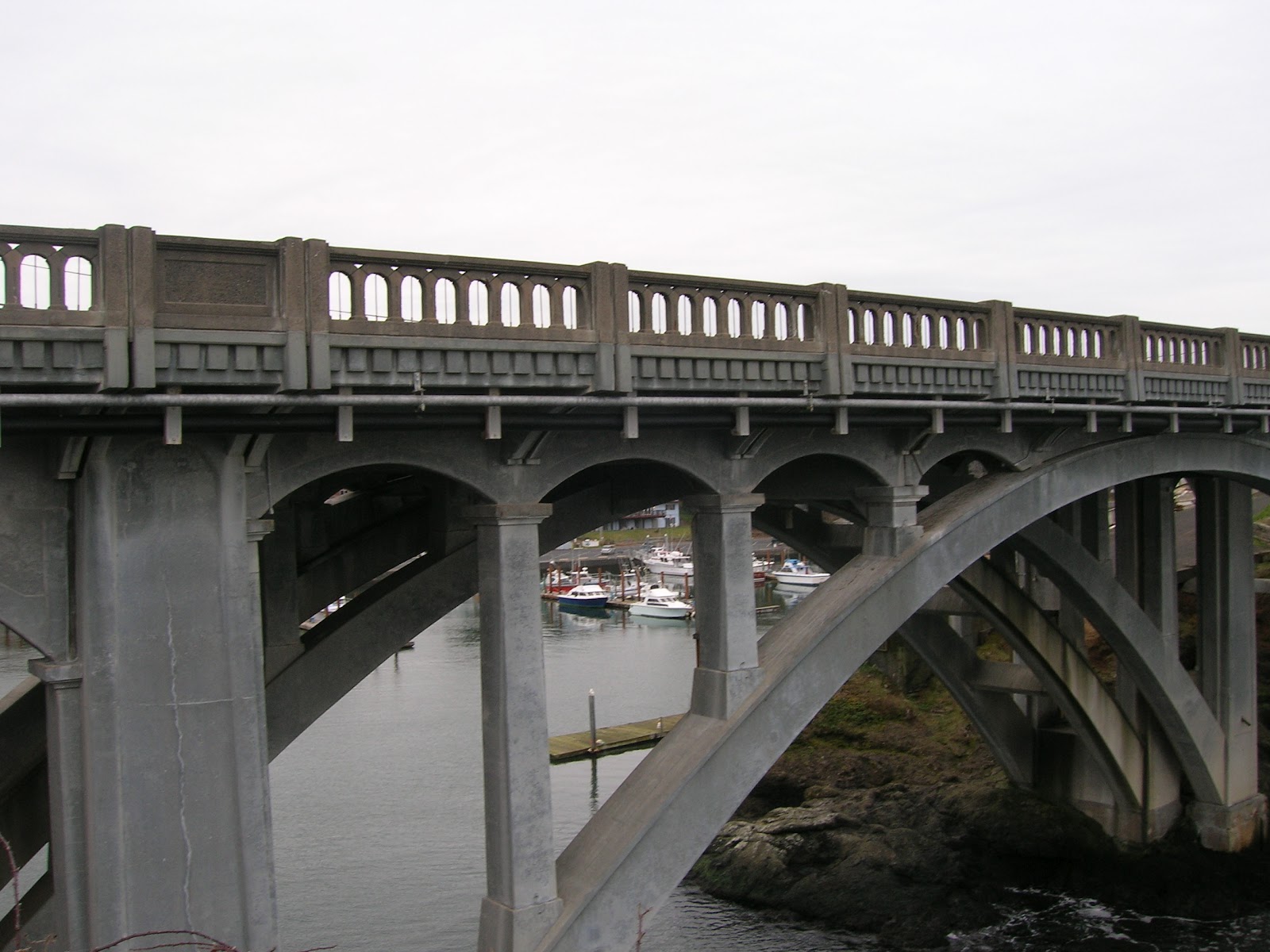
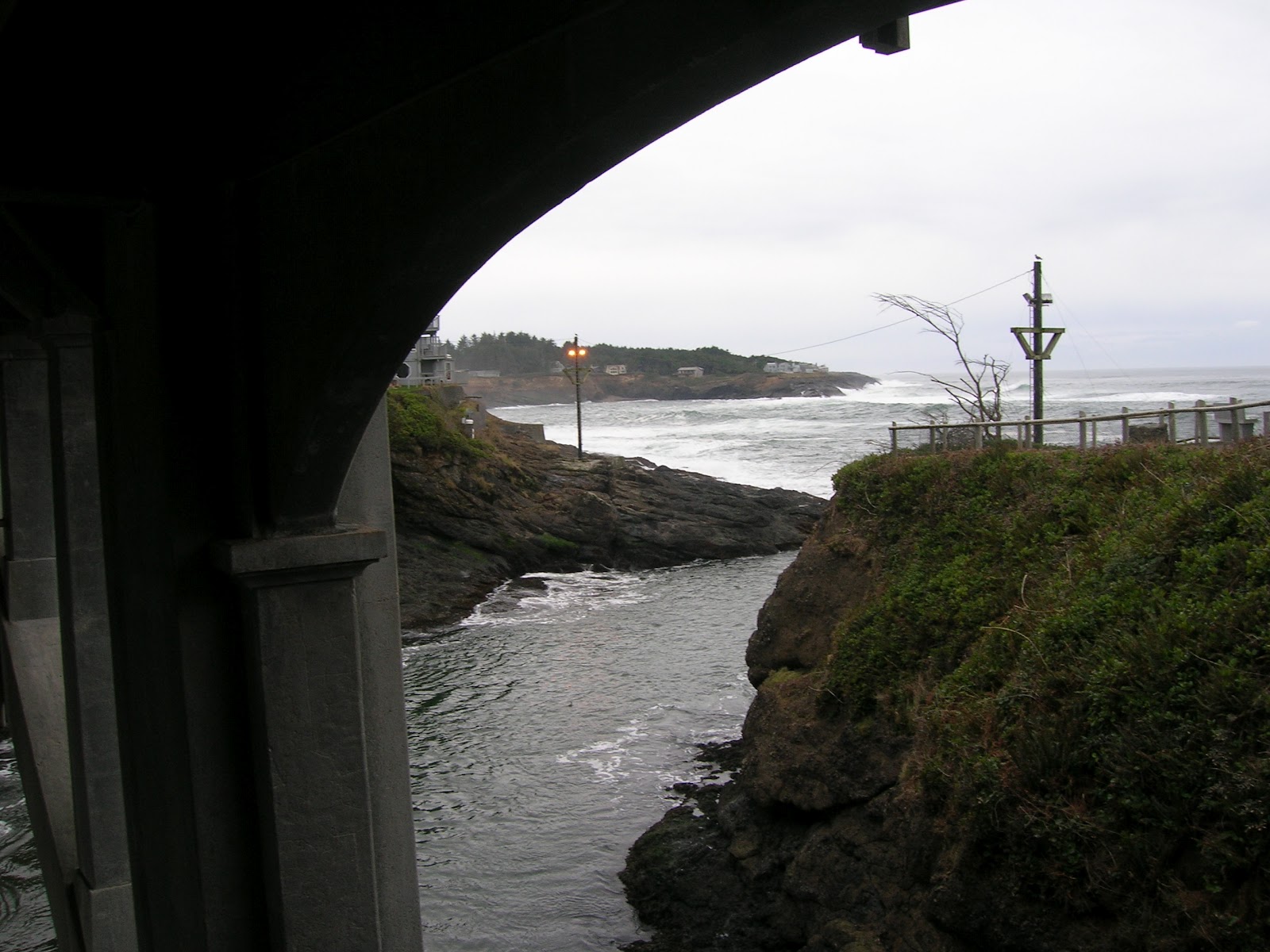
Afterward, as I started back toward the road, but I noticed a set of stairs heading in a direction I had never been. The stairs led me under the Depoe Bay Bridge, where the view was fascinating, the bridge posts framing the world’s smallest navigable harbor. The thick concrete muffled the sounds of the cars driving over me and shielded me from the light rain. A sea gull roosted in one corner, a pigeon in another.

I never thought much about the Depoe Bay Bridge. Last October, Newport went crazy as the Yaquina Bay Bridge celebrated its 75th anniversary, but the Depoe Bay Bridge, also the work of famous bridge engineer Conde McCullough, is older.
The original 312-foot long bridge with its 150-foot arch was built in 1927. It was expanded in 1940 to accommodate four lanes of traffic. Eighty-five years later, here I am walking underneath with my little digital camera. When last year’s tsunami hit, it damaged the nearby docks, but the bridge stood strong, as it has all these years. I’m so glad I took those stairs.

All contents copyright 2012 Sue Fagalde Lick

Sing Your Song Now

This past week, I’ve been thinking about death. On Friday, I heard about the deaths of two friends, the mother of a woman I sing with at church and the husband of my lifelong best friend, Sherri.
Catherine, the mother, was 89. She had suffered from the effects of a stroke for many years, and she had been bedridden since October. For years, I saw her sitting in the front row at church, a little confused, most of her hair gone, but so in love with God. Shortly before Catherine died, she told her nurse, “My stroke is better.” She was ready to go. Last Thursday, she passed peacefully into the next life. We’re singing at her funeral this coming Thursday, repeating the songs that were sung at her husband’s funeral in 1993. They’re together now.
After I heard about Catherine’s death, I gave up on work. Whenever someone I know dies now, I relive my husband’s and my mother’s deaths. I need time to deal with the turmoil in my mind and my heart. We had sunshine and blue sky with the most fascinating cloud patterns, the kind in which you can imagine all kinds of things, from animals to angels. I lay on the deck and watched them slowly change.
As the afternoon wore on, I took Annie to the dog park, where she romped with four other big dogs and a shitzu-maltese that didn’t realize it was little.
It was at the dog park that I got Sherri’s call, one I had been fearing. Her husband, Gene, had been in the hospital for two weeks, unconscious the whole time. A massive heart attack, coupled with out-of-control diabetes and kidney failure, offered a bleak prognosis, and he died. A week before he went to the hospital, they had been living a normal life with no idea that he would not make it to the end of the month. Gene was 69.
Sherri married Gene the same year I married Fred. We have shared so many things in our life. From first grade through high school, Sherri and I were always together. We went through lost teeth, First Communion, first periods and first bras, first crushes, and first attempts to play the guitar. We both married divorced men who had three children from their first marriages. As we aged, we saw the same chiropractor and took the same pills. When another friend and I formed a traveling vocal group, Gene sang bass with my husband Fred. I can still see them in their white shirts and red bow ties.
Sherri worked at Los Gatos Town Hall while I worked at the Los Gatos Weekly-Times. Eventually we both left California, but for different reasons. Sherri and Gene ran into financial trouble, lost their house and hoped to start fresh in a small home on a big patch of land in Texas. They had only been there eight months when Gene went to the hospital in Ft. Worth. Sherri buried her husband on her 60th birthday. I’ll be 60 next month. Now, we have something else in common, something no one would ever wish for: We’re both widows.
I’m thinking a lot about death these days. You never know when it will happen. If there’s something you must do in this life, do it now. Yesterday, I sat in the sun playing my guitar and singing for a long time. It felt good. It felt right. If you have a song that needs singing, sing it now.
Rest in peace, Catherine and Gene. May God be with your loved ones as they go on without you.

Homesickness in heaven

I have lived in Oregon for 15 1/2 years now, a quarter of my life. I lived the other 44 years in California, mostly San Jose. My roots go back to the 1800s there. I love the Oregon Coast. I love its natural beauty, its attitude, its friendliness, its slower pace. The weather can be brutal, but even the snow, wind and rain are beautiful in their own way. And yet, as I watched the National Figure Skating Championships, being broadcast from San Jose over the weekend, every time the announcer said “San Jose” or I saw it written on the side of the rink, something chimed inside me. I longed for shots of the area outside the building and scanned the crowd for familiar faces. The building they were in hadn’t even been built when I lived there. Downtown has changed so much I’d get lost there now, but Santa Clara Valley holds so many memories and so much of my history. I yearn for the sun-browned oak-covered hills.

I still feel “Saudade,” a feeling of longing and loss that I wrote about in  my latest book, Shoes Full of Sand. It’s a Portuguese word, common among those who left their homeland for a new life in the United States. We only moved from California to Oregon, but the feeling is the same. Now, with my husband gone and no family here, perhaps it would make sense to move back to San Jose.

But would I trade my big quiet yard with its alders and Sitka spruce for a much smaller space surrounded by people and noise? Would I trade my open two-lane roads for freeways full of cars creeping along bumper to bumper?  Would I trade the friends, the music, and the long walks with Annie for the crowded craziness of “Silicon Valley?” Would you?

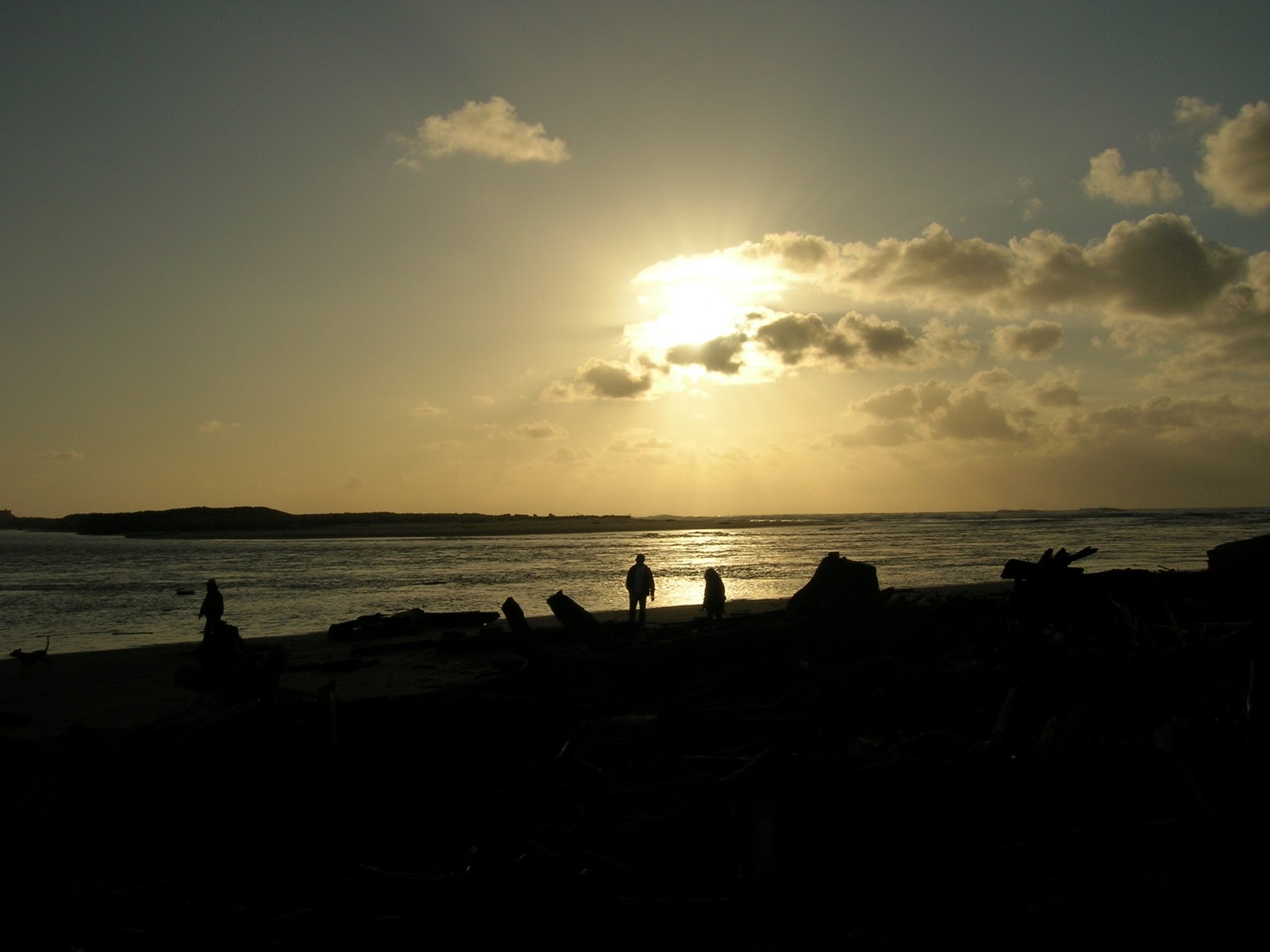
Much of my family is gone now, died or moved away, but I miss those who remain in San Jose. It’s time for a visit. And then I’ll come back to Oregon, where on the way home from an interview, I can stop to enjoy scenes like the one above on the beach in the Taft district of Lincoln City.  After days of storms, the sun had come out, and I just had to stop. Beats the freeway, doesn’t it?

Lessons from the Storms

What a crazy time we’ve had here on the Oregon Coast. Over the last week, we’ve been blanketed with snow, pummeled by wind, and drowned with rain. We’ve had power failures, trees down, closed roads and flooding. Highway 101 just north of where I live has a big chunk out of it where the land slid out from underneath it. Every trip to Newport is fraught with the worry about whether we’ll be able to get back.

At one point, all the roads east were closed, along with the Yaquina Bridge where the wind threw a semi into a pickup truck. I wondered how that could possibly happen until I tried to drive home from church yesterday. I feared that any second, the wind would have its way with my car.

Meanwhile, the creeks have turned into rivers, and the rivers have turned into lakes. Today, on a rare storm-free day, people are returning to flooded houses to see what they have left. We definitely got paid back for all the clear days we had in December, and the storms aren’t over. Rain and wind are expected to return tomorrow. Everybody’s talking about the weather. Conversations often conclude with, “Well, that’s life on the Oregon coast.”

It can be a challenge living here, but we certainly appreciate our sunny days. Meanwhile, I’ve learned a few lessons from the crazy weather. Here are just a few:

1) If you don’t buy rainboots, you’ll always have wet feet. They don’t have to be cute, just waterproof.
2) Don’t let the gas tank or the refrigerator go empty, and stock up on toilet paper. You might not be able to drive to the store.
3) Water and electricity are not guaranteed.
4) Find that old camp stove and figure out how to work it.
5) Keep at least one old-style phone that works without electricity.
6) If the sun appears, run outside and pay homage.
7) If you won’t go outside in the rain, the dog won’t either.
8) The best coastal hairdo is a hat.
9) All plans are tentative.
10) Get a boat. 

What have you learned with this winter’s weather?