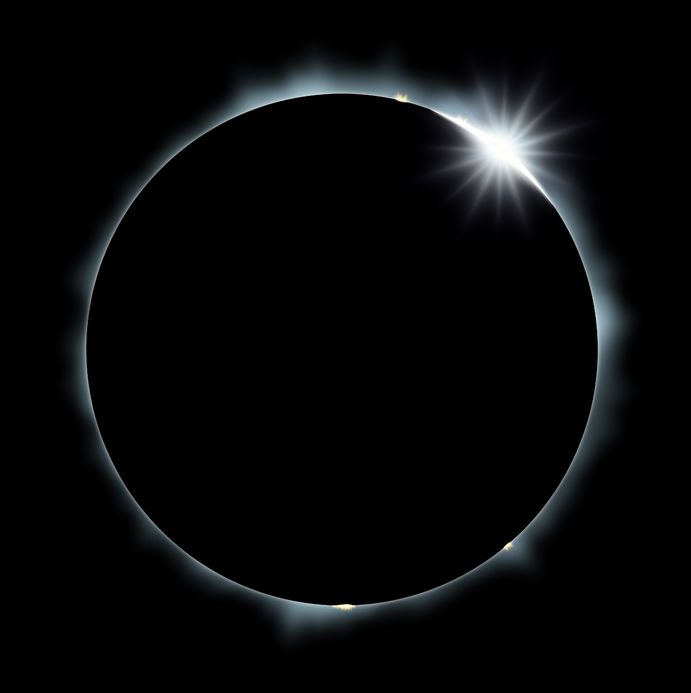
Eclipse: Sky Show Doesn’t Disappoint

12887800 - full eclipse of the sunI woke up Monday to fog. Great, I thought. I won’t see the eclipse, only the darkening and lightening as the moon passes over the sun. The naysayers were right.

“Come on, Lord,” I prayed.

He heard me. He heard lots of us. The sun burned it off just as the moon started taking bigger and bigger bites out of the sun. By 9:55, it was getting darker every second. As the shadows dimmed, I felt a physical thrill high in my chest that I can’t accurately describe. I wished my late husband Fred were here. I wished my neighbors were outside with me. I wished I were at a party with lots of people. But my plan had always been to stay home, and my back, out of whack again, seconded the motion.

As the moon slid over the sun, I walked down my street, seeking other people to watch with. I found only a flock of chickens and a black cat, all huddling in place. I noticed the fog hung very close, ready to cover our houses again. I went home, feeling like the last person on earth. No one here! Later I would learn that my neighbors had gone east to escape the fog.

So it was just me, standing in my driveway with my eclipse glasses. It got darker and darker till the sun was just an orange sliver around the moon. The street light came on, a slightly lighter orange. Cold, I pulled the red blanket out of my car and wrapped it around my shoulders. The chickens cackled then hushed. And suddenly . . .

The moon lay right across the sun, a black disk with a silver halo. I heard people shouting. I shouted back. I grabbed for my phone to take a picture, although what I saw in the viewfinder was just a round glow. After my second shot, a blast of sun burst through. More shouts. It started getting light. The street light turned off. The sun began to show on the right side of the moon. The fog crept eastward. A plane flew over. Standing in my garage huddled in my blanket, I cried.

I went in to warm up for a minute. The dog followed me around, nervous.

“Come on.” By now the sun was above the trees, so we could see the rest of the show from the back yard. Little by little, the sun reappeared. I watched until the edges of the orange ball were completely round again. I felt the sun’s warmth on my shoulders. Reluctantly, I took off my cardboard eclipse glasses. Annie sniffed them and tried to eat them. “No!” I hid them in my pocket.

I will never see anything like this again. I wish I had remembered to look for Jupiter and Venus and for the weird shadows that were expected. But totality came and went so quickly.

Afterward, I looked around at the trees and the grass and the sky. Nothing seemed the same.

While I watched the total eclipse in South Beach, Oregon, my father and my aunt were just arriving at Kaiser Hospital in Santa Clara, California, for an appointment with his orthopedic surgeon. (Some healing of his broken leg, but it’s very slow). Traffic had stopped completely. People got out of their cars. Doctors, nurses and patients were gathered in the parking lot with their eclipse glasses, looking at the sky. One of them handed Dad his glasses. He took a look. He was interested but not impressed. Ah, but he didn’t see the “totality,” that moment when the moon completely blocked the sun. That’s what I won’t forget. The rest was a lot like the lunar eclipses I have seen, but totality, oh my God.

The eclipse entered the United States on the Oregon Coast just a few miles north of where I live. As I wrote last week, thousands of visitors were expected. Stores stocked up on eclipse T-shirts and other souvenirs. Some asked their employees to stay overnight and work extra shifts. Police and fire departments called everybody in, and the National Guard was on standby. Signs went up: no beach access, no camping here, no fires anywhere. Stay off the roads, we were told. Traffic will be stuck in total gridlock. The Lincoln County commissioners declared a state of emergency in advance.

But it didn’t happen. The crowds did not come here. For us, it was another y2k, the disaster that didn’t occur as 1999 transitioned into 2000. The streets of Newport, Depoe Bay, and Lincoln City were deserted. Hotels suffered mass cancellations. Businesses saw fewer customers than they would on a normal day in August.

Now everyone is debating over why people didn’t come, why they went to places like Prineville and Madras in Central Oregon. Were they scared away by overblown predictions of horrible crowds and ridiculously high prices? Or did they simply decide not to take a chance on the coast’s ever-changing weather, the one thing no one can control?

We could easily have missed it. The day after the eclipse, we were fogged in all day. The rest of the week was a mixed bag, some fog, some sun, some clouds. Now when the sun is out, I keep wanting to look at it. I want another show. But it just sits there, glowing, while the moon finds its own place in the sky and the waves roll in and out as usual.

Besides the glasses, I have another souvenir. No, it’s not a T-shirt. As the world darkened, I walked through my garage and ran into my big steel dolly, leaving a cut and a bruise just below my right knee. I’m kind of proud of it.

Text copyright Sue Fagalde Lick 2017

Photo Copyright: johanswan / 123RF Stock Photo

Eclipse-o-Mania hits the Oregon coast

IMG_20170817_111230377_HDR[1]I drove cautiously to the edge of Highway 101 as if driving into a war zone. Would I see an impenetrable line of cars? Would tourists crowd the roadsides, strewing trash and lit matches into the salal and blackberries? Could I possibly get to Newport in one piece? Judging by what I was seeing on the news and reading on my computer, no.

But yes. Yesterday, already suffering from cabin fever, I ventured to the post office and the jetty, and it was fine. The gulls and cormorants bobbing in the blue ripples of Yaquina Bay did not know or care that the solar eclipse is coming on Monday. The surf lapped against the rocks, fishing boats cruised in and out, and the sun peeked shyly through the morning clouds. The only unusual sight was a truck delivering portable toilets to the area where the jetty meets the beach.

Eclipse-o-mania. Depoe Bay, just north of here, is supposed to be the first place in the continental U.S. to see the moon completely cover the sun when the eclipse happens on Monday morning.  The “path of totality” will continue southeast through Oregon and on across the country. Over a million people are expected to come to this state, thousands of them to the coast, to see the eclipse. Officials predict traffic jams and shortages of food, gas, and cash. Eclipse-watchers will stream onto private property looking for places to camp. We may lose electricity and cell phone coverage. Or not. Will this be like y2k, when nothing really happened?

For weeks, we have been warned to stock up on supplies and plan to stay home from Aug. 17-21. The roads will be impassable, we’re told. Businesses and government offices are planning to close on Monday. Stores, restaurants, and motels that serve tourists are putting their employees on extra shifts and urging them to sleep over so they won’t get caught in traffic. Police and firefighters are working overtime. The National Guard is on standby. The county has declared a state of emergency.

It’s as if a tsunami, a snowstorm and Woodstock were all happening at the same time. The eclipse will begin at 9:04 a.m. Pacific Daylight Time. Totality, starting at 10:16, will last for two minutes. It will get dark. The birds will hush. Night animals will come out. And then it will start to get light again. By 11:15, it will be all over, except for the traffic jams.

Meanwhile, life goes on. When the moon slides over the sun, my dad will be on his way to Kaiser Hospital for a doctor’s appointment. Other people will be at work and not even see it. Me, I’ll probably retreat to my office and write.

We don’t really know how many people will come to the coast for the eclipse. If I were traveling to see it, I’d go somewhere else. We have a 50 percent chance it will be too cloudy to see anything. Whatever we can see, I’ll be able to watch from my backyard with the eclipse glasses I picked up at the community college. Don’t look at the sun without them, ophthalmologists warn. The glasses are so dark the sun is the only thing you can see through them. It looks like a little orange dot.

My father can’t understand why people would travel great distances to see the eclipse. Neither can my 96-year-old friend Doug, who says he’s seen them before. No big deal. The next eclipse will be in 2024, and it won’t be here. I hope to see it, but I’m not making any extra trips out of South Beach. I vaguely remember a previous eclipse in 1970. It got dark, it got light. No big deal in San Jose, not like the craziness happening here. I don’t even know if we got out of class to see it.

The mania had already started last week when I went to the Fred Meyer store to buy groceries. It was a madhouse, jammed with people stocking up for the big event. Yesterday, a friend posted pictures on Facebook of empty shelves where the milk should be. Did I stock up? I have bagels, grapefruit, tea and cookies. Annie has two boxes of Milk-Bones. We’re ready.

I have seriously thought about walking to town if I can’t drive. Four miles to the bridge, three more to church. News outlets are showing photos of bumper-to-bumper traffic, but not here. Not yet. Maybe not at all.

The eclipse will happen. But whether the crowds will come and whether it will be cloudy or clear, we don’t know. The human show may turn out to be more mind-blowing than the one in the sky. Meanwhile, the gulls bobbing in the bay and the dog at my side don’t know or care.

Has eclipse-o-mania hit where you live? Would you travel to see the eclipse?

Hanging out in the Alternate World of Nursing Homes

A world exists in the midst of our own that many people are not aware of. It’s a world none of us want to live in, but it’s not so bad to visit. I’m talking about nursing homes, assisted living facilities, memory care centers, whatever you want to call them. Buildings with old people in wheelchairs and walkers, staff in matching shirts, institutional meals and alarms on the doors. The kinds of places where old people land when they can’t stay at home anymore–if they can afford them.

Long before I had family living in these places, I sang in them with the Valley Chorale in California. We didn’t pay much attention to the residents back then. We just wanted to know where to dress, where to set up, and where to plug in our amps. We performed in our silky dresses and jeweled shoes to a sea of white hair and glasses, absorbed their applause, shook a few hands, changed clothes and went out to dinner.

It’s different when someone you love lives there. I started frequenting nursing homes when Grandpa Fagalde started living in one after a series of strokes. He was 94, and it was a shock the first time I saw him in a wheelchair, saying things that didn’t quite make sense. It was easier to sit at the piano and sing than to sit with him for the hour or two I visited at lunchtime or after work. But I came regularly and gradually became part of the family there. I greeted the staff and the other residents. They grabbed for my hands and sought my attention.

Toward the end, my grandfather didn’t know who I was. He knew only that I played music and that I would listen to him for a while. It was heartbreaking to see my grandfather this way, but while I was there, I could forget about my job as a newspaper editor, the errands I need to do on the way home, the teenage stepson who was driving me crazy, or the odd noise coming from under the hood of my car. It was just these old people in their limited world.

I never guessed that fifteen years later I would be visiting my husband Fred in a nursing home. He had Alzheimer’s Disease. He stayed in four different places before he died, but the longest was at Timberwood Court in Albany, Oregon, 70 miles from where I lived. Occasionally I played music there, too, but mostly I hung out with Fred and the gang. We watched TV, ate ice cream, batted a big rubber ball around, sang with visiting musicians, and went on field trips in the little bus. Some days, I would sit on the couch resting my head on my husband’s shoulder, even falling asleep sometimes.

I got to know the names of all the other residents and the family members who visited. I knew the staff. I would walk into the offices to demand things I needed for Fred—a haircut, his lost shoes, a doctor’s appointment. I was part of the Timberwood family. Yes, the residents had dementia. They screamed, they fought, they got sick and died. Some constantly begged to go home. But most made sense at least part of the time, and day after day, it was a beautifully furnished oasis from the rest of the world, unaffected by winter storms, summer heat, or the news on TV.

Beyond the coded-lock door, we were all safe and within shouting distance of an aide who would take care of everything. Fred soon forgot he had ever lived anywhere else. When his physical health failed, he moved to another facility that was not pretty at all. It was much more like a hospital. The hiatus was over.

This year, I found myself hanging out at another nursing home with my father. He wanted only to be back at his own house taking care of his own stuff, but I fell easily into the nursing home rhythm at Somerset. Here’s the living room, the dining room, the courtyard. Here are the aides in matching shirts. Here’s the office. Write Dad’s name on his clothes, hang them in the closet, make sure he has his meds. Get everything set up, then sit with him. Talk, listen, be. Meet the other family members doing the same thing.

Janet, the daughter of one of Dad’s housemates, arrives every day at 11 a.m. and leaves at 4 p.m. It’s like her job. She feels enough at home to go into the kitchen and help herself to coffee and cookies. She joins in the activities. Her sister handles the bills and such, but Janet is the one who has become part of the Somerset family.

It was different for me this time because I live 700 miles away. I visited in concentrated doses. Three days, a week, two weeks. But I got to know and care about the other residents and staff. I liked walking in to a chorus of “Hi, Sue.” I liked that there was someone waiting for me, even on days when my father was El Groucho, as my mother used to call him. While I was at Somerset, I could do nothing about work, home repairs, the needy dog or the emails calling for my attention. All I had to do was sit in the courtyard or the living room talking to my father. When it was time to leave, time to face traffic and take care of business, part of me didn’t want to go.

But of course I had to. These places are only pleasant to hang out in when you have the option of leaving. I didn’t have to eat their food, follow their schedule, or wait an hour for help going to the bathroom. I could walk out on my two strong legs whenever I wanted to. That’s the difference. For the residents, it’s a pretty prison which is eating up their life savings.

Nursing homes are a business where they charge a fortune and often give less than wonderful care. We can only hope our loved ones end up in the good ones. But sometimes since Dad went home, I find myself missing those people and those places where I could just sit and be. Also, I miss the Somerset dog, a white fur ball named Sonny.

When it’s my turn to move in, I hope I can be one of the ones who accept it with grace and smiles. I hope I still have enough working brain cells to make the best of it.