My Flood Disaster is Almost Over–I Hope

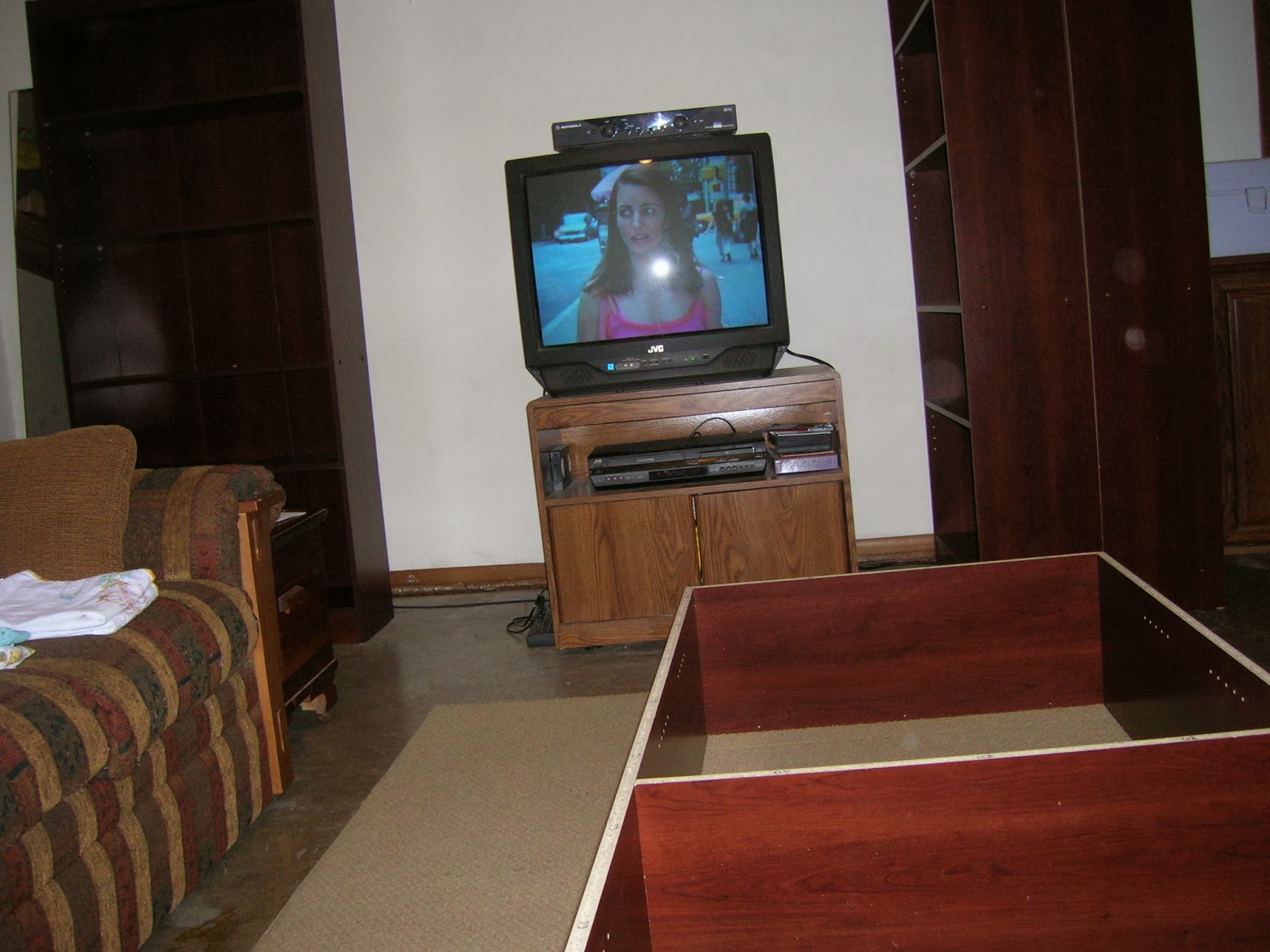
Bookshelves in progress, accompanied by a “Sex and the City” marathon.

I now have new respect and sympathy for people whose entire houses get flooded by hurricanes, overflowing rivers, tsunamis, burst dams or whatever. I only had one room get soaked, and it has taken almost two months to begin to recover. I never saw this coming.

I woke up on Aug. 20 to discover water all over my laundry room. My 12-year-old water heater had died in the night, and water was pouring out the bottom. Phooey. But the laundry room, formerly part of the garage, was never completely finished. Once I mopped the water off the concrete floor and got a new water heater, I figured my troubles were over.

But no. The next night, I was on the phone with a friend when I happened to walk barefoot through my den, also formerly part of the garage. The carpet was soaked. Major curse words flew out of my mouth. I have already blogged about the details of all this ad nauseum. The short version: I spent a day trying to sop up the water with minimal success as the stench of wet carpet padding, wood and sheetrock permeated the house. The next day, I followed my father’s advice and called the insurance company. Water damage workers tried to dry things out, then removed my entire carpet and my four six-foot tall bookshelves. They also chopped a soggy section out of my wall. Over the weeks that followed, I had many visits from various professionals, interspersed with long periods of waiting.

Everything from that room, including hundreds of books, all of my clothes and a host of photos and knick-knacks, is spread through the rest of the house. But now it’s almost over. The wall is patched and painted, I finished putting together the last bookshelf last night, and the carpet is due to be installed on Wednesday. Emerald cut, rust-colored Spanish tile instead of the silly white Berber that used to be there. It will all turn out to be an expensive blessing, I’m sure.

Having been surrounded by my possessions all this time, I’m not so fond of them anymore. And I realize that when the flood hits, everything that gets wet becomes worthless. I will reconsider every item that I put back in that room. Do I really need so much stuff? Don’t answer that. I know what you’ll say.

Meanwhile, yesterday I noticed the roof is leaking in the laundry room. Just a little.

To Build a Bookshelf

Another episode in the wake of the great water heater flood of 2013
Saturday I built a bookshelf. That statement may evoke visions of sawing, hammering, sanding, staining and lovingly polishing, of creating something unique from a few pieces of raw wood. Wow, that Sue is so talented. You can smell the sawdust, can’t you?
But no. I tore open a long heavy Home Depot box delivered by the UPS guy, removed a ton of foam rubber and cardboard packing material, laid out pieces of wood-finished pressboard and a baggie of screws, nails, dowels and brackets, and started putting it all together. Each part was lettered, and the screw holes were already drilled. I just had to follow steps one through six on the instruction sheet with the added attraction of learning how the same instructions would be translated into Spanish and French. Tools required: one hammer, one screwdriver, and two people. I made do with one human and a dog.
You may recall that my previous bookshelves got wet when my water heater gushed water all over my laundry room and den a month ago. The water damage experts sent out by my insurance company declared the shelves deceased and tossed them into the front yard, to be taken to the dump. They sat there for three weeks before my neighbor got sick of looking at them, hacked them up with an ax and burned them in his fire pit. We had a nice visit while I watched my bookshelves turn to ashes. In replacing them, the insurance company would only cover shelves that were similarly inexpensive, hence the fake-wood bookshelf kits.
It sounds mindless, but after I carefully nailed the backing on with 22 little nails and tilted the shelf up to admire my work, I discovered the backing was on backwards. Oh no! Did I mention I’m not mechanically gifted? I had to lay the shelf back down on the throw rug on the bare concrete of my damaged den and take out 22 little nails I had hammered in good and tight.
I had brought the bookshelf components from the garage to the den one or two pieces at a time because I couldn’t lift the 75-pound box, and I couldn’t think of anywhere big enough to assemble a six-foot tall, five-shelf monster except on the floor. Oh my aching knees and back. Luckily, I had the TV to entertain me. It took a movie, “Monster-in-Law” with Jennifer Lopez and Jane Fonda, plus an episode of “Friends”—the one where Monica and Chandler get approved to adopt a baby—but I got it done. I got parts A, C, C1, G, G2, F, P and P1 all in the right places. Why weren’t there any B’s, D, E’s or H through O’s?
Anyway, the shelf is up. It doesn’t match much of anything. Why did I order royal cherry “wood?” But it’s pretty. I’m dying to put books on it, but I can’t until I get my carpet, which is scheduled to be installed on Oct. 2, hopefully after the water damage guys finish patching and painting the closet. The books will remain on the kitchen floor, on the guest room floor and bed, stacked in the living room, and tucked here and there in the laundry room. I’m only moving them once.
I have three more shelves to build. I find the whole process fascinating. The kits are sheer genius with all those perfectly matched parts. But yesterday, when an unemployed friend at church offered to build the rest of the shelves for me, I said yes. Why should I hog all the fun?

When is a Garage Not a Garage?

What is a garage? In modern American houses, it’s supposed to be a place to store the car, although in many homes it’s too full of other stuff for the car ever to fit inside. Tools, Christmas decorations, washer and drier, suitcases, garden equipment, stuff you plan to give to charity someday, and stuff you just plain don’t know what to do with live in the garage. At my house, it’s also where I store: pellets for the pellet stove and kindling for the wood stove, a spare tire, tire chains I have never used but must carry in the winter, my husband’s old bike that he never used, two dollies, three ladders, an umbrella for the patio table that fell apart ages ago, a Shop Vac, an American flag hanging above a Christmas tree stand, a few dozen empty boxes, two bags of Styrofoam “popcorn,” a file cabinet that didn’t fit in the house, and a nearly lifesize image of my late husband signed by all the folks at one of his many retirement parties. We call it Styrofoam Fred. But yes, I do get the car in. Thank God it’s small.

My single-car garage is very garage-ish. Cobwebs in the single-paned window, bare-wood walls, electric-powered door that rattles in the wind, bugs traveling freely through, mouse droppings in the corners, cold, stained concrete floor. When the door is open, everything is exposed to the world. It’s not the kind of room you’d like to live in—unless you’re a mouse.
But here’s the thing. The current garage is an add-on. The original two-car garage is now my den. In the wake of the great water heater flood of 2013 (see earlier posts), the bookshelves and carpet were ruined. For the last three weeks, I have been living with a den that more and more feels like a garage. Yes, it’s got sheetrock which I lovingly repainted two years ago. It’s got curtains, carefully matched furniture, and closets all along one end. I was so proud of that room, the one room I felt I had finished. But you know what? It’s still a garage. Behind the soggy sheetrock is bare wood. Behind the wall-hanging I made of felt and crochet hangs the fuse box. Under the Berber carpet was concrete, stained, pitted, cold and hard. Ants travel the edge of the southern wall like it’s a freeway. My sofa and TV sit like islands in a hard gray sea.
The former owners turned the garage into a den in 1990, eight years before Fred and I bought the house. They had four kids, a dog and a parrot; they needed the space. I don’t. I have often thought I’d rather have the house a little more compact and use the garage as a garage, but it’s too late for that. Unless the gradual westward settling of our land here eventually sends it into the ocean.
Post-flood, my beautiful den/library has been mired in insurance-hired service providers. Three guys came out and dried the old carpet for several days, then ripped it out. They tossed my bookshelves into the front yard. Last weekend, my neighbor got tired of looking at them and burned them in his fire pit, causing another neighbor to complain about the smoke. I have new bookshelves ordered and I’m waiting for a sample of my old carpet to be analyzed Back East so I can find out how much State Farm will pay for new carpet so I can finally order it and get it installed. Meanwhile, today, guys are supposed to come out and patch the hole the first guys chopped out of my wall. And then they will paint it. But the drywall will have to dry first, won’t it? And I don’t have any more matching paint.
It’s a slow process. I currently have mountains of clothing from the closets and approximately 600 books all over my house. I had no idea that room, that garage-turned-part-of-the-house, held so much stuff. I don’t plan to put a single thing back without reconsidering whether I need it.
Meanwhile my guest room bed is buried in clothing, books and musical instruments, but you’re welcome to sleep in the garage.

Tourists Invade the Oregon Coast

It’s Labor Day weekend, time for the Oregon coasties to hide while tourists take over the town. Most of us moved here to get away from crowds, to escape stop-and-go traffic, cities full of strangers, and long lines at restaurants, stores and gas stations. We like our small-town setting where we can move around freely, never wait in line, and always run into someone we know.

So does everyone else. The Oregon Coast is one of those places people go for recreation. As a result, from around Memorial Day to sometime after Labor Day, the place is packed with visitors. Every other vehicle crawling down the highway is from somewhere else. Lots of those vehicles are slow-moving RVs and big trucks towing boats, but even the little cars slow us down as the drivers gawk at the sights. I’m thinking okay, it’s the ocean, it’s a bridge, it’s a lighthouse, take your picture and move along.

At the grocery stores, travelers fill the aisles, not knowing where anything is and having to confer on every purchase. Shall we have corn with that? What kind of cereal do you like? Me, I’ve got my list, and I’m still in my church clothes. Let me get my food and go home. 

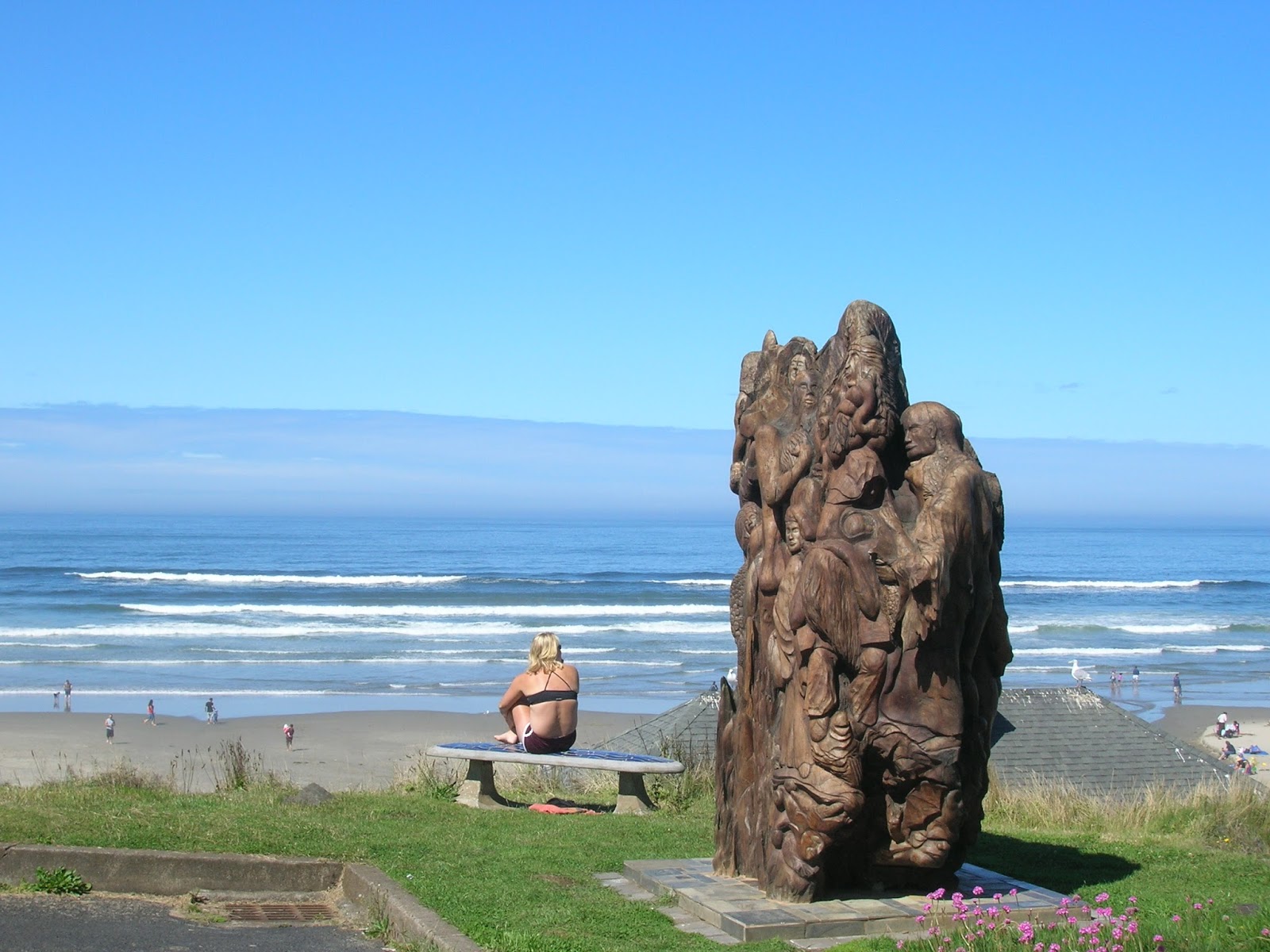
I drove through Nye Beach yesterday to take pictures and found nowhere to park. Visitors wearing shorts, leading children and dogs, and snapping pictures with their cell phones, clogged the sidewalks and spilled out of the eateries. Great sweating masses of visitors stared at the ocean. I surprised a couple kissing on the stairs by the Visual Arts Center.

I want them all to go home, but like everyone who lives here, I know our economy depends on folks from out of town coming here to spend their money. They stay in our motels and RV parks, eat our food, fill their vehicles with our gas, and buy our glass floats, thereby enabling the local kids to have school clothes and me to buy groceries. I get it.

Like a large portion of Oregon Coast residents, I moved from a place people leave for vacation to a place where people come. My husband and I were tourists here, too. We walked on the beaches, visited the lighthouses and aquariums, shopped in the gift shops, and ate in the restaurants. We fell in love with the place and resolved to move here someday. And then, like so many Californians who first came as visitors, we sold our house and drove the big rental truck north.

Now I have the nerve to resent all those tourists. Twenty years ago, I was one of them with my California license plate, slowing down traffic to take pictures. I must try to embrace these wide-eyed tourists as just like me. So come, let me show you my beautiful home. Then, either learn to drive the speed limit or go back to wherever you came. And by the way, put away the cell phone. Why drive hundreds or thousands of miles if all you’re going to see is your iPhone?

Tomorrow, the local kids are going back to school. Soon the weather will turn, the tourists will trickle away, and we will reclaim our town. But today, I’m staying home in my little piece of paradise.